Ripple-65B Preview: A 65B Open Model That Out-Codes Giants

Amir Farid
7 min read
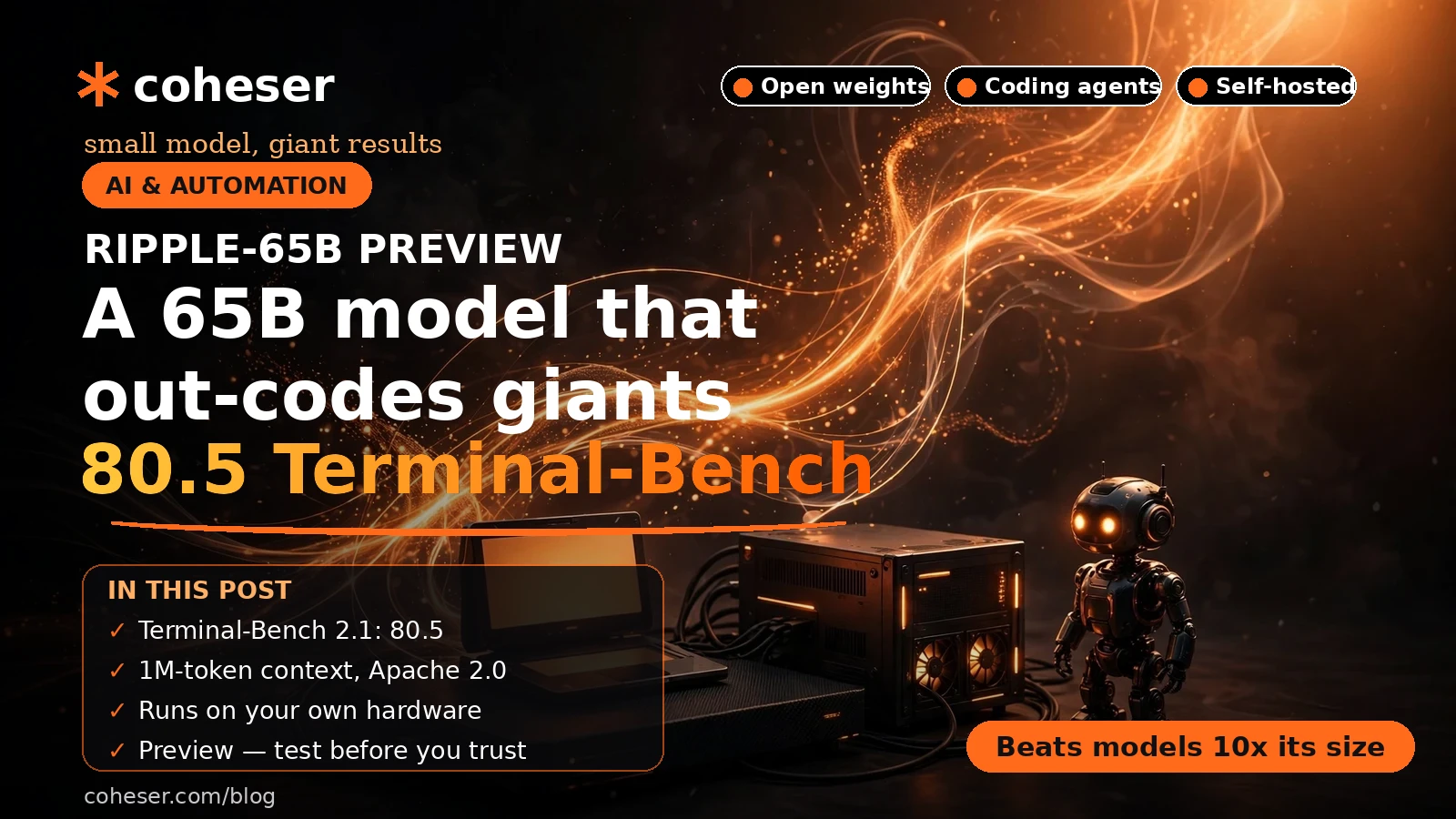
Ripple-65B Preview is a 65-billion-parameter open model from RicursiveAI, released on 4 November 2026, that scores 80.5 on Terminal-Bench 2.1 — ahead of open models up to fifteen times its size, including Meta's Muse Spark Open at 816B parameters. It is a dense Transformer, not a mixture-of-experts model, pretrained from scratch on 12 trillion tokens with up to 1 million tokens of context, under the Apache 2.0 licence. For a software or SaaS business, the headline is simple: frontier-class coding-agent performance may no longer need a big vendor's cloud. It may fit on hardware you own.
What Ripple-65B Preview actually is
Ripple-65B Preview comes from RicursiveAI, a small team that grew from one person to five during development. It is a dense Transformer: all 65 billion parameters are active on every token, unlike the mixture-of-experts giants it is measured against. Pretrained from scratch on 12 trillion tokens, it supports up to 1,048,576 tokens of context.
The architecture is thin and deep: a narrow hidden dimension of 5,120 with 80 layers, built from an Olmo 3 baseline. It ships as a BF16 instruction-tuned model, an NVFP4 checkpoint for efficient local running, and a BF16 base model — all Apache 2.0 licensed for commercial use without a licence fee. It fits on consumer hardware such as Nvidia's DGX Spark; Ricursive reports 250 tokens per second on two B200 GPUs. Read the full details on the Ripple-65B Preview model card on Hugging Face.
The benchmark numbers — and what they really mean

Every figure below is Ricursive's self-reported score from its own model card — not independently verified, and Ricursive warns that replicating agentic benchmark scores is difficult because harness choices shift results. Treat them as a strong signal, not a guarantee.
- Terminal-Bench 2.1: 80.5. Ahead of Reflection Beam 501B (80.1), Meta Muse Spark Open 816B (76.4), Thinking Machines Inkling 975B (63.8) and Nvidia Nemotron 3 Ultra 550B (56.4).
- SWE-bench Verified: 76.5. Strong, but not the leader: Reflection Beam scores 81.6 and Inkling 77.6.
- SWE-bench Pro v2.0 Hard: 79.1. Here Ripple leads the group clearly, ahead of Reflection Beam (76.5) and Muse Spark Open (72.4).
- Knowledge: MMLU 89.6 and GPQA Diamond 85.2 — respectable, but Ripple's edge is agentic coding, not everything.
The pattern is consistent: Ripple wins where an agent works in a terminal, runs tools and finishes a task — exactly the shape you want from a coding agent. Our guide to the GDPx agent benchmark explains why long-horizon tasks are the hard test; our coverage of Inkling 2 Small, LongCat-2.5 and SWE-2 Flash adds context on the giants it is measured against.
Why a 65B model matters for your business
For most software companies, the model is not the product — the agent built on top of it is. A 65B model at this level changes three practical things.
Your code stays on your hardware
When a coding agent runs on a hosted frontier model, your source code and your clients' data leave your network on every request — a deal-breaker for a firm under client NDAs. A self-hosted Ripple instance keeps the code inside your walls, the same control argument behind governed AI agents.
Costs become predictable
Hosted API pricing is per token, so a busy month costs more than a quiet one and a runaway agent loop can surprise you. Self-hosting swaps that for a fixed cost — hardware, electricity and maintenance. Our custom software cost guide covers how to scope a build honestly.
Small teams can compete on tooling
Ricursive built this with five people. A small SaaS team in Lahore, Leeds or Dubai can now run a coding agent that, on one respected benchmark, outperforms models from teams with hundreds of engineers — the advantage shifts from the biggest model to the best agent built around it, which is where AI agents for small business automation earn their keep.
What "Preview" means — and the rough edges to expect
Do not mistake "Preview" for a marketing label: Ricursive states plainly that this release went through relatively light post-training, focused on agentic coding. It is specialised, not general-purpose: the MMLU and GPQA scores above show it trailing bigger models outside coding. Expect rough edges — formatting slips and instruction-following failures — so plan for guardrails and human review. The ecosystem is young too: a brand-new model lacks the tooling around an established one. And the benchmarks are self-reported — independent evaluations will arrive over the coming weeks. Treat Ripple as a serious experiment with a clear evaluation plan, not a drop-in replacement on day one.
Try it before you trust it
A benchmark score is a claim about a standardised test, and your codebase is not one. Before you let any coding agent near production code, run your own evaluation — small, cheap and honest.
1. Pick ten real tasks from your own backlog
Choose tasks a junior developer could do in an hour — a bug fix, a small refactor, a new endpoint with tests — ones you already know the answer to. Score each on whether the tests pass and whether it follows your conventions.
2. Measure the human time, not just the model time
An agent that writes code in thirty seconds but needs an hour of senior review has not saved you anything. Track review time, rework time and how often the agent's change broke a test — the same discipline behind our RAG chatbot and voice agent guides.
3. Put a human gate on anything that ships
Never let an agent merge to production unsupervised. Pull requests, code review and CI checks stay exactly where they are. The agent is a fast junior developer with infinite energy and no judgement — treat it that way, and remember an AI agent that can act on your behalf needs tighter guardrails than a chatbot.
Self-hosted vs hosted frontier: when each wins
Choose self-hosted Ripple when privacy or cost predictability matters, the work is coding-shaped, and someone can run the infrastructure. Choose a hosted frontier model when you need the broadest capability, the task is not code-shaped, or you want zero operational burden.
- Privacy: self-hosted keeps code on your network; hosted sends it to the vendor's cloud.
- Cost: fixed hardware and running costs versus variable per-token billing.
- Capability: Ripple is strong on agentic coding, weaker on general knowledge; hosted models are strongest overall.
If you are scoping either route, talk to Coheser about a scoped AI pilot — or start from Coheser to see how we build agents for clients.
What this means for UK, Gulf and Pakistan teams
A UK team faces strict client expectations around data handling, a Gulf team works under data-residency rules, and a Pakistan team may face higher latency and cost on dollar-billed hosted APIs. A self-hosted open model sidesteps all three: the code stays local, the cost is in hardware you control, and there is no per-token dollar bill. See also Mistral Large 4's open weights and Gemini 4's security push.
Be realistic about the starting line. Running a 65B model well still needs capable GPUs, and the NVFP4 checkpoint exists to lower that bar — Ricursive even provides a Colab to get started. Start there, run the ten-task evaluation above, then decide on hardware. The same staged approach works for scaling a SaaS MVP, a WhatsApp chatbot, or automation for a logistics firm.
The bottom line: evaluate Ripple on your own code, keep a human in the loop, and the frontier may have moved into your own server room.
Frequently asked questions
What is Ripple-65B Preview?
A 65-billion-parameter dense open model from RicursiveAI, released 4 November 2026, pretrained on 12 trillion tokens with up to 1M tokens of context. Apache 2.0 licensed, focused on agentic coding, with light post-training — hence "Preview".
How good is it really?
On Ricursive's self-reported model-card scores: 80.5 on Terminal-Bench 2.1, ahead of Reflection Beam 501B (80.1) and Meta Muse Spark Open 816B (76.4), and 76.5 on SWE-bench Verified, trailing Reflection Beam (81.6). Not independently verified — evaluate it on your own codebase first.
Can I run it on my own hardware?
Yes — that is the point. It fits on consumer hardware such as Nvidia's DGX Spark, ships as an NVFP4 checkpoint for efficient local running, and Ricursive reports 250 tokens per second on two B200 GPUs. Try the provided Colab before buying hardware.