AI Chatbot vs AI Agent: What Your Business Actually Needs

Amir Farid
7 min read
Quick answer: An AI chatbot talks — it answers questions and holds a conversation. An AI agent acts — it plans multi-step work and uses your tools and APIs to get things done without you watching. Faster customer answers? Choose a chatbot. Work completed — leads chased, tickets resolved, reports built? Choose an agent. The price gap is real: chatbots typically run $3k–$15k, while useful agents start around $10k and climb past $50k (estimates from our own delivery work, not fixed prices).
AI Chatbot vs AI Agent: What Your Business Actually Needs
Both get sold as "AI", and the terms are used so loosely that buyers compare a small chatbot widget with a five-figure agent system as if they were rivals. They are not: they are different tools for different jobs. This guide gives you the practical difference, honest cost ranges, and the decision rule we use with our own clients.
What a chatbot actually is
A chatbot is a conversational interface. It receives a message, works out the intent, and responds — ideally with the right answer drawn from your knowledge base or documents. The best modern builds use retrieval-augmented generation (RAG) so they answer from your business's actual content rather than making things up. But whatever the technology, the output is the same kind: words in a chat window.
What chatbots do well — and where they stop
Chatbots shine wherever the bottleneck is answering. A clinic fielding the same fifty questions about timings and fees. A restaurant group whose WhatsApp floods with "are you open?" at dinner rush — WhatsApp chatbots pay back quickly in the UK, UAE and Pakistan, where customers expect answers within minutes. The honest limit: a standard chatbot does not do anything. It cannot check stock, book appointments or chase invoices. The moment the answer is "let me look into that", it has reached its ceiling.
What an AI agent actually is
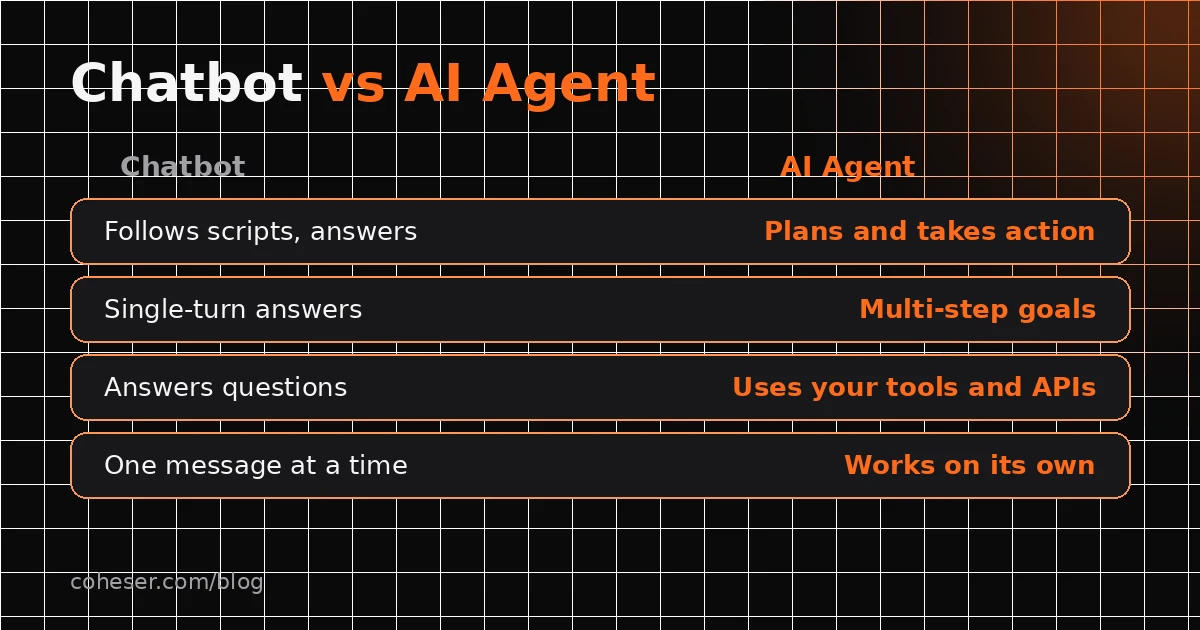
An AI agent is software that works towards a goal. It plans steps, uses tools (CRM, calendar, email, payment systems, APIs), checks its own progress, and completes work — sometimes without any human involvement. A chatbot answers "do you deliver to Birmingham?"; an agent books the delivery, sends the confirmation and updates the order status. That is the whole difference.
The planning loop that makes it an "agent"
An agent runs a loop: decide the next step, act with a tool, observe the result, adjust. This is why building AI agents costs more — you are wiring up the agent's hands: permissions, tool connections and guardrails. Get the hands wrong and the agent fails in ways a chatbot never can.
Real agent work in small businesses
Agents already do useful work for smaller firms: a lead-follow-up agent that chases enquiries on WhatsApp, qualifies them and books viewings. A calling agent that rings through the no-show list. Our agent automation guide for small businesses covers which processes are ready today — and which are not.
The side-by-side comparison
| AI chatbot | AI agent | |
|---|---|---|
| Primary output | Answers in a conversation | Completed work across your tools |
| Interaction | Responds to each message | Plans and executes multi-step goals |
| Tool use | None, or simple lookups | CRM, calendar, email, APIs, payments |
| Autonomy | Acts only when asked | Can act proactively and follow up |
| Build effort (estimate) | Weeks | Months for anything serious |
| Typical cost (estimate) | ~$3k–$15k project | ~$10k–$50k+ project |
| Failure mode | Wrong or unhelpful answers | Wrong actions in live systems |
The practical test: ask any vendor "show me what happens after the answer." If the demo ends at a nicely worded reply, it is a chatbot. If it ends with a booking made or a record updated in your real system, it is an agent. Most products sold as "AI agents" in 2026 are still chatbots with integrations bolted on — the test catches that in minutes.
Cost: what each one really costs
All figures below are rough estimates from our own delivery work, for budgeting — not quotes. A chatbot build typically runs from around $3,000 for a focused website or WhatsApp bot with a trained knowledge base, up to about $15,000 for multi-channel deployments with integrations and proper testing. Beyond the build, budget the running costs: model API usage (pay-per-message at scale), hosting, and keeping the knowledge base current — our WhatsApp cost breakdown goes deeper.
Why agents cost multiples more
An agent project starts around $10,000 for one well-scoped workflow and climbs past $50,000 with multiple workflows, custom integrations, approval gates and serious testing — every tool needs connection work, error handling and guardrails. Agents also make far more model calls than chatbots, so build the ROI case on labour hours saved, not on looking modern. Gartner's analyst coverage tracks agentic AI's move into customer service — worth knowing, but a prediction is not a business case.
When a chatbot is the right call
Choose a chatbot when the job is conversational and bounded: answering FAQs, qualifying visitors, taking bookings through a form, deflecting support tickets with a clean handoff to humans. It is also the right first step when you are unsure which processes deserve automation — cheap enough to be a pilot, and the conversation logs reveal what an agent should do later.
Signs you should stop at a chatbot
- The bottleneck is information, not action — your team answers the same questions all day.
- You want results this quarter, with a modest budget and low risk.
- Nobody can describe a clear multi-step workflow yet — if the process is fuzzy, an agent will automate the fuzz.
When you need an agent
Choose an agent for a repeatable workflow with clear steps, defined tools and a measurable outcome: chasing new leads within five minutes, reconciling daily sales, rebooking no-shows, or running your automation layer between systems. Scope one workflow at a time and instrument it — if you cannot measure the hours it saves, you cannot tell whether it earns its keep.
The one-workflow rule
Every failed agent project we have seen tried to automate five workflows at once. The ones that work start with one workflow, one owner, one metric. Each additional workflow is its own integration and testing job — never a free add-on.
Mistakes we see over and over
Buying an "agent" that is a chatbot in a trench coat
Ask for the tool integrations and watch the demo past the conversation. If nothing in your real systems changes, it is a chatbot — price and judge it as one.
Automating a broken process
An agent does not fix a bad workflow; it makes a bad workflow run faster. Sort the process out first. If part of the job fits simpler workflow tools, our automation platform comparison is worth a read.
Skipping the human in the loop
Agents should draft, propose and queue — not silently execute anything irreversible. Refunds, payments and legal language need an approval step, especially in the first months.
Judging everything by demo magic
Demos are rehearsed. The questions that matter are boring: who maintains the knowledge base, what happens when the API changes, what does month six cost? See how we answer them in our client work.
Unsure which fits? The cheapest next step is a conversation, not a purchase. Talk to us — tell us the one process you wish ran itself and we will give you a straight answer: chatbot job, agent job, or neither.
Frequently asked questions
Can a chatbot become an AI agent later?
Yes — this is often the smart path. Start with a chatbot, then add tool integrations and goal-driven behaviour to the workflows the conversation data proves valuable. The knowledge base transfers directly.
Do I need an AI agent if I already have automation like Zapier or n8n?
Not necessarily. Fixed workflows are usually better served by workflow tools — deterministic, cheaper, easier to debug. Agents earn their place where work needs judgement: an unusual email, a fuzzy match, steps that change case to case.
How long does each take to build?
From our delivery experience: a focused chatbot takes 2–6 weeks; a single-workflow agent takes 2–4 months including integration, guardrails and testing.
What is the biggest hidden cost of an AI agent?
Maintenance. APIs change, rules shift — and the agent silently does the old thing. Budget ongoing time to monitor and update, or it quietly rots.
Should a small business start with a chatbot or an agent?
Start with the chatbot unless you can name one workflow whose automation would save measurable staff hours every week. It is cheaper, ships faster, and reveals what your future agent needs to handle.