AI Agents for Real Estate: Lead Follow-Up That Never Sleeps

Amir Farid
7 min read

Quick answer: An AI agent for real estate is software that watches for new enquiries — portal leads, missed calls, valuation requests — and responds in seconds, day or night. It messages the lead on WhatsApp or SMS, qualifies them on budget, timeline and mortgage status, books a viewing straight into the diary, and nurtures the not-yet-ready ones. It doesn't replace your team; it makes sure no enquiry sits unanswered. The case is blunt: in the best-known study of web leads, firms responding within the hour were nearly seven times as likely to qualify the lead — and 23% of firms never responded at all.
Why estate agency leads go cold so fast
The clock starts before anyone notices
Enquiries arrive at the worst times: evening portal browsing, Sunday scrolling, a missed call mid-viewing. Every silent minute is one the buyer spends with a competitor. In "The Short Life of Online Sales Leads" (Harvard Business Review), researchers sent a test lead to 2,241 companies: 37% replied within an hour, 23% never replied, and the average response took 42 hours. Firms responding within the hour were nearly seven times as likely to qualify the lead — sixty times as likely as firms waiting a day. Caveat: it covered B2B web leads, not property — but this breakdown of the lead-response research traces each figure to its source. In practice the leaks are mundane: missed calls go to voicemail, portal enquiries sit in a shared inbox, valuation requests get one template email, and "not yet ready" buyers are never nurtured. An AI agent built for estate agency work closes every one of these gaps at once.
What an AI agent actually does for an estate agency
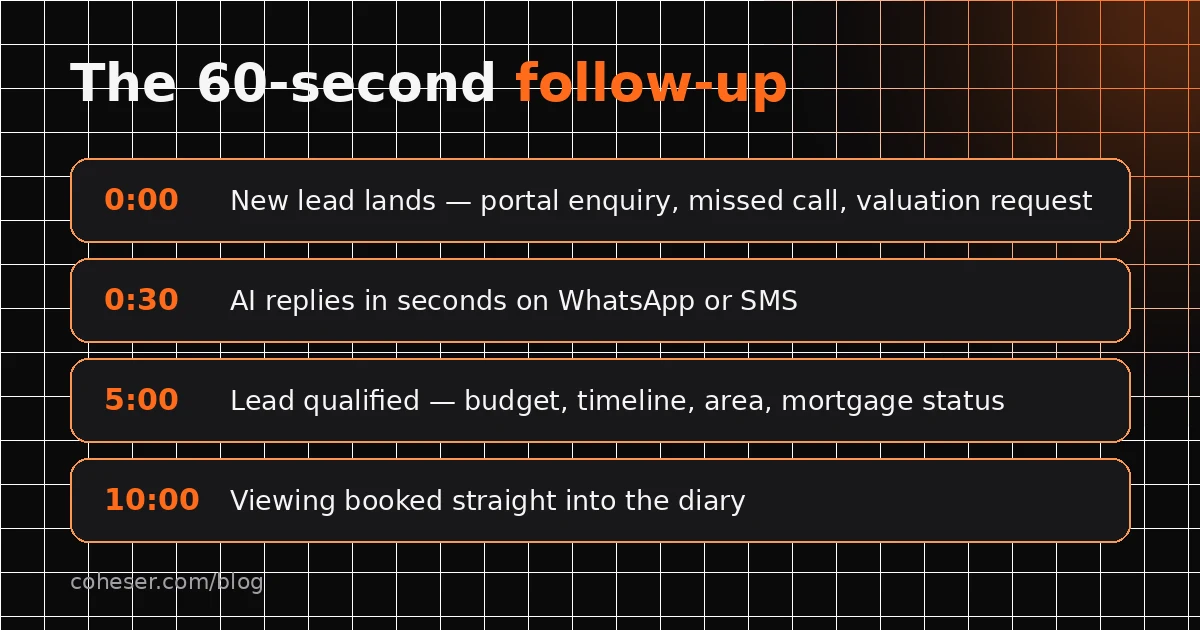
Not a homepage chatbot — an always-on member of the follow-up team that works new enquiries toward a booking on the lead's preferred channel.
The five jobs it takes off your plate
- Instant first response — a reply within seconds, 24/7, on WhatsApp, SMS or email.
- Qualification — budget, timeline, areas, mortgage status, chain position.
- Booking — real diary slots, confirmations, reminders. No phone tag.
- Nurture — scheduled check-ins for the not-yet-ready.
- CRM hygiene and handoff — every conversation logged; hot leads routed to a human instantly.
| Manual follow-up | AI agent follow-up | |
|---|---|---|
| First response | When someone's free | Seconds, any hour |
| Coverage | Working hours only | 24/7, weekends included |
| Consistency | Varies by person | Same process, every lead |
| Cold-lead nurture | Often forgotten | Runs on schedule |
| Handoff | Inbox notes, if written | CRM updated, transcript attached |
It's the same class of AI automation we deploy across sectors — pointed at the most expensive leak in an agency's pipeline. See also our guide to AI agents for small business automation.
Workflow 1: portal lead to booked viewing
- The lead lands at 9:47pm. Nobody in the office sees it — the AI does.
- It replies in seconds on WhatsApp: thanks for the enquiry — is the property still of interest?
- Qualification: budget band, timeline, area flexibility, mortgage status. A two-year timeline gets nurtured, not a negotiator's morning.
- The booking: real diary slots offered, viewing confirmed with details.
- Reminders go out 24 hours and two hours before.
- After the viewing, a follow-up captures feedback and keeps warm buyers looped in on similar instructions.
WhatsApp goes first because it's where your leads already talk — fastest path to a reply, SMS as fallback. Same thinking as our WhatsApp bot development work.
Workflow 2: the missed call that calls itself back
Missed calls are the cruellest leak — someone actually picked up the phone. Every missed call triggers an instant text-back, and our AI calling agent can ring the caller back within a minute: who they are, what they need, quick qualification, then booking or routing to a human. Voice wins with older sellers and valuation requests — and a call-back that's honest about being an AI assistant converts callers who'd never reply to a text. More in our AI voice calling agent guide.
Workflow 3: valuation requests and long nurture
Valuation requests are the highest-value enquiry and the easiest to fumble: the seller is "thinking about it", the negotiator gets busy, and three months later the board goes up with a competitor. The AI treats it as a campaign — instant acknowledgement with a booking link, prep material before the visit, and scheduled check-ins if the seller stalls. Registered buyers get matching new instructions first, plus a monthly check-in.
The handoff rule that keeps trust
Any genuine buying or selling signal — a viewing request, a fees question, an objection — goes to a human negotiator immediately, transcript attached. The AI never negotiates price or terms and never pretends to be a person. That boundary is what makes it trustworthy for UK estate agents.
What it plugs into: channels, CRM and the diary
Channels your leads already use
WhatsApp for speed, SMS as fallback, email for the formal trail, voice for high-intent moments, and a website chat widget for out-of-hours visitors — one continuous conversation, no repeating yourself.
CRM, calendars and your data
The unglamorous part that decides whether it works: read-write access to your CRM and your negotiators' diaries. Most agency CRMs expose this via API; where they don't, we build the integration as custom software or extend the CRM — see our CRM development service. Multi-branch groups can run it as a managed SaaS platform. Conversations live in your systems under your retention rules. We also work with agencies in the UAE, agencies in Saudi Arabia and agencies in the USA — data residency and local rules designed in from the start.
Costs, ROI and the pitfalls to avoid
The honest maths
We won't quote a price in a blog post — scope varies too much. But here's the framing, as an illustrative example only. An agency handling 300 portal leads a month: if faster first response and proper nurture lift the viewing-booking rate by even a few percentage points, that's a handful of extra valuations and instructions monthly — against the negotiator hours currently spent on first-response admin, chasing no-shows, and re-keying CRM notes. Treat any vendor promising exact uplifts with suspicion, including us. Measure your own response time and booking rate before and after.
Live in weeks, not quarters
Weeks 1–2: connect lead sources, CRM and diaries. Week 3: write qualification scripts and handoff rules with your best negotiator. Week 4: pilot, listen to real conversations, tune, then scale. Delivered across our Southampton head office and Lahore engineering centre. See the full range on our services page.
Pitfalls we see agencies make
- Ignoring consent rules. UK marketing texts and emails are governed by PECR: generally prior consent or the narrow "soft opt-in", plus a working opt-out in every message. Read the ICO's PECR guidance on electronic mail marketing first — and take proper legal advice.
- No human handoff. An AI left to handle complaints or price negotiation will damage the brand. Escalation rules are a feature, not an afterthought.
- Sounding like a robot. Stiff scripts erode trust. Short messages, natural phrasing, honest identification as an AI assistant.
- Automating a broken process. If diary management is chaos, the AI books viewings into chaos faster. Fix the diary first.
Frequently asked questions
Will an AI agent annoy our leads?
Only if badly designed. A fast, relevant reply to a fresh enquiry is welcomed — silence is what annoys people. Robotic scripts, antisocial-hour messages, and no path to a human are the real irritants.
Does it replace our negotiators?
No. It takes the admin around first response — instant reply, qualification, diary Tetris, reminders, CRM notes. Negotiators still do viewings, valuations and closing, but with qualified, booked-in people.
Is it legal to text or call leads automatically in the UK?
Responding to an enquiry is generally fine. Marketing texts and emails fall under PECR — typically consent or the soft opt-in, plus a clear opt-out; automated voice calls have stricter rules. Check the ICO guidance linked above and get proper legal advice.
How long does it take to set up?
Typically around four weeks from kickoff to pilot. See our AI agents development page for how we scope it.
What does it cost?
It depends on channels, integrations and branches. Start with a scoping call: talk to us and we'll tell you honestly whether the maths works for your lead volume — and say so if it doesn't.