AI Chatbots for Clinics and Healthcare: Bookings, Reminders and Patient FAQs

Amir Farid
7 min read
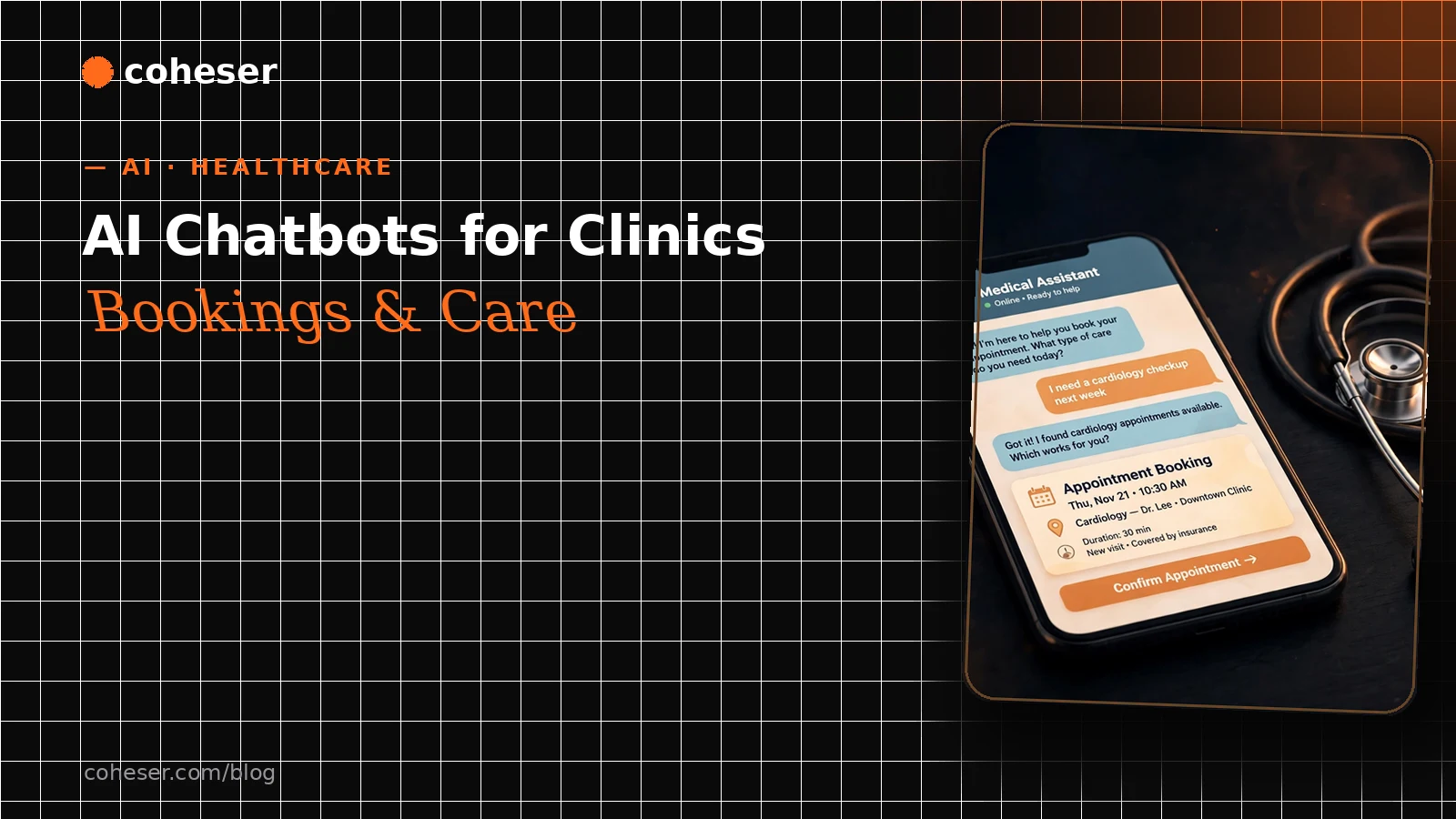
Quick answer: An AI chatbot for clinics is a chat assistant on your website, WhatsApp or phone that handles appointment booking, sends reminders, and answers patient FAQs — hours, services, prices, prep instructions — around the clock. It cuts no-shows, stops your front desk drowning in repetitive calls, and hands complex cases to a human. In the UK, eight million of 124.5 million NHS outpatient appointments went unattended in a single year (NHS England) — the business case for automated reminders alone is hard to argue with.
What an AI chatbot for clinics actually does
Strip away the marketing: a clinic chatbot is a practical tool living where your patients talk — WhatsApp, your website, sometimes voice — doing the three jobs that eat most reception time.
Online booking and appointment scheduling
A patient asks for "an appointment next Tuesday morning." The bot checks real availability, offers slots, confirms, and writes it into the calendar — no phone tag. It works at 11 PM and on Sundays.
Reminders that patients actually answer
Reminders 48 and 24 hours before the visit, with one-tap Confirm / Reschedule buttons, are the single most effective no-show reduction there is — the NHS App's digital push stopped 1.5 million hospital appointments being missed, saving 5.7 million staff hours.
Patient FAQs on demand
Opening hours, services, fees, insurance networks, parking, what to bring, fasting rules, scan prep. These questions arrive hundreds of times a month with fixed, known answers — the work a bot does perfectly. The bot should answer them from a single, curated knowledge base you control:
- Logistics: opening hours, holiday closures, address, parking, public transport.
- Money: consultation fees, packages, insurance networks, deposit policy.
- Preparation: fasting before blood work, documents for first visits, what to wear for physiotherapy, scan prep.
- Services: which doctors see which conditions, specialities on offer, languages spoken.
Two rules: every answer comes from approved content — the bot never improvises medical information — and prices and policies get a "last updated" date, because a wrong fee from a bot is worse than no answer. If you are also building the underlying systems, our SaaS development and custom software development teams build the portals and back-office tools behind the chat.
What a clinic chatbot handles vs what stays human
The bot handles: bookings, reschedules, cancellations, reminders, FAQs, directions, fee lists, document checklists, post-visit follow-ups. Humans handle: clinical advice, diagnosis, treatment decisions, distressed patients, billing disputes, anything flagged as uncertain. A serious build fails safe — low confidence hands over to reception with the full conversation attached. That discipline is the difference between a proper chatbot build and a gimmick.
Reminders that cut no-shows: the sequence that works
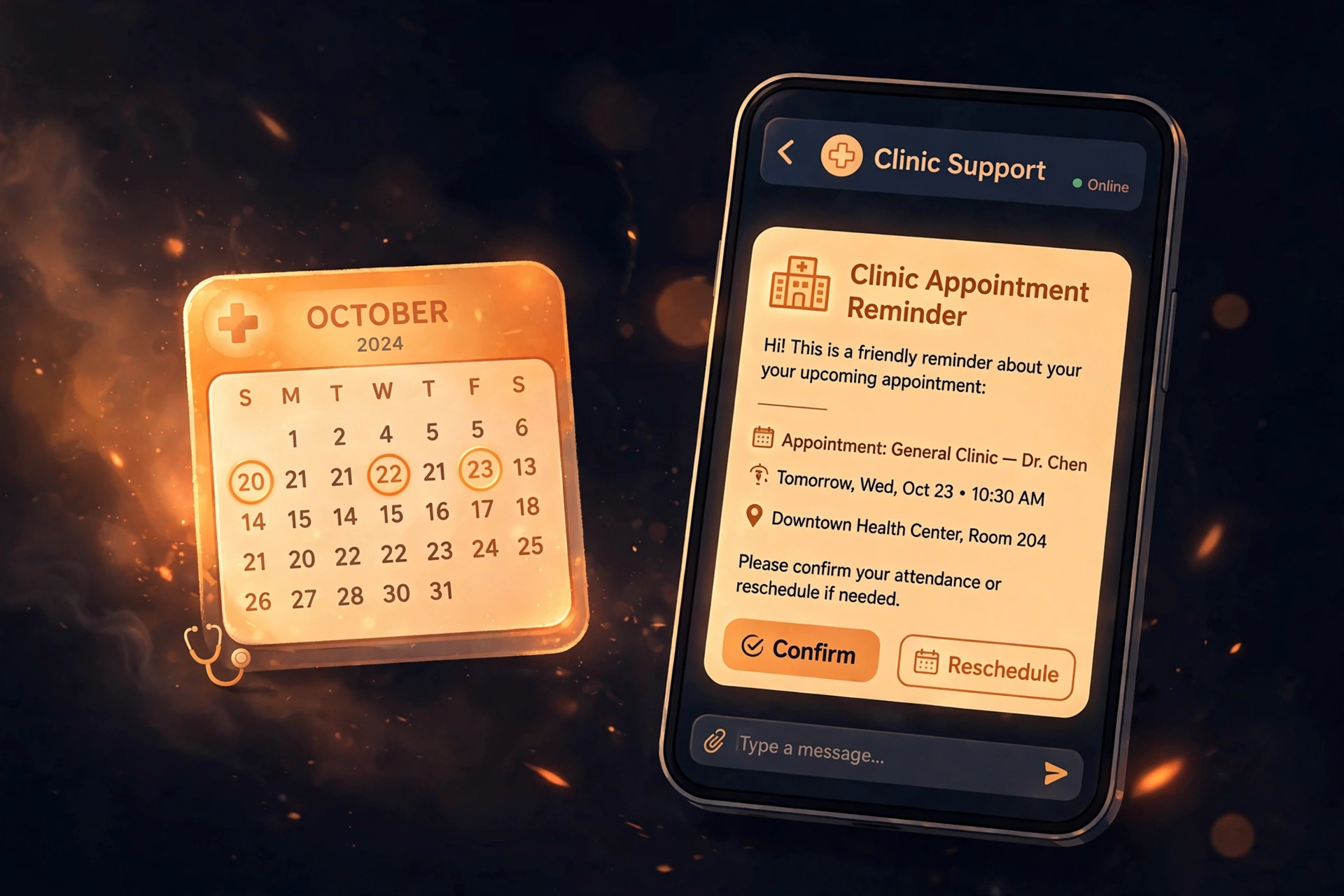
No-shows cost clinician time and lengthen waiting lists. The reminder sequence that works best in our experience is boring and consistent:
- At booking: instant confirmation with date, time, doctor, address and a "add to calendar" option.
- 48 hours before: reminder with Confirm / Reschedule buttons — most empty slots get refilled here, as rescheduling patients free slots for the waiting list.
- 2 hours before: short nudge with address and parking or floor details.
- After a missed visit: a polite rebooking follow-up — no lectures.
Clinics we work with typically see no-show rates fall by roughly a third to a half — an estimate, not a guarantee. For voice reminders at scale, an AI calling agent can make the calls too — see our AI voice calling guide.
After-hours cover and handoff to your team
About half of all booking enquiries arrive outside working hours. A bot taking bookings at 10 PM while your reception sleeps is not a luxury.
Handoff rules worth demanding
- Instant escalation when the patient asks for a person, sounds distressed, or asks anything clinical.
- Full context transfer — the human sees the whole conversation, so the patient never repeats themselves.
- Clear bot identity — patients know they are talking to an assistant, not a doctor.
The same handoff pattern works across industries — see our real-estate lead follow-up guide. For clinics, add your on-call rota to the handoff list and, in emergencies, a plain instruction to call the emergency number.
What the bot must never do: the honest limits
A clinic chatbot is an administrative assistant, not a clinician. It must never diagnose, interpret symptoms, recommend treatment, or adjust medication — diagnostic AI is a different, regulated product category. This guide sticks to bookings, reminders and FAQs deliberately — the safest, fastest return in clinic AI is operational. Your bot needs an explicit "no medical advice" policy, and any health question beyond administrative FAQ routes to a human immediately. For the broader picture, see our AI agents for small business automation in 2026 guide.
Patient data privacy: the basics that matter
A booking chatbot handles personal data — names, numbers, health details. Get it wrong and the cost dwarfs the gain.
- Data protection law applies. In the UK that means UK GDPR and the Data Protection Act 2018; the UAE, Saudi Arabia, the USA and Pakistan each have their own rules — a bot deployed across borders needs per-market review.
- Collect the minimum. The bot needs a name, a number and an appointment — not a life story.
- Consent for marketing messages. Appointment reminders over WhatsApp are fine as part of the booking; promotional messages need separate consent.
- Host and audit. Know where patient data is stored, who sees conversation logs, and how long they are kept — one reason clients with strict requirements ask for self-hosted or private-cloud builds, the same data-residency argument in our n8n vs Make vs Zapier comparison.
None of this is a reason not to build — it is a reason to build with a team that treats privacy as a design constraint, not an afterthought. Our AI agent development and AI automation practice starts every healthcare project with these decisions, and patient records should sync with your CRM, not live in a chat tool's silo.
Rolling it out without disrupting your clinic
A sensible rollout takes weeks, not months:
- Week 1–2: FAQs only, on your website — low risk, immediate relief for reception.
- Week 3–4: add booking on your real calendar; monitor every handoff daily.
- Month 2: add reminders and rescheduling, then WhatsApp as a second channel — where patients respond fastest.
Costs vary with integrations and channels — see our WhatsApp cost guide for honest pricing. We build for clinics across the UK, UAE, Saudi Arabia, the USA and Pakistan. Want a scoped quote, not a sales call? Contact us — we'll tell you honestly whether a chatbot or your booking system deserves the budget first. Also useful: our AI agents for small business guide and the SaaS MVP cost guide.
Frequently asked questions
How much does an AI chatbot for a clinic cost?
It depends on channels and integrations: a website FAQ bot is cheapest, WhatsApp booking with calendar integration costs more, voice adds another layer. A phased build — FAQs first, then booking, then reminders — keeps the budget predictable. Ask for a scoped quote against your patient volume, not a flat package price.
Can a clinic chatbot integrate with our existing booking system?
Yes — that is where most of the value is: the bot reads live availability and writes bookings back via your scheduling system's API. No API? Usually solvable with a connector or lightweight middleware. A bot without calendar integration is just a FAQ page with extra steps.
Is it safe to let patients book through a chatbot instead of calling?
For routine appointments, yes — provided the bot confirms instantly, sends reminders, and offers one-tap rescheduling. Keep urgent or complex cases with humans, and monitor handoff logs weekly in the first months to tune escalation.
What about patient privacy — is a clinic chatbot compliant with data protection law?
It can be, if built that way: collect only what booking needs, store data in a known jurisdiction, keep consent separate for reminders vs marketing, and log access. Make privacy part of the build spec, not a retrofit.
Can the chatbot diagnose symptoms or give medical advice?
No — and it should be explicitly configured not to. The chatbots in this guide handle administration: bookings, reminders, FAQs. Any symptom or treatment question routes to a human clinician immediately; diagnostic AI is a separate, regulated product category.