RAG Chatbots Explained: How to Chat With Your Own Company Data Safely

Amir Farid
7 min read
Quick answer: A RAG chatbot for business is an AI assistant that answers questions using your company documents instead of guessing from what it memorised during training. RAG — retrieval-augmented generation — searches your documents for the relevant passages first, then hands them to a language model so it answers from your facts. Done properly, it cuts hallucinations, stays current without retraining, and — with the right setup — your data stays private and is never used to train anyone else's model.
What a RAG chatbot actually is
Think of a closed-book exam versus an open-book exam. A standard chatbot answering from memory is doing the closed-book version: it answers from what it absorbed during training, which may be months out of date and knows nothing about your company. A RAG chatbot takes the open-book exam — it looks up the relevant pages in your documents first, then answers from what it found.
The idea comes from a 2020 research paper (Lewis et al.) that paired a neural retriever with a language model and found the combination produced more specific, factual answers than the model alone.
How the RAG pipeline works, step by step
A production RAG system has five moving parts — search engineering plus a language model.
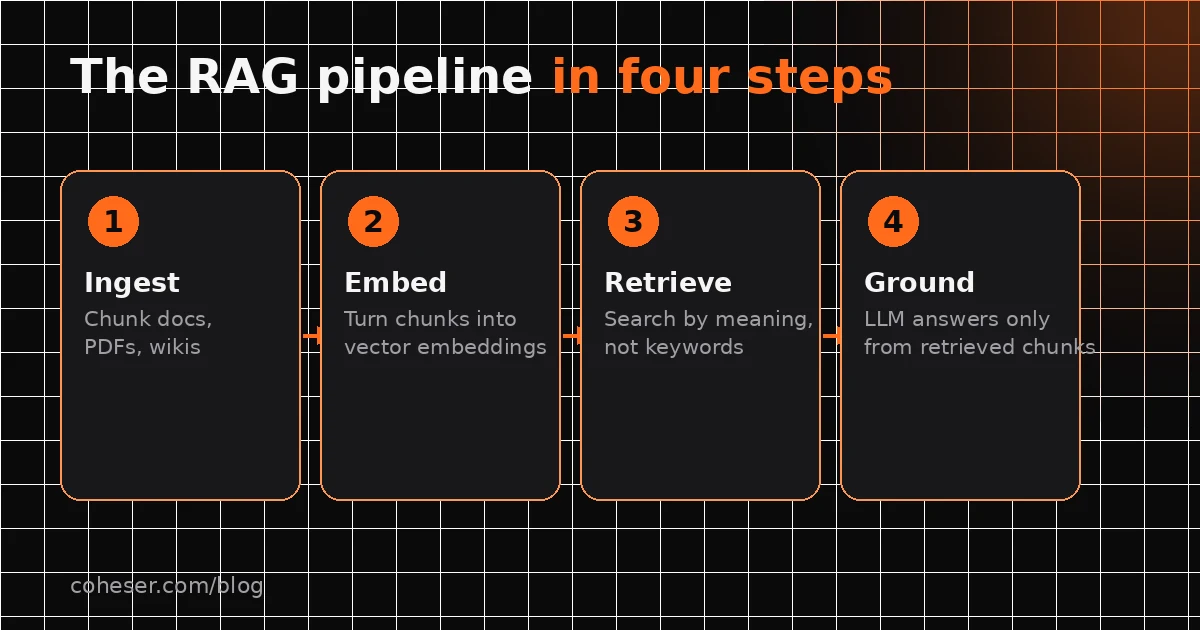
1. Chunk your documents
PDFs, help-centre articles, SOPs and wikis are split into passages — typically a few hundred words — each tagged with metadata like document title and last-updated date. Too-large chunks dilute retrieval; too-small chunks lose context.
2. Convert chunks into embeddings
Each chunk becomes an embedding: numbers capturing its meaning, so "refund policy for annual plans" and "can I get my money back on a yearly subscription?" sit near each other. Embeddings live in a vector database built for searching by meaning — Pinecone, Weaviate, Qdrant or pgvector.
3. Retrieve the relevant passages
The question is embedded too, and the database returns the closest-matching chunks — semantic search combined with classic keyword search, plus a re-ranker that re-scores the top candidates. This step is where most quality problems live.
4. Ground the answer
The top chunks go to the language model with instructions like "answer only from the passages below; say you don't know if the answer isn't there." The retriever supplies the facts; the model supplies the phrasing.
5. Evaluate continuously
Keep a test set of real questions with known-correct answers and re-run it on every change — if retrieval fails, no language model can rescue the answer.
Why RAG beats pasting your documents into ChatGPT
Teams often start by uploading files to a consumer chatbot. It works for a demo, then breaks three predictable ways. Hallucinations: without your documents in front of it, the model fills gaps with plausible fiction; grounding it in retrieved passages sharply reduces invented answers. Stale knowledge: training data has a cut-off date, but with RAG, updating the bot means updating the document — no retraining. Data leakage: pasting internal files into a consumer account routes your data through consumer terms, far looser on retention and training use than API terms.
Keeping your company data safe
A RAG chatbot for business is only worth building if your data stays yours.
Self-hosted vs cloud
With a cloud vector database and commercial LLM API, your embeddings and retrieved passages travel to third-party servers. Fine for public help-centre content; regulated material may demand self-hosted storage or UK/EU data residency.
Your data must not train anyone's model
OpenAI's API data controls state that since 1 March 2023, API data is not used to train its models unless you opt in — and eligible customers can request Zero Data Retention. Verify your provider's current terms.
Access control on retrieval
The retriever should only search documents the asker may see. Enforce this with metadata filtering — each chunk tagged with who may read it — at retrieval time, not just in the prompt.
Redact PII and keep audit logs
Mask personal data before indexing where possible, encrypt data at rest and in transit, and log what was asked and which documents were cited — the first thing an auditor asks for.
What kinds of documents work — and which don't
RAG rewards good source material and punishes bad. Strong fits: help-centre articles, product docs, SOPs, HR and IT policies, pricing pages, structured FAQs — factual, question-answering, maintained. Poor fits: contradictory undated documents, scanned images with no text layer, decks where the answer is a chart, tribal knowledge nobody wrote down.
Value concentrates where the same questions repeat: WhatsApp support bots answering order and policy questions, internal helpdesks, sales teams querying specs mid-call, and sector assistants like the AI chatbots clinics use for patient FAQs — see the WhatsApp chatbot cost breakdown for channel pricing.
Honest limits: RAG is search plus governance, not magic
No vendor promising "zero hallucinations" is telling the truth. Retrieval can fail — the right passage ranks sixth instead of first — and when it does, the model still produces a fluent answer, sometimes from the wrong context. Grounding reduces invention; it doesn't abolish it.
RAG also can't fix bad source documents: garbage in, confidently-phrased garbage out. And RAG answers questions; it doesn't approve refunds or update your CRM. When the bot needs to do things, you're moving into AI agents that act on your systems — the small-business guide shows what that first automation step realistically looks like.
How to build one: a practical plan, plus costs
Experienced teams scope a RAG chatbot for business in this order:
- One use case, one audience. Support FAQs or internal helpdesk — a tight scope means a testable document set.
- Clean the documents. Remove duplicates, resolve contradictions, add dates and owners — usually a third of the project.
- Choose the stack. Managed vector database, commercial embeddings, an LLM API with a data-processing agreement — or self-hosted if compliance insists.
- Build the pipeline. Ingest, chunk, embed, store — capturing metadata at ingest time, since retrofitting it later is painful.
- Add guardrails. Hybrid search, re-ranking, access filters, and an "escalate to a human" threshold instead of guessing.
- Evaluate and pilot. A 50–200-question test set, re-run on every change; then instrument, improve documents and retrieval, and expand.
Costs fall into three buckets. Build: a typical estimate for a focused pilot is the low thousands to low tens of thousands of pounds, comparable to other custom software builds in the UK. Running: mostly per-question API usage plus vector-database hosting — typically tens to low hundreds of pounds a month at pilot scale. Maintenance: the forgotten one — budget a few hours a month for re-indexing and quality monitoring. The cheap win is starting with public, low-sensitivity content so the privacy architecture stays simple. The pattern also extends beyond text: pair the knowledge base with AI voice agents or an AI calling agent — see real-estate lead follow-up for a sector example.
Frequently asked questions
What is a RAG chatbot for business, in simple terms?
An AI assistant that answers questions by first searching your company's documents and writing its reply from what it found — rather than answering from general knowledge learned during training. Answers stay accurate, current and specific to your business.
Is a RAG chatbot safe for confidential company data?
It can be: data-processing terms that exclude your data from training, self-hosting for sensitive embeddings, access control so the retriever only surfaces documents each user may see, and PII redaction before indexing. Safety comes from architecture and contracts.
How is RAG different from fine-tuning a model on my data?
Fine-tuning bakes data into the model's weights — expensive to update. RAG keeps data in an external store the model consults at answer time, so updates are instant.
What does it cost to build a RAG chatbot?
A focused pilot typically costs the low thousands to low tens of thousands of pounds to build, with modest per-question running costs at pilot scale. The biggest variable is document quality: messy, contradictory source material multiplies clean-up effort. Treat figures as estimates and scope against your own documents.
When should I choose AI agents instead of a RAG chatbot?
Choose RAG for answering questions from documents. Move to AI agents when the bot must take actions — updating records, booking appointments, processing refunds. Talk to us to scope which fits, whether you're in the UK, the USA, the UAE, Saudi Arabia or Pakistan.