How to Build an AI Voice Agent for Your Business: A Step-by-Step Guide

Amir Farid
7 min read
Quick answer: To build an AI voice agent you wire four layers together: a phone connection (SIP trunking or WebRTC), speech-to-text that transcribes the caller, a language model that decides what to say, and text-to-speech that speaks the reply — all fast enough that the round trip stays under about 1.5 seconds. Most businesses buy each layer from specialists and spend the real effort on conversation design, testing and compliance. This guide covers each step in plain English.
Step 1: Decide what the agent is actually for
"Answer our phones" is too vague to build against; "handle appointment bookings and FAQs between 6pm and 9am" is a specification. Voice agents succeed when the task is narrow, repeated and well understood — write the job down before touching any technology.
Start with inbound, not outbound
Inbound agents take calls; outbound agents place them (reminders, payment nudges) — and outbound brings extra consent rules in most markets, so start inbound. For the business case behind both, see our guide on what AI calling agents do and cost.
Define the refusal list, not just the task list
List the call types the agent must handle, then what it must never attempt — with an escalation path for every refusal: transfer to a human, take a callback number, or push a summary into your custom CRM.
Step 2: Understand the pipeline
Every AI voice agent runs the same loop, dozens of times per call: capture audio, transcribe it (speech-to-text), decide the response (the language model, with tool access to your systems), convert the reply to audio (text-to-speech), and play it back. The LLM sits in the middle, every stage adds latency — that is the architecture; the rest is plumbing.
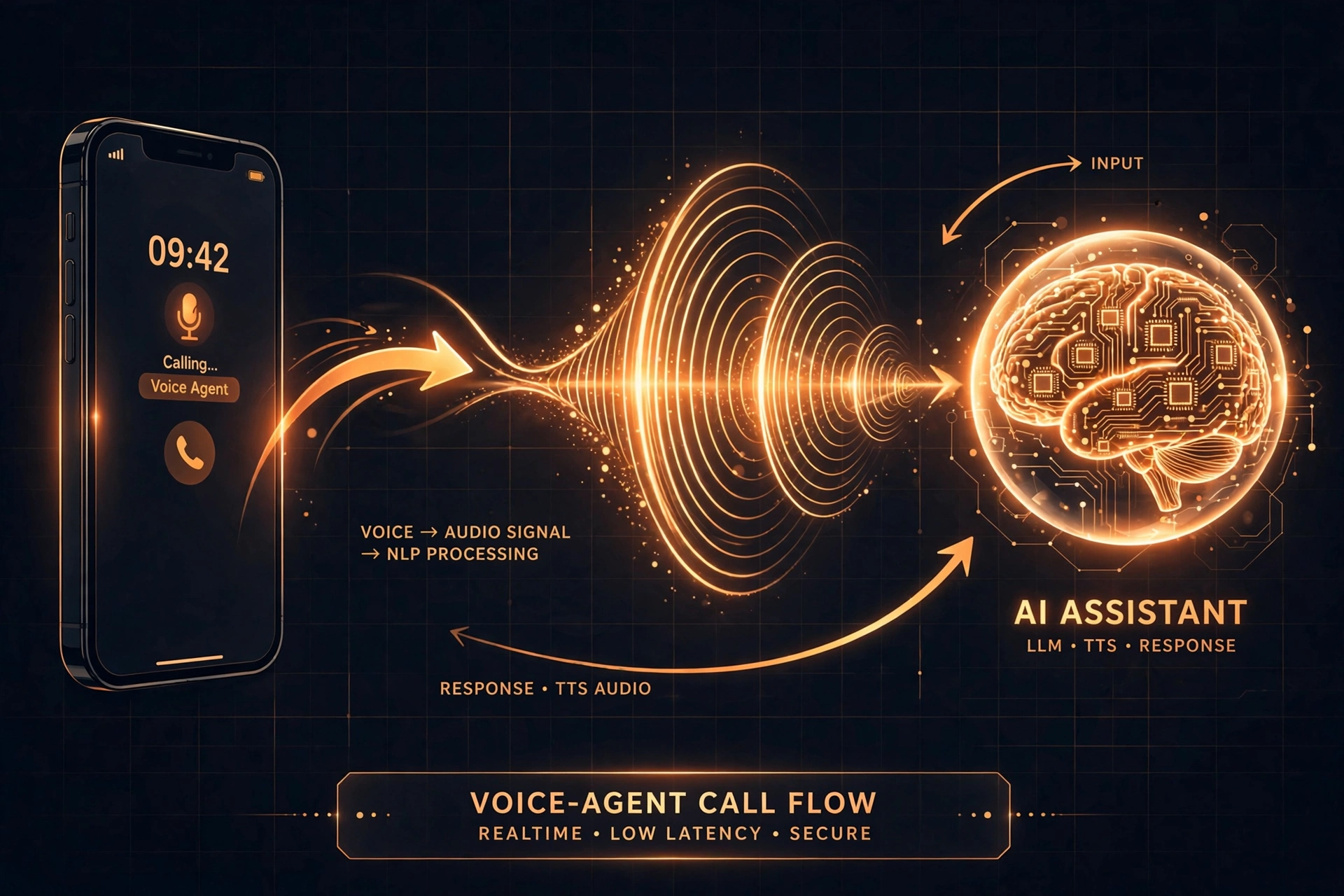
The four layers are replaceable components
- Telephony: how calls reach the agent — SIP trunks, WebRTC, or a provider's managed numbers.
- Speech-to-text: streaming transcription tuned for phone audio (8 kHz, noisy, accented).
- The brain: an LLM with a system prompt, conversation memory and tools.
- Text-to-speech: natural voices, increasingly cloned from a real human voice.
Each layer is swappable — providers leapfrog each other constantly. Newer speech-to-speech models (e.g. OpenAI's Realtime API) collapse the middle stages, but the pipeline logic stays the same; for a full-stack build on your own infrastructure, see our AI automation services.
Latency is the whole game
Rule of thumb: callers feel the conversation break when gaps pass about 1.5 seconds. Budget roughly 300–500 ms for streaming transcription, 300–800 ms for the LLM's first words, and 200–400 ms for speech synthesis to start. Stream at every stage — words flowing through as ready, never batched — and pick a fast model over a clever one — if calls feel sluggish, the fix is almost always streaming or a smaller model.
Step 3: Choose a provider for each layer
Buy best-of-breed per layer rather than one vendor for everything — the integration glue is smaller than the providers want you to believe.
Match the layer to the job
Speech-to-text: use an engine tuned for telephony — providers like Deepgram and AssemblyAI publish streaming-latency figures. Test with recordings of your actual callers; phone audio is where code-switching (Urdu-English, Arabic-English) matters most.
The brain: you need low first-token latency, function calling, and a system prompt you control. The proven pattern in AI agent development is a small set of well-described tools — check availability, create booking, look up order status — not a giant instruction manual; short tool descriptions keep the model fast.
Text-to-speech: callers judge the agent by its voice within three seconds. If you clone a real human voice, get written consent and keep it on file — required under UK and UAE data-protection rules.
Managed platforms (Vapi, Retell, Bland and similar) bundle the layers and are a fine way to prototype — convenience now, metered pricing later, as our n8n vs Make vs Zapier comparison puts it. Our AI calling agent product runs on a custom stack for exactly this reason.
Step 4: Get the agent on a phone line
The dullest part of the build — and the one that most often delays launch.
SIP for the public network, WebRTC for in-app
SIP trunking connects the agent to the public phone network through providers like Twilio — real numbers, calls from any mobile; Twilio's SIP interface documentation is the clearest starting point. WebRTC runs calls in a browser or app with no phone numbers needed, but the caller must have your app open. Buy local numbers for every market you serve and check local rules before any outbound calling — Pakistan's PTA, the UAE's TDRA and Saudi Arabia's CST all regulate automated calls. Inbound-first is the safe start.
Step 5: Design the conversation
This is where projects live or die, and it is mostly writing: phone callers give short answers, interrupt constantly and give up fast.
Write the system prompt like a call-centre brief
Name, role, tone, hard rules: what to ask first, how to confirm details ("table for four at 8pm — is that right?"), what to do when it doesn't understand. Keep turns to two sentences maximum. Then handle interruptions: barge-in must work from day one — stop speaking the instant the caller talks and keep the partial transcript. Agents that finish their sentence while the caller interrupts are the number-one complaint in testing.
Design the handoff before you need it
Every call has a failure mode, and the handoff must be warm — "I'm connecting you with the team; I've noted you're asking about the catering menu" — with the transcript logged so the human has context. We build the same discipline into our WhatsApp bots and chatbot development work.
Step 6: Test it before it talks to customers
LLM agents are probabilistic — they will say things you didn't expect. Build an eval suite from 50–100 real customer calls (consent obtained, anonymised) that re-runs after every prompt change — the voice equivalent of a test suite for custom software. Then load-test with concurrent synthetic calls: p99 latency, not the average, is what callers feel. Size telephony channels and API limits against your busiest hour.
Step 7: Compliance, recording and rollout
Voice agents touch the most regulated ground in software — recorded calls, personal data, telephony law. Handle it up front: retrofitting compliance costs ten times more.
Disclosure, consent and data
Tell callers they are speaking to an AI at the start of the call — legally required in the EU and several US states, honest practice everywhere else. In the UK, a clear "this call may be recorded" announcement plus a legitimate business purpose generally suffices — orientation, not legal advice; get counsel for your market. On data: store transcripts, not raw audio, redact payment details and national IDs, and set a retention period. Clients in Saudi Arabia and the UAE increasingly ask about data residency first.
Roll out in stages
- Shadow mode: the agent runs alongside staff for a week while staff compare its answers against theirs.
- After-hours pilot: nights and weekends only — high value, low risk.
- Full hours: flip the switch once resolution rate beats your baseline.
Measure containment rate, average handle time and caller satisfaction — not just volume. A rough planning estimate is US $0.05–0.25 per minute in provider usage (STT + LLM + TTS), plus telephony and the build: for sizing, not a quote. For the build, see our guide to AI agents for small business automation, our services overview, or talk to us directly.
Frequently asked questions
How long does it take to build an AI voice agent?
A prototype on a managed platform can take calls in days. A production agent — custom pipeline, conversation design, testing, compliance and CRM integration — is typically a 4–8 week build, where conversation design and testing are the long pole.
Can an AI voice agent speak Urdu or Arabic?
Yes — modern speech models handle Urdu, Arabic and code-switched speech far better than the previous generation. Always test with your actual callers' accents — provider playground demos are not representative of phone audio.
Build custom or use a managed platform?
Prototype on a managed platform, then move to a custom stack when the agent becomes business-critical. Real estate teams are among the earliest adopters we see; if you are weighing voice against messaging, our WhatsApp chatbot cost guide is the natural companion read.