Custom Software Development Cost in the UK: What Businesses Actually Pay in 2026

Amir Farid
7 min read
Quick answer: In our experience, a straightforward custom software project for a UK business — a booking portal, an internal dashboard, a basic CRM-style tool — typically lands between £15,000 and £40,000 with an offshore or nearshore team, or £40,000 to £120,000+ with a UK onshore agency. A mid-complexity platform (client portal, integrations, mobile companion app) usually runs £60,000–£180,000; enterprise-grade software with compliance, multi-role workflows and heavy integrations commonly exceeds £200,000. Typical market ranges, not quotes — the price is set by scope, team shape, integrations and how well you define requirements before work starts.
What it costs: typical UK price ranges by project type
Forget a single "software cost" — think in tiers. Below are typical UK market ranges for 2026: honest estimates, not fixed numbers. Any agency quoting a flat price before seeing a specification is guessing.
Simple applications: £15k–£40k
A single-workflow tool — booking system, quote calculator, internal admin dashboard, basic custom CRM with a handful of user roles. One developer can carry most of the build, with design borrowed from a component library; offshore or nearshore teams typically land in this band, UK agencies start higher.
Mid-complexity platforms: £60k–£180k
The most common tier: a customer portal with permissions, two or three integrations (accounting, payments, messaging), a mobile companion app, and real AI agent features such as a support-ticket bot. This is where most SaaS products begin — see our SaaS MVP cost guide for 2026.
Enterprise-grade software: £200k+
Multi-branch systems, regulated-data software (healthcare, finance), or products integrating ten-plus systems — the ceiling is effectively unlimited.
Where the money goes: the typical budget split
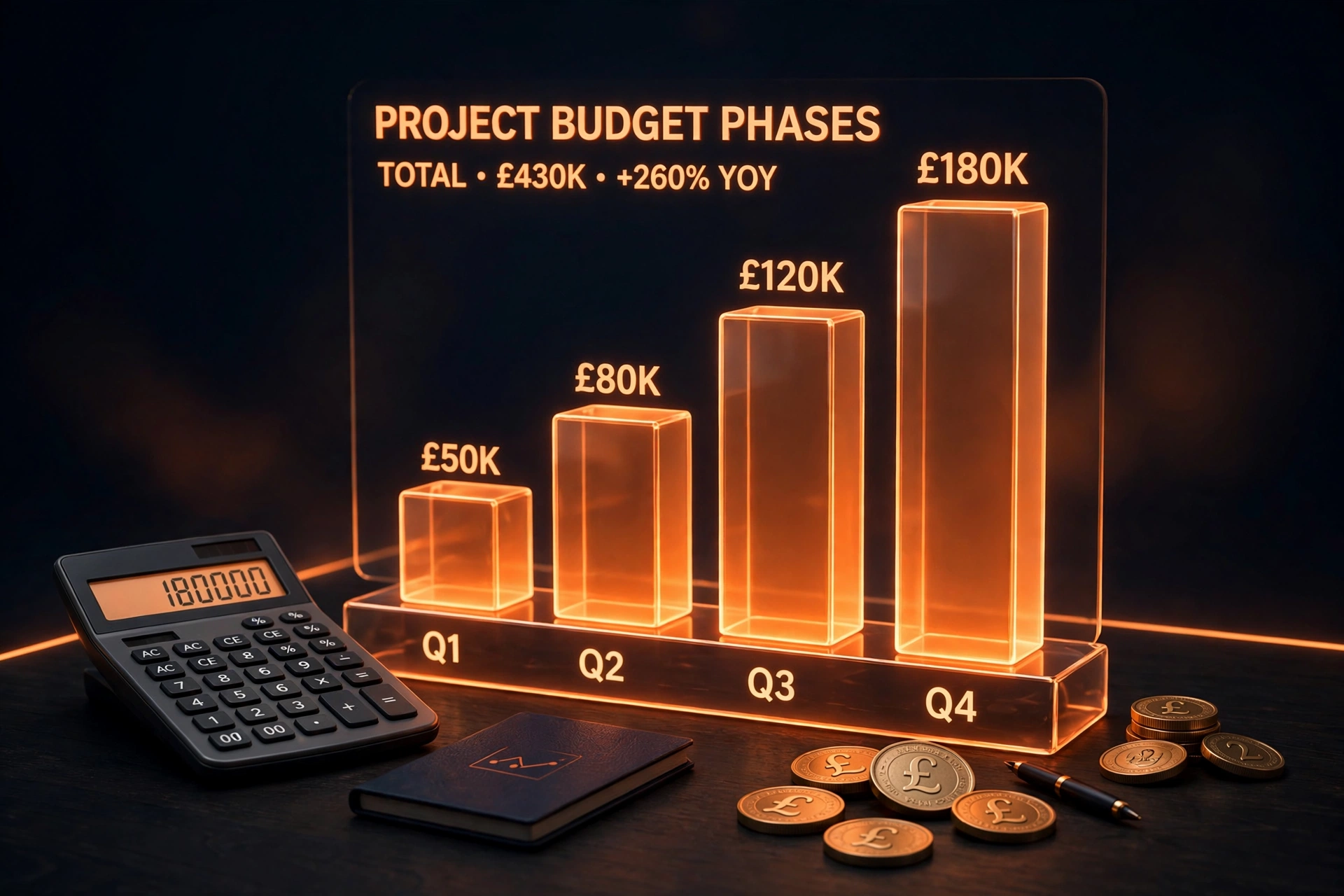
Business owners assume "development" is the whole bill; in our experience it is 60–70% of the total — the rest decides whether the software works in the real world.
Discovery and specification: 10–15%
Two to four weeks mapping processes, writing the specification and prototyping the riskiest parts — the cheapest phase, and the one businesses skip and then pay for twice in rework.
Design: 10–15%
User flows, screen designs and a design system — clear designs cut build cost by reducing mid-build decisions and rework.
Development: 60–70%
The build itself, including integrations and AI features — from WhatsApp bots that take orders to AI calling agents handling appointment reminders. Integration work is the most underestimated part: a clean modern API takes hours, a legacy one takes weeks.
Testing, launch and handover: 10–15%
Real user testing, security checks, data migration, documentation and training — software shipped without this ships with bugs, and the support tickets cost more than the testing would have.
Onshore, nearshore and offshore: the UK day-rate picture
The single biggest lever on your bill is who builds it. Typical 2026 day-rate ranges: roughly £500–£1,200+ UK onshore, £250–£500 nearshore, £150–£350 experienced offshore — market ranges, not fixed rates; seniority and specialism move them.
UK onshore: premium, and usually worth a conversation
Same time zone, familiar legal footing — right for regulated industries, but you pay for it. Our UK clients typically use onshore for discovery and product ownership, not the whole build.
Nearshore and offshore: the hybrid model that works
The model we see succeed most: UK-based product leadership with the build team offshore or nearshore — senior-quality engineering at a fraction of onshore rates, and it works the same for our USA, UAE and Saudi Arabia clients. It demands a written specification and disciplined communication — savings evaporate if every requirement is negotiated twice.
What drives the price up (or down)
When two businesses get wildly different quotes for "similar" software, it is almost always one of these factors.
Scope clarity
A ten-page specification with wireframes gets a tight quote; "like X but better" gets a padded one, because the agency is pricing the unknown. Clear scope is the single cheapest way to lower a quote.
Integrations
Each third-party system adds a week or more of work, plus licensing and maintenance — a portal connecting to accounting, payments and SMS is doing three separate integrations, so map them all before asking for a price.
GDPR and UK data rules
Software handling UK personal data needs data protection designed in — consent flows, data minimisation, access rights, deletion. Not optional polish: the ICO's UK GDPR guidance is clear that privacy must be designed in from the start. Budget it as a line item, not a retrofit.
Design ambition
Custom-designed interfaces cost two to three times a clean component-library UI. Internal tools don't need the former; for customer-facing products, design is part of the marketing.
AI and automation features
An AI voice calling agent or support bot adds a real line item — model costs, integration and tuning. Price AI separately: our guide to AI agents for small business automation shows where they actually pay for themselves.
The running costs nobody quotes you
The build quote is not the total cost of ownership — every year of operation adds a layer most businesses discover only after launch:
- Hosting: typically £50–£500/month for small apps, £1,000+/month for platforms with real traffic — cloud bills scale with usage.
- Maintenance: budget 15–20% of the build cost per year: dependencies update, APIs change, security patches are non-negotiable — software without a maintenance plan rots.
- Licences and APIs: payments, SMS, email, AI model usage, map tiles. Individually small, collectively a real monthly number — get the list in writing before you sign.
- Change requests: your business will evolve and the software must too — negotiate a fair change process up front.
Mistakes we see over and over
Starting with an agency before starting with a document. The specification is the contract's brain — write it (or pay for a discovery phase) before anyone quotes the build.
Choosing on price alone. The cheapest quote is usually the vaguest: a £20,000 quote for what two others priced at £60,000 is not a bargain — it is a smaller project than you described, and the difference arrives as change orders.
Skipping the MVP question. Many projects can launch a first version at a third of the full scope and earn revenue while the rest is built — if your vendor never suggests phasing, they are selling hours, not outcomes.
No one owns the product on your side. Whatever the model, software needs a decision-maker who answers within days — delayed answers are the most expensive line item in most projects.
How to spend less without paying for it later
The honest way to cut the bill is not cheaper hands — it is less uncertainty: a written specification before quotes, web first and mobile later, component-library design for internal tools, only the integrations the first version needs, and a maintenance plan from day one so year two doesn't ambush you.
The blended model — UK product leadership with a skilled build team elsewhere — is the most reliable route we know to senior-quality software at mid-market prices. And AI automation is worth pricing against headcount first: our n8n vs Make vs Zapier comparison shows where off-the-shelf automation beats a custom build.
Sizing up a project? Start with a fixed-price discovery phase that produces the specification, the real quote and the risk list. Explore our services, or talk to us — we'll tell you honestly whether to build custom or buy.
Frequently asked questions
How much does custom software cost for a small UK business?
Typically £15,000–£40,000 for a focused tool (booking, dashboard, simple CRM) with a nearshore or offshore team, £40,000+ onshore. Scope decides the final number — ranges, not quotes.
Why do quotes for the same project vary so much?
Agencies quote different things: different scopes, rates, integration assumptions and contingency. Identical specifications produce comparable quotes — vague ones produce fiction.
Is it cheaper to build offshore?
Hourly cost is usually much lower, but the total depends on communication and scope. UK product ownership plus an offshore build team typically gives the best cost-to-quality ratio.
What ongoing costs should I budget for?
15–20% of the build cost per year in maintenance and support, plus hosting, licences and API fees — get the full list of running costs in writing before signing.
Should I build custom software or buy off-the-shelf?
Buy when a product covers 80%+ of your needs. Build when the process is your competitive advantage, no product fits, or subscriptions and workarounds cost more than the build in a few years.