NVIDIA NemoClaw: Governed AI Agents You Run Yourself

Amir Farid
7 min read
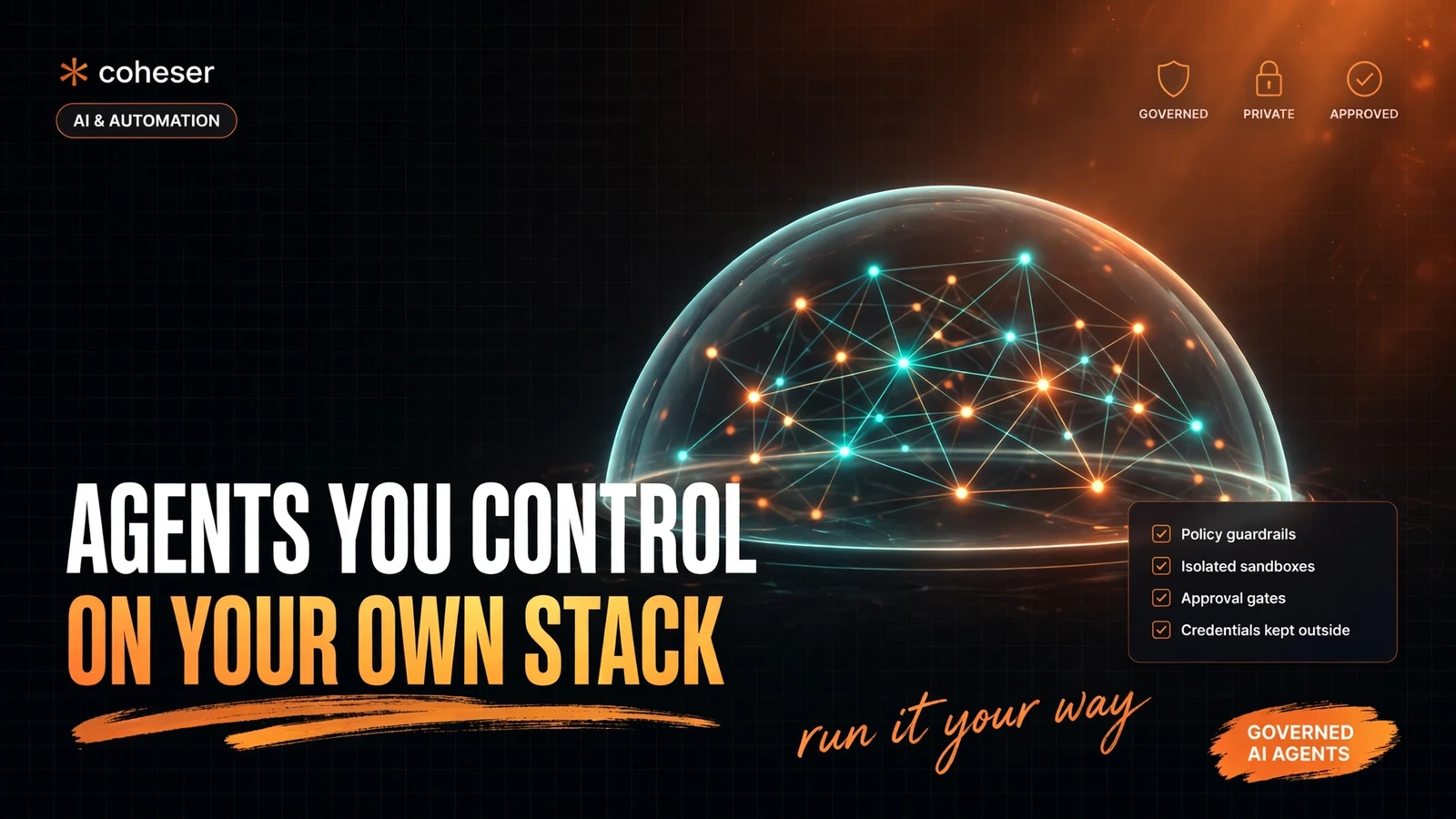
NVIDIA NemoClaw is a governed, self-hosted way to run AI agents on your own stack, not a ready-made product. In a developer post published on 30 October 2026, NVIDIA expanded its NemoClaw blueprints for specialised AI agents: patterns for an open agent stack the developer controls, combining a tuned harness, NVIDIA Nemotron open models, NVIDIA NeMo tools for optimisation and observability, and NVIDIA OpenShell as the secure runtime. It is a pilot-stage pattern for running agents under your own rules, with approval gates over what they can touch — worth understanding if your data cannot leave your systems, but not yet a turnkey product.
NVIDIA NemoClaw: Governed AI Agents You Run Yourself
Most agent demos skip the hard part. The demo agent answers questions; the production agent reads your CRM, updates records or sends a message. That second agent needs governance before cleverness — and NemoClaw is NVIDIA's blueprint for agents you control.
What NemoClaw actually is — and what it is not
NemoClaw is not a competing harness or runtime. It sits on top of a harness the developer chooses — currently OpenClaw, Hermes Agent from Nous Research, and LangChain Deep Agents — adding a model, domain tools, and a runtime governing what the agent can access.
The four parts of a governed agent
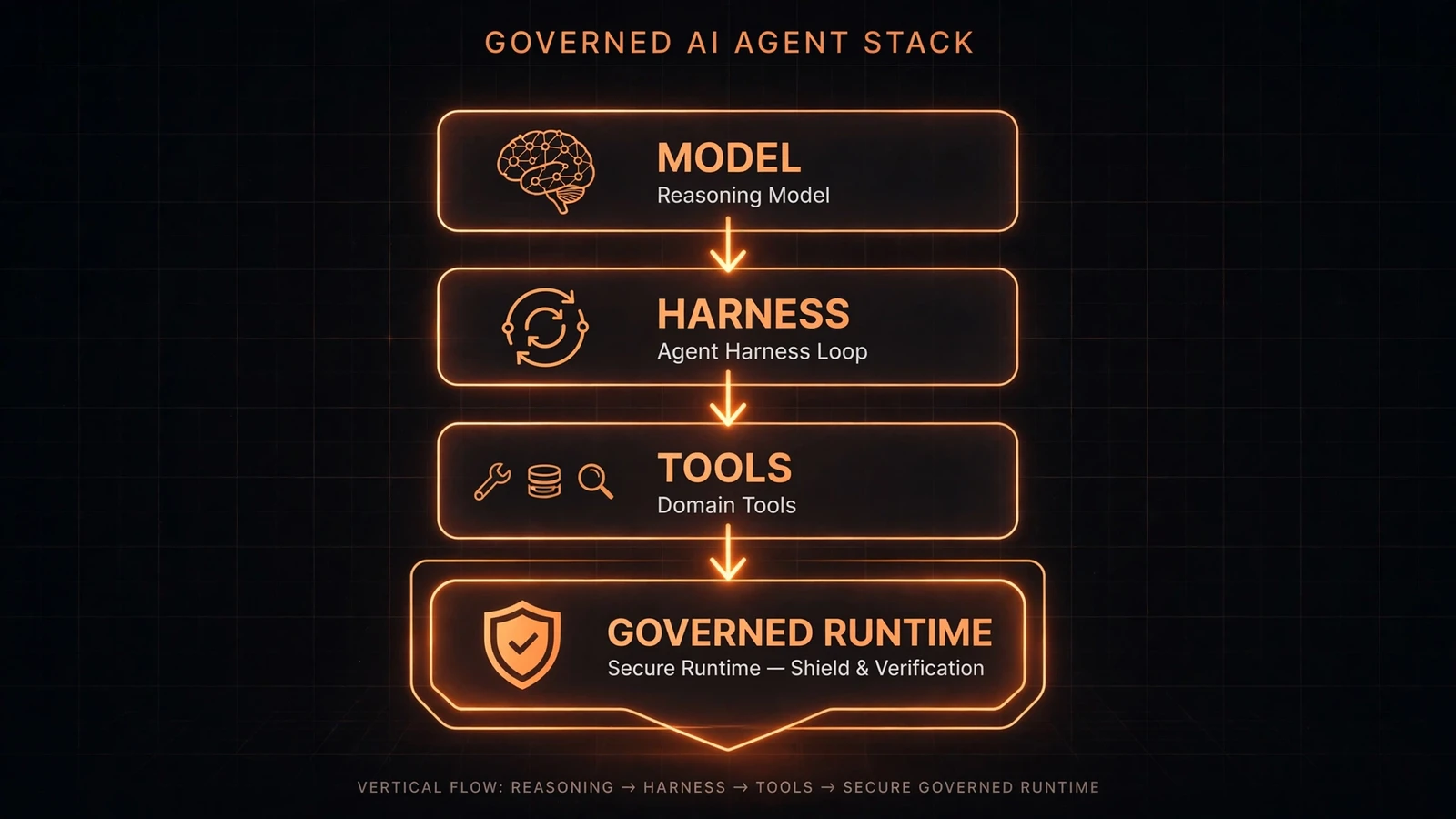
An autonomous agent has four parts: a reasoning model (here, NVIDIA Nemotron open models); a harness organising the task–tool–action–check loop; domain tools, such as looking up an order; and a runtime governing the whole thing — NVIDIA OpenShell — which makes the pattern "governed", not merely autonomous.
Why "sits on top of a harness" matters
No lock-in to one framework: a team already using OpenClaw or LangChain Deep Agents can add the governed runtime and model layer around what it has, instead of a full rip-and-replace. Pick one your team can operate and debug. Our guide to AI chatbot vs AI agent explains the distinction: an agent acts across steps, with permission; a chatbot answers.
When a self-hosted governed agent beats a hosted one
A hosted agent is usually the right starting point: faster to try, no infrastructure to run, and someone else handles scaling. Self-hosted governed agents win in three situations: data control, where sensitive material must not leave your environment; cost at sustained volume (any saving is an estimate until measured); and internal systems, where agents must reach tools a hosted service cannot easily access.
The trade-off is responsibility: self-hosted means your team owns uptime, updates and monitoring. Smaller teams often start hosted and move to self-hosted only for specific workflows. If you are weighing that move, our AI agents development team can map which workflows genuinely need self-hosting.
Hosted agent vs governed self-hosted agent
- Data: hosted agents use the provider's infrastructure; self-hosted agents keep data inside your cloud, data centre or workstation.
- Internal access: hosted agents are limited to exposed APIs; self-hosted agents reach internal tools behind your own network controls.
- Control: a governed runtime enforces policy-based security, network and privacy guardrails, and isolated sandboxes.
- Burden: hosted is lighter; self-hosted needs people who can operate and monitor the stack.
The blueprint pattern, step by step
A NemoClaw blueprint is a starting pattern, not a finished application: harness, model, tools, runtime.
Choose the harness, model and tools
Start with the harness your team can already run, paired with a Nemotron model suited to the job — drafting, classification and planning reward different models. Test on real, anonymised examples and record why you chose that model. Then give the agent the smallest toolset that completes the job: read-only where reading is enough, write access only to the specific records required. A broad "access everything" toolset turns a small mistake into a large one — the discipline behind good AI automation.
Put the runtime in charge of access
OpenShell is where policy lives: policy-based security, network and privacy guardrails, and isolated sandboxes, with credentials kept outside the sandbox, so the agent's working environment never holds your systems' keys. NeMo observability shows what the agent did.
Approval gates: the control that makes agents safe
Governance is not a document; it is gates the agent cannot pass without approval. Before any agent touches a real system, decide what is free, what needs a human, and what is forbidden.
Three gate levels that work in practice
- Free: read-only lookups and drafts that change nothing.
- Human-approved: anything that writes, sends, books or charges. A named person approves, and the approval is logged.
- Forbidden: deleting records, changing prices or permissions, or accessing credentials. Blocked by policy.
Gates protect against the agent's most common failure: confidently doing the wrong thing at speed. A chatbot that hallucinates wastes a minute; an agent with write access that hallucinates can corrupt a day's records. Gates, sandboxes and logging turn a demo into something a manager can sign off on — whether a small-business automation agent or a larger workflow.
Where NemoClaw fits alongside Claude, Codex and Cursor
NemoClaw is not a replacement for frontier systems. NVIDIA states that NemoClaw specialists can work alongside frontier systems such as Claude, Codex and Cursor, by delegating domain subtasks to the specialist: the general system handles broad reasoning or coding, the governed specialist handles a domain job inside your stack.
Few businesses run everything on one system. If your team already builds custom software, a specialist agent can slot in as one governed component. NVIDIA states deployment options of cloud, data centres, DGX Spark, and RTX PCs and workstations — so a pilot needs no data centre. Coheser works across the United Kingdom, the UAE, Saudi Arabia, the USA and Pakistan.
Pilot checklist before any agent touches real systems
NemoClaw's history counsels patience: announced on 16 March 2026 at GTC as an open-source layer for OpenClaw, it is still described as an early preview or alpha for a single trusted operator. Treat it as a pattern to pilot, not a turnkey product.
- One narrow workflow with a measurable outcome, such as ticket triage.
- Sandbox data first: prove behaviour on anonymised data.
- Gates in writing before the first run, with a named approver.
- Test failure, not just success: ambiguous inputs should make the agent stop or ask.
- Log everything: every tool call, approval and outcome reviewable.
- Baseline cost and reliability during the pilot, so scaling rests on your measurements.
- Decide the exit: what switches off if the pilot fails?
For context, see our Mistral Large 4 and open weights for business guide and RAG chatbots guide. Product builds may also need SaaS development, ecommerce development, CRM development or Flutter app development alongside the agent — the agent is one component, not the whole product.
The blueprint pattern — harness plus model plus tools plus a runtime governing access — suits business agents where data control and internal access matter. But its early-preview status means the sensible move today is a contained pilot with approval gates, sandbox data and a clear measure. Build governance first, prove it on one workflow, and let the pilot's numbers decide. Coverage is summarised by Blockchain.News, with an explainer at AI Expert's guide to NemoClaw. To scope a pilot, talk to Coheser about AI agents development.
Frequently asked questions
Is NemoClaw a finished product I can buy and deploy?
Not yet. It is a blueprint pattern for a governed agent stack you control, still described as an early preview or alpha for a single trusted operator. Pilot it on one workflow with sandbox data.
Does NemoClaw replace OpenClaw or LangChain?
No. It sits on top of a harness you choose — OpenClaw, Hermes Agent or LangChain Deep Agents — adding the model layer, tools and governed runtime.
When does self-hosted beat hosted?
When data must stay in your environment, when the agent needs internal systems a hosted service cannot reach, or when sustained volume makes hosted pricing worth comparing against your measured costs. Otherwise, hosted is simpler.
What is the single most important safety control?
Approval gates for write actions, backed by isolated sandboxes and credentials kept outside the sandbox. An agent that reads freely but cannot write, send or charge without logged approval is far safer than one with broad access.
Can I pilot NemoClaw without a data centre?
Yes. NVIDIA lists cloud, data centres, DGX Spark and RTX PCs or workstations, so a workstation-class pilot is a realistic starting point.