AI Automation for Logistics Companies: Dispatch, Tracking and Customer Updates

Amir Farid
7 min read
Quick answer: AI automation for logistics means software that handles the repetitive work around moving freight — route planning, shipment tracking, customer updates, delivery documents and exception spotting. The highest-return starting points are automated customer updates (WhatsApp and SMS tracking alerts) and document processing (proofs of delivery, invoices, customs paperwork): high-volume, rule-based tasks where AI is genuinely reliable today.
The workflows worth automating first
A typical small-to-mid-size logistics operation runs on phone calls, spreadsheets and WhatsApp. Dispatchers spend half their day answering "where is my shipment?" instead of managing exceptions that need human judgement. That is where AI automation earns its keep: clearing repetitive noise so your team focuses on decisions that protect margins. The blunt rule: AI won't fix a broken process — start with workflows that are repetitive, data-rich and documented:
- Tracking and proactive customer updates — automated milestone alerts via WhatsApp and SMS.
- Document processing — PODs, invoices, bills of lading, customs paperwork.
- Dispatch assistance — AI load planning and route suggestions, approved by a dispatcher.
- Driver communication and exceptions — automated check-ins, delay detection, escalation.
- Warehouse receiving and picking — barcode/OCR verification, putaway suggestions, discrepancy flagging.
- Demand forecasting — volume prediction from your own booking history for capacity planning.
Fully autonomous dispatch is deliberately not on the list: DHL's Logistics Trend Radar 8.0 covers agentic AI's rise, but their own research stresses people remain central to logistics operations. The model that works is augmentation: AI drafts, your people decide.
AI dispatch and route optimisation assistance
Dispatch is where the money quietly leaks out. A dispatcher juggling 30 vehicles, traffic, driver hours and time windows makes decent decisions most of the time — but decent across thousands of loads a year is expensive. AI dispatch tools analyse orders, capacity, locations and constraints, then suggest load plans and routes for the dispatcher to review and approve.
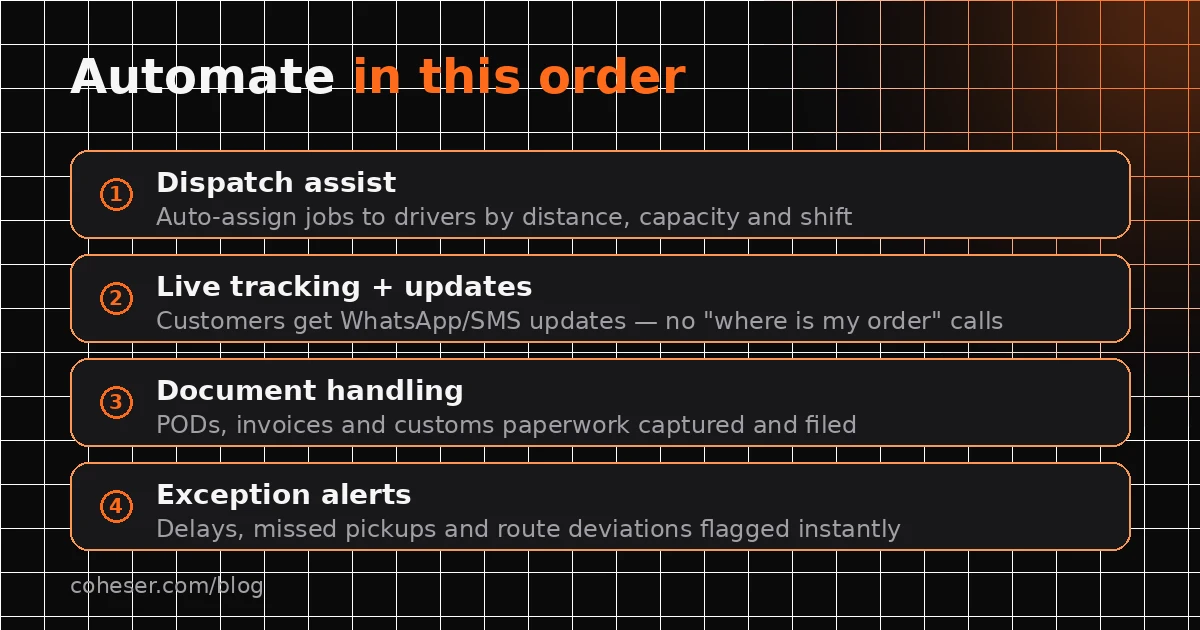
What AI dispatch tools actually do
- Load consolidation: match LTL orders to capacity so fewer vehicles run half-empty.
- Route sequencing: order multi-drop routes around time windows and driver-hour limits.
- Cost comparison: own-fleet vs subcontractor vs linehaul on the same lane.
- Replanning on disruption: re-optimise affected loads in minutes when delays hit.
What they don't do
They don't know that a certain consignee only accepts deliveries before noon, or that a regular customer's forklift is always down on Mondays. That local knowledge lives in your dispatchers' heads — the system proposes, the dispatcher disposes.
Shipment tracking and proactive customer updates
If your team spends its day answering "where is my shipment?", you don't have a staffing problem — you have an automation gap. The fix is a notification engine: when a milestone fires in your TMS — booking confirmed, loaded, customs released, out for delivery, delivered — the customer gets a clear message with a live tracking link. The AI layer is an AI agent that also answers follow-ups in plain language. It is the highest-impact, lowest-risk automation a logistics company can deploy, because status enquiries typically dominate inbound customer messages.
WhatsApp and SMS automation that customers actually read
In the Gulf, Pakistan and much of Asia, WhatsApp is where business happens. A WhatsApp bot for logistics pushes milestone updates, shares PODs on delivery and hands over to a human when the conversation gets complicated. Our WhatsApp chatbot cost guide for 2026 breaks down realistic price ranges.
Paperwork: PODs, invoices and customs documents
Logistics runs on documents, and document-extraction AI is where the technology is most reliably useful. Bills of lading, invoices, packing lists, PODs, customs declarations — each carries data that someone currently retypes into your systems. That retyping is slow and wrong more often than anyone admits.
From paper and PDF to structured data
Modern OCR combined with language models reads these documents and extracts the fields that matter — consignee, container number, HS code, quantities, amounts — pushing them straight into your systems. A driver photographs a signed POD at the delivery point; it lands on the shipment record before the next stop. On international lanes, the same technology classifies goods against HS codes — DHL's MyGTS platform uses AI and machine learning for exactly this — and flags the inconsistencies that trigger inspections. AI voice calling agents can handle routine status calls with consignees and brokers — see our AI calling agent product for how these workflows run.
Warehouse, yard and driver operations
Inside the warehouse, AI earns its keep in the boring middle: verifying received goods against the advance shipping notice, flagging quantity mismatches at the dock door, suggesting putaway locations based on turnover, and checking picked orders before dispatch. A phone camera, a barcode scanner and a workflow engine connected to your WMS covers it.
For drivers, an AI layer automates the routine: dispatch instructions pushed with the route and documents attached, automated check-in prompts at milestones, and delay detection from GPS data that alerts the dispatcher — and the customer — before anyone has to ask. When something genuinely goes wrong, the system escalates to a human with the context attached. Our guide on how to build an AI voice agent covers driver-facing voice automation.
Demand forecasting without a data-science team
You don't need a machine-learning department to forecast demand — you need your own history. Most logistics companies sit on years of booking data and never use it. A model trained on that history, adjusted for seasonality — Ramadan shifts Gulf freight patterns; Q4 peaks everywhere — gives you a working view of capacity needs two to eight weeks out. Use it to plan how many subcontractor vehicles to line up, when to offer spot rates to fill gaps, and when to warn key customers about tight capacity.
The honest limits, and a 90-day rollout plan
What AI automation can't do (yet)
- It can't fix bad data. Records scattered across five spreadsheets produce confidently wrong answers at speed.
- It can't replace dispatcher judgement. Edge cases, relationships and local knowledge still need humans.
- It can't integrate itself. Connecting to your TMS, WMS or ERP is the hard part — budget for it.
- It can't work without buy-in. Dispatchers who see automation as a threat will route around it.
Regional priorities differ: in the UAE and Saudi Arabia — analysts estimate the GCC freight and logistics market at over USD 80 billion and growing — WhatsApp-first customers make update automation the obvious first move; in the UK, post-Brexit customs paperwork pushes document automation up the list; in Pakistan, basic milestone SMS updates are a genuine differentiator. For budget anchors, see our UK software cost guide and SaaS MVP cost breakdown.
A 90-day rollout plan
- Days 1–30: automate one pain end to end. Usually proactive tracking updates via WhatsApp/SMS. Connect TMS milestones to a messaging channel and test on your top 10 customers. Measure inbound status calls before and after.
- Days 31–60: attack the paperwork. Deploy document extraction on PODs and supplier invoices — this is where custom integration work usually lives.
- Days 61–90: add the intelligence layer. Pilot AI-assisted dispatch on one lane and a basic demand forecast. The AI suggests; the human approves.
Decide early whether to build, buy or blend. Off-the-shelf TMS add-ons get tracking automation live quickly but lock you into their roadmap. Many companies blend: bought software for commodity parts, custom AI agents and chatbots for the customer-facing layer. If you're evaluating options, talk to our team — we'll give you an honest answer on whether off-the-shelf is better.
Frequently asked questions
How much does AI automation cost for a logistics company?
It depends on scope. Tracking notifications via WhatsApp/SMS are typically cheapest to get live; document extraction is a mid-range integration project; AI-assisted dispatch is the largest because of the TMS integration work. Start with the customer-update layer and fund the bigger projects from those savings.
Will AI replace our dispatchers?
No. Dispatchers handle edge cases, customer relationships and local knowledge that no current AI system manages reliably. AI clears the routine work so each dispatcher handles more volume and spends their time on exceptions.
Can small freight forwarders benefit, or is this only for large 3PLs?
Small forwarders often benefit more: a higher share of staff time goes to routine communication and paperwork. Automating tracking updates and POD processing can free up a full-time role's worth of capacity without hiring. Start with one workflow, one lane, one customer segment, and expand from measured results.