Conversational AI for Logistics: Tracking, Updates and Customer Conversations That Run Themselves

Amir Farid
7 min read
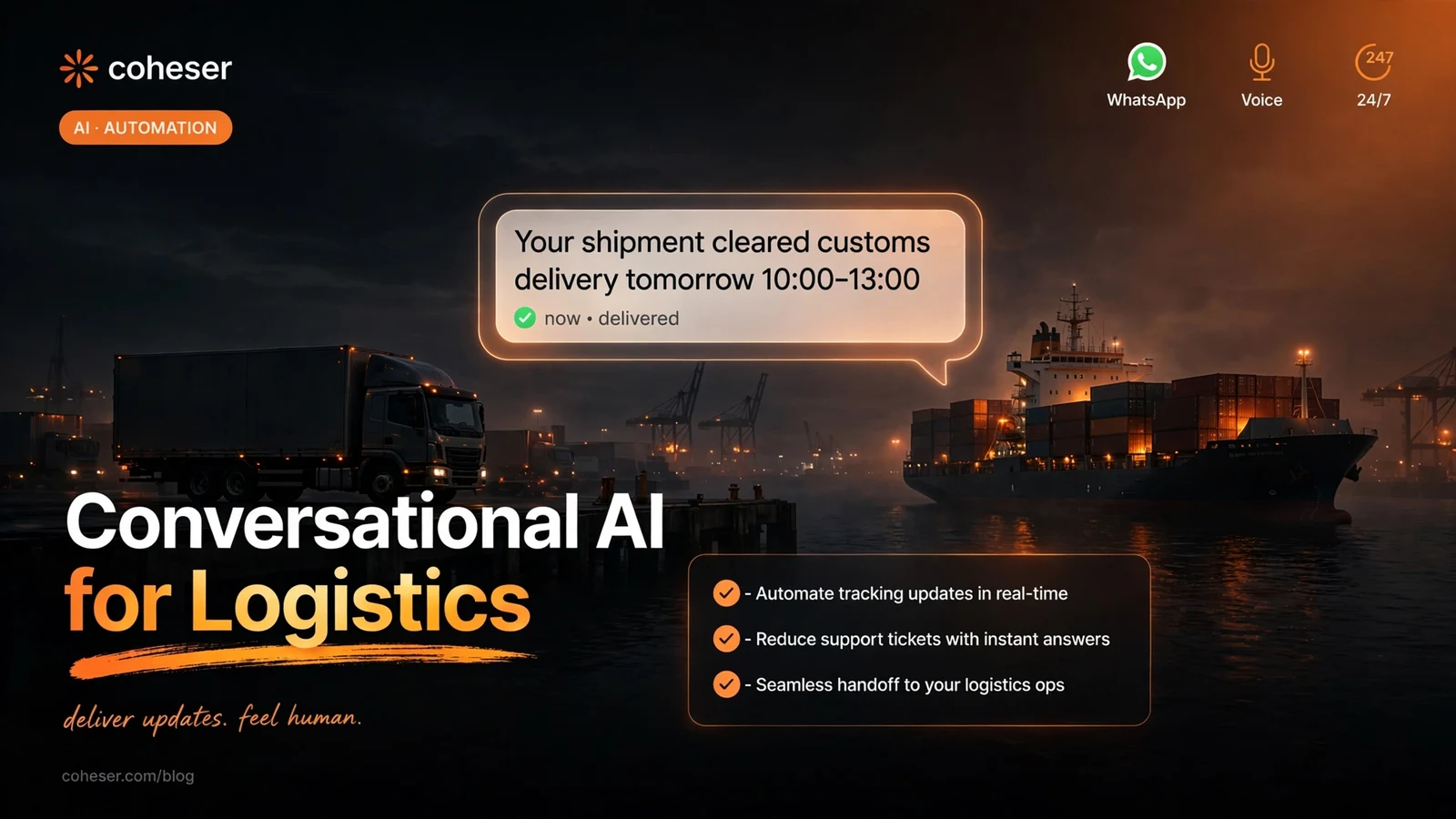
Conversational AI for logistics is software that holds real two-way conversations with your customers, drivers and consignees — on WhatsApp, SMS, voice and web chat — about shipments, deliveries, quotes and problems. A customer asks "where is my container?", the AI checks your tracking system and answers with the live status. A driver reports a delay, the AI logs it and tells the customer, escalating to your dispatcher only when a decision is needed.
Most logistics companies already send one-way updates. What eats your team's day is everything that comes back — follow-up questions, changed delivery times, "can you hold it until Tuesday?" requests. Conversational AI takes on that back-and-forth, so your people handle the exceptions instead of the routine.
What conversational AI means in a logistics business
At its simplest, it is a chat or voice assistant connected to your real shipment data — bookings, milestones and delivery windows from your TMS or spreadsheet. It identifies the shipment from a booking reference or phone number, and answers in plain language.
It differs from a basic chatbot: it remembers context, so a customer can ask about a second shipment without repeating themselves; and it knows when to stop — anything involving money, a dispute or an angry customer goes to a human, with the full conversation attached.
Our guide to AI automation for logistics companies covers the wider picture — dispatch, documents and forecasting.
The five conversations worth automating first

1. "Where is my shipment?" — track and trace chats
A customer sends a booking reference on WhatsApp or web chat, and the AI replies with the current milestone — booked, loaded, in transit, customs cleared, out for delivery — plus a tracking link. If the shipment is delayed, it says so and gives the new estimate.
How does AI handle track and trace updates in logistics? It sits between your tracking data and the customer, answering from live data whenever a milestone changes. The catch is data quality — late milestones mean politely repeated late information.
2. Delivery exceptions — the conversation that saves the shipment
A delivery fails because nobody is at the gate, the consignee refuses the goods, or the address is wrong. The AI shortens the usual chain of phone calls to one thread: it contacts the consignee when the exception is logged, offers the options — redeliver, collect, change the address — and books the choice back into the job.
3. Driver check-ins
Drivers do not want to phone the office at every stop, and dispatchers do not want to chase them. The AI messages the driver at each milestone, asks for a one-tap confirmation, and records arrivals and problems in the driver's own language. A reported delay goes straight to the dispatcher and the customer.
4. Quotes and booking conversations
Many quote requests arrive as chat messages — "How much to move two pallets from Lahore to Dubai?" The AI collects the price details — origin, destination, weight, dimensions, dates, goods type — checks them against your rate card, and gives a quoted price or range. Anything unusual goes to your sales team with the full conversation.
5. Multilingual customer support
Logistics is multilingual by nature: a customer in Dubai, a driver in Karachi, a consignee in Rotterdam. An AI that switches languages mid-conversation removes the "we will call you back" delay — the customer writes in Arabic, the driver replies in Urdu, the dispatcher reads the summary in English.
Proactive vs reactive updates: when to push, when to answer
Reactive updates answer a question a customer has already asked. Proactive updates answer it before they ask. Can AI send proactive shipment updates to customers? Yes — when a milestone fires (loaded, departed, customs cleared, out for delivery), the AI sends a short message with the new status and what happens next.
Message on change, not on schedule: when the status changes, when a delay appears, when delivery is imminent. Always give the customer a way to reply — a message that cannot be answered is just a notification, and the customer will phone you anyway.
Which channel: WhatsApp, SMS, voice or web chat
In the Gulf, Pakistan and much of Asia, WhatsApp is the default business channel. Customers read it, reply to it, and send photos of damaged goods through it.
SMS
SMS reaches everyone, including customers without WhatsApp and drivers on basic phones — best for short, time-critical alerts like "Out for delivery today, 10:00–13:00". Use it for the alert, and let the customer continue on WhatsApp or a call.
Voice
Some customers still prefer to talk — an urgent delay, a high-value shipment, a customer who does not read messages. An AI voice agent handles routine status calls, confirms delivery windows and takes reschedule requests by phone. Our AI voice calling agent guide covers the voice side of these conversations.
Web chat
Web chat catches customers who found you through search and have not yet booked. It answers tracking questions and collects quote details. It is the easiest channel to start with — but pair it with WhatsApp or SMS for follow-ups.
How to roll it out in five steps
Step 1: Count your conversations. Count a week of inbound messages and calls by type — status checks, reschedules, quotes, exceptions, complaints. Start with the highest-volume type with the clearest answer.
Step 2: Connect it to live shipment data. The AI must read from the same system your dispatchers use — a TMS, or a spreadsheet to start. The integration is the work. Our step-by-step guide to building an AI voice agent explains the process.
Step 3: Write the rules before you write the replies. Decide what the AI may do alone — answer status questions, reschedule within a window, share a proof of delivery — and what it must ask a human about: refunds, claims, anything involving money.
Step 4: Pilot with your best customers. Launch on one lane or channel, with ten or twenty friendly customers. Read every conversation for the first two weeks.
Step 5: Expand one conversation type at a time. Add the next type only when the first runs without daily fixes.
Measuring ROI: what to count
Count these four numbers before launch and again after thirty days.
Status calls and messages per shipment. If customers asked about a shipment three times on average before, and ask once now, the AI is doing its job.
Time to first response. A customer answered in thirty seconds does not phone you as well — and a slow handover to a human cancels the benefit.
Exception resolution time. How long from a failed delivery to a booked redelivery? The AI starts the consignee conversation within minutes.
Cost per conversation. Divide the build and running costs by the conversations handled, and compare with the cost of the same conversation handled by your team.
Frequently asked questions
What logistics tasks can AI automate today?
The reliable ones are repetitive and data-driven: tracking-status questions, proactive shipment updates, rescheduling, quote details, driver check-ins, and proofs of delivery. Dispatch planning and forecasting can be AI-assisted, but a human still approves the decision.
Can AI send proactive shipment updates to customers?
Yes. When a milestone changes, the AI sends a short WhatsApp or SMS message with the new status and what happens next. Message on change, not on a schedule, and let the customer reply.
What tools automate shipment status updates?
Three layers work together: your transport management system holds the milestone data, a messaging layer (WhatsApp Business, SMS or voice) delivers the messages, and a conversational AI layer sits between them — reading the milestones, writing the update, and handling the customer's reply. Off-the-shelf TMS add-ons cover the one-way updates; the conversational layer is usually custom.
How is conversational AI different from a tracking page?
A tracking page waits for the customer to check it. Conversational AI goes to the customer — it sends the update, and answers the customer's reply in the same conversation.
If your team spends its day answering "where is my shipment?" instead of moving freight, talk to Coheser. We build custom AI agents and chatbots for logistics companies in the UK, UAE, Saudi Arabia and Pakistan — tracking conversations, proactive updates and driver check-ins on WhatsApp, SMS and voice. Book a free AI consultation and we will tell you which conversations to automate first.