Meituan LongCat-2.5: A 1.6T Agent Model That Sees, Codes and Works Cheap

Amir Farid
7 min read
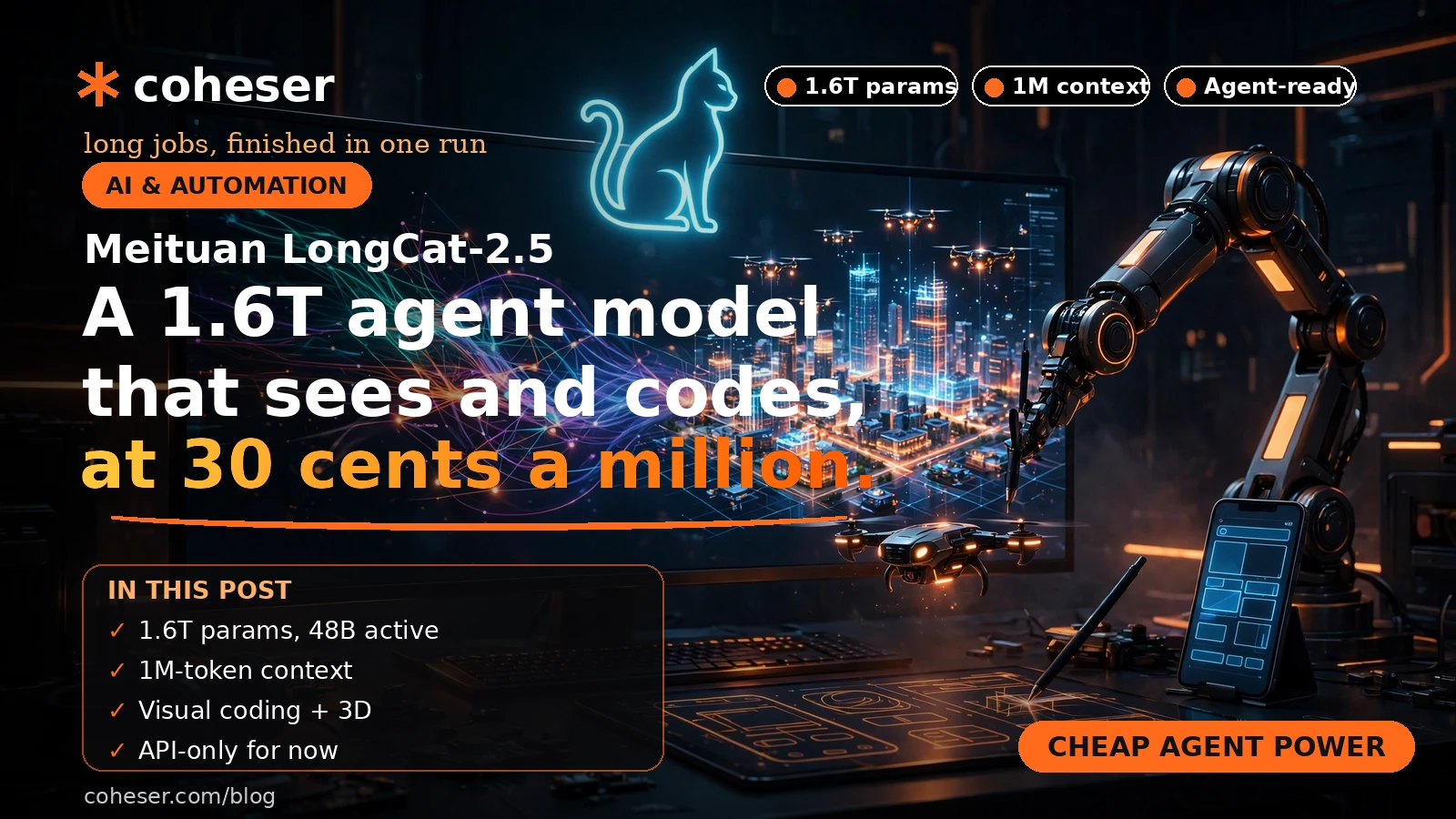
Meituan LongCat-2.5 is a native multimodal model built for long-horizon agent work: jobs that run for hours — reading screens, writing code, checking its own work. Announced 1 November 2026, on the LongCat API platform from 2 November, it has 1.6 trillion total parameters, about 48 billion activated per token. It costs $0.30 per million input tokens and $1.20 per million output tokens — a fraction of leading closed-model prices.
That is the story. Below: what it can do, where it fits against Claude and GPT, the caveats, and a safe pilot plan.
Meituan LongCat-2.5: A 1.6T Agent Model That Sees, Codes and Works Cheap
What LongCat-2.5 actually is
LongCat-2.5 is a mixture-of-experts model: 1.6 trillion total parameters, but only about 48 billion activated for each token. Meituan calls it natively multimodal: visual signals become discrete tokens, so text, images and video share one backbone instead of a bolted-on vision encoder.
It is built for long-horizon agentic tasks — an agent plans, acts, observes, adjusts, over many steps. Meituan says it was trained with long-horizon reinforcement learning and long-sequence training, and works with Claude Code, Codex and Hermes harnesses, so teams can drop it into setups they already use. Judge it over a whole workflow — the point of our guide to AI agents for small business automation.
The price that changes the maths

Long-running agents burn tokens for hours: planning, tool calls, retries, re-reading context. At leading closed-model prices, one long session can cost more than the developer time it saves.
Meituan's pricing page lists $0.30 per million uncached input tokens, $0.006 per million cached input tokens, and $1.20 per million output tokens. That pricing is limited-time — check it before budgeting. Even so, at those rates the token bill for an hours-long run becomes a rounding error — and cached input matters most, since agents re-read the same context again and again.
Meituan's own stress tests claim W4A4 inference — 4-bit weights and activations — gives 43.3% higher prefill and 42.77% higher decode throughput than a W8A8 INT8 baseline. Meituan's own claim, not an independent measurement — but it explains the low price.
Long-horizon coding agents: where it is meant to shine
Meituan positions it at coding agents and long-running tasks. Meituan's own table lists Terminal Bench v4.0 38.5, v2.1 88.4, BrowseComp 91.9, and AutomationBench 51.8. Terminal Bench covers real terminal tasks; BrowseComp, deep research; AutomationBench, multi-step automation.
They are Meituan's own results, and the rival scores in its table — GPT-5.6-Sol at 37.3 and Claude Opus 5 at 53.9 on Terminal Bench v4.0, both asterisked — come from public reports and are described by Meituan as indicative only. The honest picture: competitive, trailing the strongest Claude model.
The table omits GDPx, covered in our GDPx post on 2 November, where the best agent scores around 12%. Meituan has published no GDPx score — do not claim LongCat-2.5 solves it.
Where long coding agents help first
- Prototypes and MVPs: turning a brief into working code fast, for a developer to review. See our guide to scaling a SaaS MVP without rebuilding.
- Refactors and migrations: long, repetitive changes across many files.
- Test coverage and bug fixes: reproducing an issue, fixing it, running the tests.
- Documentation: generating docs from a codebase for faster onboarding.
The pattern in every case: the agent drafts, a human reviews — the guarded workflow behind good AI agent development and AI automation.
Visual coding and design: screenshots to working code
Being natively multimodal, it works from what it sees as well as what it reads. Meituan highlights visual coding — screenshots and designs into code — plus creative design and 3D tasks. Published numbers include 3DCodeBench Text-to-3D at 55.4 and Vision2Web at 78.6.
For a business, screenshot-to-code is the most useful piece: a designer hands over a mockup, the model produces a first interface version, and a developer polishes it. That shortens the design-to-code handoff for Flutter app development. As with Tencent's Hunyuan Hy4 visual AI, the rule is the same: pilot the workflow you actually have, not the demo you liked.
LongCat-2.5 vs Claude and GPT: how to choose
Most businesses will not replace Claude or GPT outright. The question is where each model earns its place.
| Factor | LongCat-2.5 | Claude / GPT |
|---|---|---|
| Price | $0.30 in / $1.20 out per million tokens | Substantially higher |
| Long-horizon coding | Strong on Meituan's benchmarks; trails Claude Opus 5 | Strongest published results |
| Visual coding | Native multimodal; screenshot-to-code strength | Capable, but not the headline pitch |
| Access | API-only; GitHub/Hugging Face "Coming soon" | Mature APIs and enterprise tiers |
| Hosting | China-hosted, domestic accelerators | US/EU hosting options |
Use LongCat-2.5 where volume and cost dominate — long agent runs, bulk prototyping, visual coding drafts — and keep Claude or GPT where quality, tooling, or data residency dominate. The wider market agrees: Kimi K3.1 Pro and DeepSeek's open-source SuperAgent are also pushing coding-agent costs down, while Mistral Large 4 offers the open-weights route for teams that want to self-host.
The caveats: API-only, China-hosted, no open weights yet
LongCat-2.5 is on the LongCat API platform only. GitHub and Hugging Face links are marked "Coming soon"; no open weights exist to download. Self-hosting is not possible today — treat open availability as announced, not delivered.
The second caveat is hosting. It is trained and served on domestic Chinese accelerators, so prompts and data go to Meituan's infrastructure in China. For many uses that is fine; regulated data or client-confidential code needs a proper review first. Do not send customer data, credentials, or proprietary code through the API until that review is done. Our governed AI agents guide covers the controls that matter: limited permissions, logging, human approval.
Third, this is a new model from a company better known for food delivery than foundation models. LongCat is a young platform: API stability, support, and pricing beyond the limited-time window are unproven. Budget on the assumption the $0.30/$1.20 pricing may rise, and keep harnesses portable so switching models is a configuration change, not a rebuild. The Claude Duet launch the same season shows the other side: proactive agents from an established lab, at established-lab prices.
A safe pilot plan for LongCat-2.5
Test it on a small, contained pilot: one workflow, one team, one month, and a clear measure of success decided in advance.
A practical five-step pilot
- Pick a long, repeatable coding task. A prototype, a refactor, or test coverage — work where output is easy to check.
- Use non-sensitive code only. A side project, never customer data or production credentials, until the hosting review is complete.
- Run it through a harness you already use. Claude Code, Codex or Hermes support lets you compare it against your current model on the same task.
- Keep a human in the loop. Every output is reviewed before reaching a customer or a live system.
- Measure cost per finished task, not per token. A cheap model needing three retries can cost more than one that gets it right first time.
That discipline applies whether the end product is custom software or a SaaS product. To scope a pilot, see our contact page — we work across our core markets, including the United Kingdom and the UAE. Models will keep changing; piloting cheaply, measuring honestly, and keeping humans in charge does not.
Frequently asked questions
What is Meituan LongCat-2.5?
Meituan's native multimodal model, announced 1 November 2026 and on the LongCat API platform from 2 November: 1.6 trillion total parameters, about 48 billion activated per token, built for long-horizon agent work, visual coding and design. See Meituan's own LongCat-2.5 announcement.
How much does LongCat-2.5 cost?
Meituan lists $0.30 per million uncached input tokens, $0.006 cached input, and $1.20 per million output tokens — limited-time pricing, so confirm it before budgeting.
Can I download and run LongCat-2.5 myself?
Not yet — API-only, with GitHub and Hugging Face links "Coming soon" and no open weights released. If self-hosting matters, see our Mistral Large 4 guide.
Is LongCat-2.5 better than Claude or GPT for coding agents?
On Meituan's own benchmarks it is competitive — Terminal Bench v4.0 at 38.5 against GPT-5.6-Sol at 37.3 — but it trails Claude Opus 5 at 53.9, and rival scores there are indicative only. A strong, cheap option, not a proven leader.
Should my business send real data to LongCat-2.5?
Not before a review. It is hosted in China on domestic accelerators — check data-residency and confidentiality requirements first, and pilot with non-sensitive code only.