Gemini Robotics 2.5: Humanoid Robots Now Work on Live Mercedes Lines

Amir Farid
7 min read
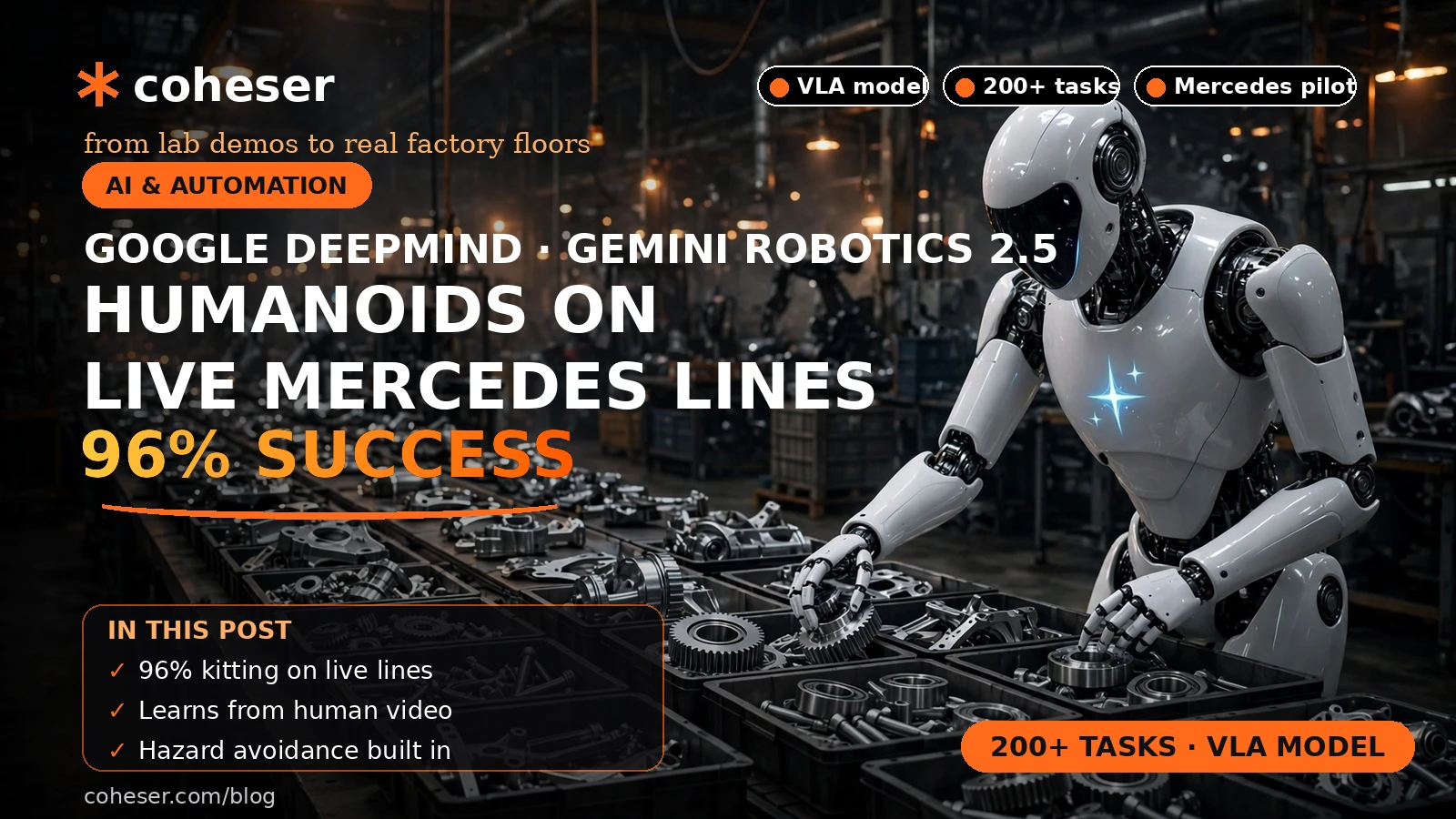
Google DeepMind announced Gemini Robotics 2.5 on 10 November 2026, the first robot model from the company to be tested on a live car production line. Described by DeepMind as its most capable vision-language-action model to date, it combines the Gemini 4 Argon foundation model with Gemini Robotics ER, an embodied-reasoning model that helps a robot think through physical tasks. An Apptronik Apollo 2 humanoid is doing automotive kitting on live Mercedes-Benz production lines in Hungary and Germany.
What has not changed is availability. There is no public API, no price and no general-availability date. Gemini Robotics 2.5 is rolling out only to DeepMind's robotics partners and more than 100 trusted testers, so this is not a product you can buy this week. It is a signal about where physical AI is heading.
What Gemini Robotics 2.5 actually is
A vision-language-action model, usually shortened to VLA, takes in what a robot sees, understands an instruction, and decides what the robot should do. Gemini Robotics 2.5 is DeepMind's newest version of that idea, built on Gemini 4 Argon and paired with the Gemini Robotics ER embodied-reasoning model. DeepMind's own announcement is the primary source for this post.
That pairing is the point. Earlier robot models were often good at one half of the job: they could see and describe a scene, or they could move a gripper, but they struggled to connect the two. The embodied-reasoning layer is meant to close that gap, letting the model reason about a task before it moves. It is the same direction of travel we have tracked all month, from AGIBOT's GO-3 to NVIDIA's GR00T 2 and Agility Robotics' Nasdaq debut.
The numbers DeepMind is claiming — read them as vendor claims

Every figure here comes from DeepMind, and none of it has been independently verified. Treat the numbers as the vendor's claims, not proof. Ars Technica's coverage reports the same figures.
DeepMind says the model was tested across more than 200 tasks, including serving food with tongs and pipetting liquid. It claims success rates 30 to 100 percent higher than previous baselines, depending on the task type, and tasks finished 20 to 30 percent faster.
The honest reading is narrower. A range of 30 to 100 percent is wide, and a zero-to-100 percent jump on one task says more about that task than about general reliability. What matters is the shape of the claim: better at more tasks, and faster at them. Our coverage of the GDPx agent benchmark is a reminder of the gap: the best software agent there clears only about 12 percent of long-horizon tasks.
A humanoid on a live Mercedes production line
The headline proof point is a factory pilot. An Apptronik Apollo 2 humanoid, fitted with a five-finger SharpaWave hand with 22 degrees of freedom, is doing automotive kitting on live Mercedes-Benz production lines in Kecskemet, Hungary and Sindelfingen, Germany. Kitting means gathering the right parts for a build in order. DeepMind reports a 96 percent success rate.
Read that number carefully. It is DeepMind's figure, and the pilot is a proof of concept, not full production. A 96 percent success rate on a supervised pilot is not the same as a robot running unsupervised on a shift. But the location matters more than the number: this is a live line, with real parts, real timing and real people nearby.
Why kitting is the right first job
Kitting is repetitive, structured and easy to measure: the right parts, in the right order, on time. It is the same pattern we described in our AI automation in logistics guide and our physical AI in ecommerce returns post.
Safety: the part businesses should watch closest
DeepMind says Gemini Robotics 2.5 uses inference-time reasoning guidance that steers the robot around physical hazards in real time: the model reasons about what it is about to do, and adjusts before it acts. DeepMind reports hazard avoidance improved by 33 percent around obstacles and 43 percent around people. Again, these are DeepMind's figures, not independently verified results.
The company has also open-sourced ASIMOV-Jailbreak, a safety benchmark of hundreds of prompts that disguise unsafe requests as harmless ones. It tests whether a robot model can be talked into doing something dangerous.
For any business considering robots, this is the right order of priorities: a robot that moves fast is only useful if it stops when it should. Our coverage of NVIDIA's NemoClaw governed agents makes the same point for software: guardrails first, capability second.
What this means for warehouses, assembly lines and retail stockrooms
The business case is not "robots replace staff". It is "a robot learns a new task and keeps improving at it". Gemini Robotics 2.5 is part of a wider shift from frozen routines to models that reason about the job in front of them.
For a warehouse, that could mean a robot that handles a new product line without a full reprogramming job. For an assembly line, kitting and sorting that adapts when a part changes. For a retail stockroom, moving stock and preparing orders with less manual handling. Our AI agents for small business guide makes the same point.
But none of this is available to buy today, and the first deployments will go to large manufacturers with robotics partners, not to small warehouses.
How to plan now: pilot scoping, safety and human oversight
Pick one narrow, repetitive task with a clear success measure, the same advice as our Gemini 4 Argon coverage and our AI chatbot versus AI agent guide. Kitting, sorting and packing are good candidates.
Scope the pilot, not the factory
Do not plan a factory-wide rollout. Plan one task, in one place, with one clear metric: how often does the robot complete the job, and how long does retraining take when the task changes? Film the task properly, with a fixed camera and consistent lighting. Our guide to building an AI voice agent applies the same discipline.
Decide who owns safety before a robot arrives
Work out who is responsible when a robot makes a mistake, and what the stop procedure is. A human must be able to halt the robot instantly. DeepMind's hazard-avoidance figures are encouraging, but they are vendor claims.
Price the whole job, not just the robot
A humanoid robot is only part of the cost. There is integration, safety fencing or sensor coverage, training, maintenance and supervision time. Our custom software cost guide for the UK applies the same budgeting discipline, with hardware on top. A quote without integration and safety costs is incomplete.
What you cannot buy yet
Gemini Robotics 2.5 is rolling out to DeepMind's robotics partners and more than 100 trusted testers. There is no public API, no price and no general-availability date. You cannot download the model, and you cannot order an Apollo 2 running it. If a vendor offers you Gemini Robotics 2.5 today, treat that as a red flag.
That is normal for this stage of physical AI. The model is real, the factory pilot is real, and the safety benchmark is public. But the path from a partner rollout to a product a mid-sized business can buy runs through more testing, more safety work and more cost reduction. Use this period to scope a pilot. If you want help, talk to Coheser about an AI agent pilot, see our AI calling agent work, or contact us.
Frequently asked questions
What is Gemini Robotics 2.5?
Google DeepMind's most capable vision-language-action model to date, announced on 10 November 2026. Built on Gemini 4 Argon with the Gemini Robotics ER embodied-reasoning model, it lets robots understand instructions and do physical tasks.
Can I buy or use Gemini Robotics 2.5 today?
No. It is rolling out only to DeepMind's robotics partners and more than 100 trusted testers, with no public API, price or general-availability date announced.
Where is it actually being used?
An Apptronik Apollo 2 humanoid is doing automotive kitting on live Mercedes-Benz production lines in Kecskemet, Hungary and Sindelfingen, Germany. DeepMind reports a 96 percent success rate, but this is a proof of concept, not full production.
How should my business prepare for physical AI?
Pick one narrow, repetitive task with a clear success measure, such as kitting or sorting. Decide who owns safety and how a robot is stopped, price the full job including integration and supervision, and pilot one task before committing.