Physical AI in E-commerce Returns: Lessons for Retailers

Amir Farid
7 min read
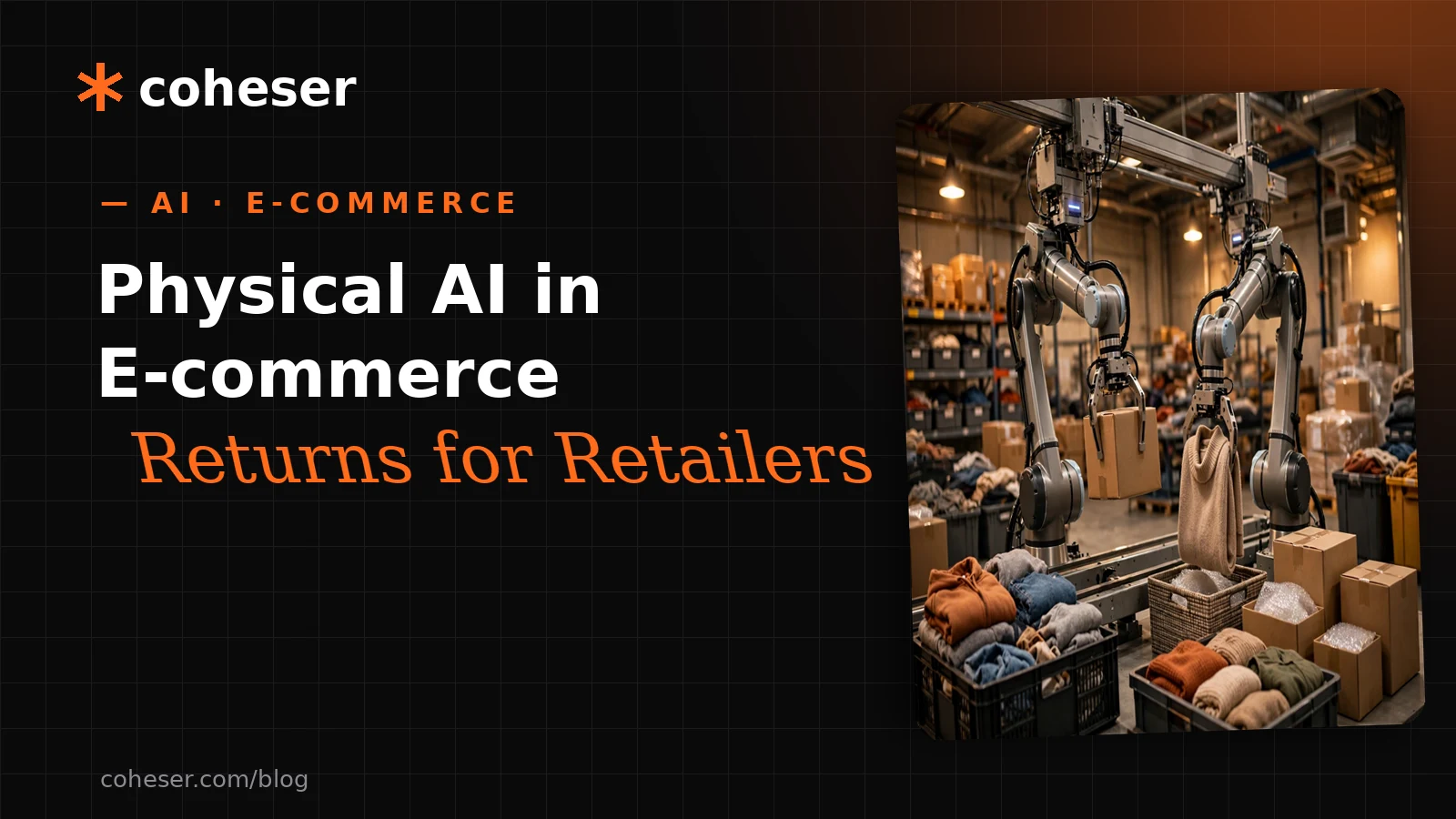
On 28 October 2026, Otto Group and Sereact announced a deployment that takes physical AI into one of e-commerce's hardest corners: returns processing. The plan starts with 10 AI-controlled dual-arm systems at Otto Group's logistics centre in Poland, then 15 more based on initial results — 25 in total, with a broader rollout evaluated if phase two succeeds.
Most retailers cannot buy a fleet of robots tomorrow, and that is not the point. The real lesson is how the work is divided: robots handle repetitive grasping and lifting, software decides how each item is handled, and people move to supervision, exception handling and quality checks.
Physical AI in E-commerce Returns: Lessons for Retailers
Why returns break traditional automation
Returns are where tidy warehouse automation meets reality. An item that went out folded, tagged and boxed comes back crumpled, repackaged in something else, or missing its packaging entirely. A multi-category retailer's assortment never stops changing either.
Traditional automation is built for the opposite: known products, presented predictably, in a fixed sequence. That works on outbound picking, but fails in returns, where input is unpredictable by definition. If a process only works when everything arrives in perfect condition, it is not really automated — a useful test for any AI automation claim.
What Otto Group and Sereact actually announced
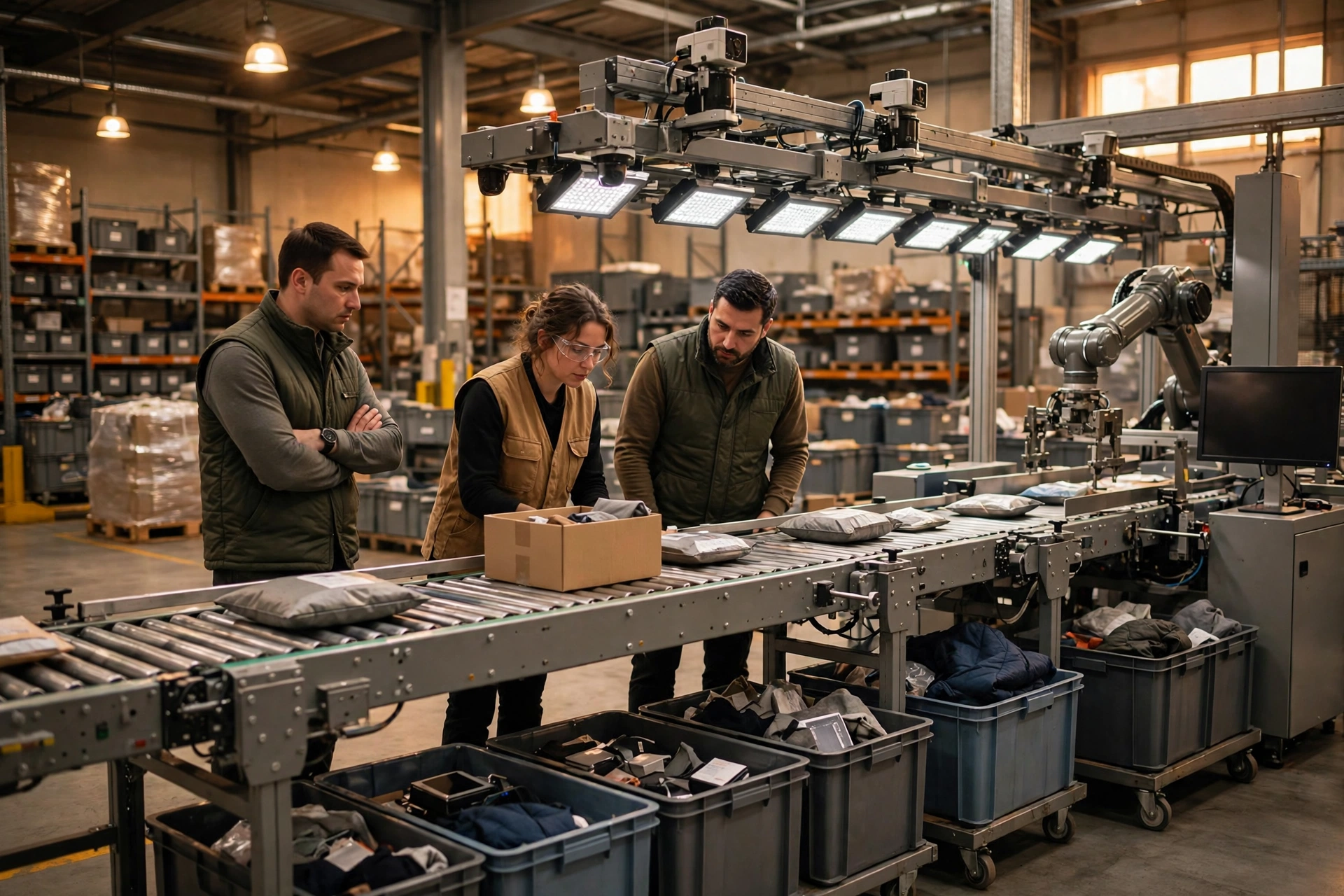
The deployment is deliberately staged: 10 systems in phase one, 15 more in phase two based on first-phase results (25 total), with a broader rollout evaluated only if phase two succeeds. Nothing is committed at full scale on day one: pilot, measure, then scale.
The system in plain terms
Each system is a dual-arm robot controlled by Sereact's Cortex physical AI model, which generalises to objects it has never seen — deciding in real time how to grasp each item, assess its condition and route it. The robots come under a Robotics-as-a-Service model, with Sereact operating them. The full announcement is available from GlobeNewswire.
Why physical AI generalises where fixed automation fails
The core claim behind Cortex is generalisation: handling items it has never seen, rather than only items it was programmed for. A fixed line needs a known product and presentation; a generalising model works out grasp, condition check and routing for each new item.
That capability is built on NVIDIA's physical AI stack: NVIDIA Isaac Sim and Isaac Lab for simulation, and NVIDIA Cosmos world foundation models to re-render items across garment states, packaging, materials and lighting. Post-training runs on NVIDIA Blackwell GPUs, and the system is tested on held-out cases before reaching the robots. When a robot struggles with a new item, the fix can return as a tested update within days instead of weeks. Software buyers should ask vendors the same: how fast is a new product type absorbed, and what testing happens first? The same test applies to AI agents in back-office work.
What retailers without robots should automate now
Returns triage and routing
Triage is the first job worth automating. When a return is registered, a software agent can check the order, the item, the return reason and the customer's history, then decide the route: restock, refurbish, markdown, repair or disposal. Too often that decision waits in a queue. An agent that routes instantly, with clear rules and human override, shortens that queue without removing human control. Building this usually means custom software development connecting the storefront, warehouse system and customer record — and for retailers already on a platform, the same logic belongs in their ecommerce development roadmap.
Condition assessment and customer updates
Full physical condition assessment still needs eyes and hands, but software can support much of it. Guided photo capture — at the returns desk, or by the customer before posting — creates a structured condition record, which an agent can compare against the return reason, flagging mismatches for a human and routing clear cases straight through. Customer communication is the other quick win: a chatbot or WhatsApp bot can handle routine returns questions, while a person handles disputes — see our guide to chatbots versus AI agents. Automated updates at each stage prevent most chasing contacts, and an AI calling agent can confirm a return status by voice — see our guide on how to build an AI voice agent.
Where human judgement still belongs
The Otto Group deployment keeps people in supervision, exception handling and quality checks — a deliberate design choice, not a temporary compromise. Disputed damage, high-value items, suspected fraud and ambiguous evidence need a person; automating those decisions away hides the risk until a customer complains. Automate the clear cases and escalate the rest with full context — photos, order history, previous returns — so the human decides quickly. That is how AI automation for logistics companies works best: system does volume, person does judgement.
A staged path from software automation to physical AI
- Stage 1 — Map the returns journey: step times, stock waits, decisions made by habit rather than rule.
- Stage 2 — Automate triage and routing in software, with human override for edge cases.
- Stage 3 — Automate customer updates at every stage, with self-serve tracking and bot or voice handling.
- Stage 4 — Add assisted condition assessment: photo capture, structured condition records, agent-flagged exceptions.
- Stage 5 — Evaluate physical AI: once volumes and exception rates are known, judge whether robotic handling or a Robotics-as-a-Service offer earns its place.
Each stage produces data for the next. Jumping straight to stage five means buying hardware to solve a workflow problem you have not yet understood. Businesses needing that layer should look at SaaS development, or CRM development so returns data sits alongside the full customer record.
What this means for retailers in the UK, UAE, Saudi Arabia and Pakistan
In the United Kingdom, high returns volumes and firm refund-speed expectations make automated triage and instant updates table stakes. In the UAE and Saudi Arabia, rapid growth and same-day promises make a slow returns tail especially visible, and WhatsApp is often the channel used to chase a refund. In Pakistan, where logistics varies widely by city, a software layer tracking a return honestly through every handoff beats any hardware. Retailers selling into the USA face the same triage problem at larger scale.
Mobile matters everywhere: many customers manage returns entirely on a phone, so returns flows belong in the app experience — where Flutter app development earns its keep. The honest conclusion: physical AI in returns is real and staged, not speculative — but for most retailers, the next twelve months' opportunity is a returns operation where triage, routing, condition records and customer updates happen automatically, humans handle the exceptions, and the data tells you whether physical AI is worth buying.
Frequently asked questions
What did Otto Group and Sereact announce on 28 October 2026?
A two-phase deployment of AI-controlled dual-arm systems for returns processing at Otto Group's logistics centre in Poland: 10 initially, then 15 more based on initial results (25 total), with a broader rollout evaluated if phase two succeeds — under a Robotics-as-a-Service model, with Sereact operating them.
What is Sereact's Cortex, and why does it matter for returns?
Cortex is Sereact's physical AI model: it generalises to objects it has never seen, deciding in real time how to grasp each item, assess its condition and route it. That matters because returns arrive folded, crumpled or repackaged, and assortments never stop changing — conditions where traditional automation fails.
How is Cortex built and tested?
It is built on NVIDIA's physical AI stack: NVIDIA Isaac Sim and Isaac Lab for simulation, NVIDIA Cosmos world foundation models to re-render items across garment states, packaging, materials and lighting, and post-training on NVIDIA Blackwell GPUs. It is tested on held-out cases before reaching robots, and when a robot struggles, a tested fix can return as an update within days instead of weeks.
Should a retailer without robots copy this approach?
Copy the division of labour, not the hardware: automate triage, routing and customer updates in software now, support condition assessment with structured records and photo capture, and keep humans on supervision, exceptions and quality checks.
What should a retailer automate first in returns?
Start with triage and routing: on registration, decide automatically whether an item goes to restock, refurbishment, markdown, repair or disposal, with human override for edge cases. Add status updates at every stage next, then assisted condition assessment.