AGIBOT GO-3 Preview: Robots That Keep Learning on the Job

Amir Farid
7 min read
AGIBOT's GO-3 Preview, unveiled in Shanghai on 3 November 2026, is an embodied foundation model for robots that keep learning after they leave the factory. Instead of freezing a robot's skills at training time, GO-3 is built for what AGIBOT calls "full-lifecycle scaling": learning across pre-training, post-training and post-deployment, so a robot improves on the job. For warehouses, shops and assembly lines, that is the idea that matters.
This guide explains what GO-3 is, how WRAM works, what AGIBOT claims, what is still unproven, and how to pilot physical AI.
AGIBOT GO-3 Preview: Robots That Keep Learning on the Job
What GO-3 Preview actually is
GO-3 Preview is AGIBOT's third embodied foundation model, after GO-1 (ViLLA) and GO-2 (action chain-of-thought). It learns from human first-person videos and robot trajectories, keeps learning from a robot fleet, and — in AGIBOT's account — keeps improving in a real location. AGIBOT announced its 20,000th robot rolled off the production line in September 2026.
The difference from the software agents businesses already use is the body: a chatbot or AI agent works on text and screens, while an embodied model must understand a physical scene, predict what happens next, and move hardware without breaking anything. AGIBOT claims first place on RoboDojo, RoboTwin and RoboColiseum — its own press-release claims, not independently verified results. See our guide to AI chatbots versus AI agents.
Inside WRAM: how GO-3 thinks, predicts and acts
GO-3 is built on WRAM, the World Reasoning Action Model, unifying task understanding, future-state prediction and action generation. Behind it sit three designs: CoAE (Control-Oriented Autoencoder), visual representations tuned for robotic control; SVP (single-step future-state prediction), the immediate next state of the scene; and KASO, which keeps only future predictions consistent with actions taken during training.
The business translation: this aims to give a robot judgement about cause and effect, not just pattern matching. The same applies to software agents — one that predicts and checks its next step fails less often than one that fires off actions. That discipline is central to AI automation done properly.
Pre-training: learning from people, not just robots
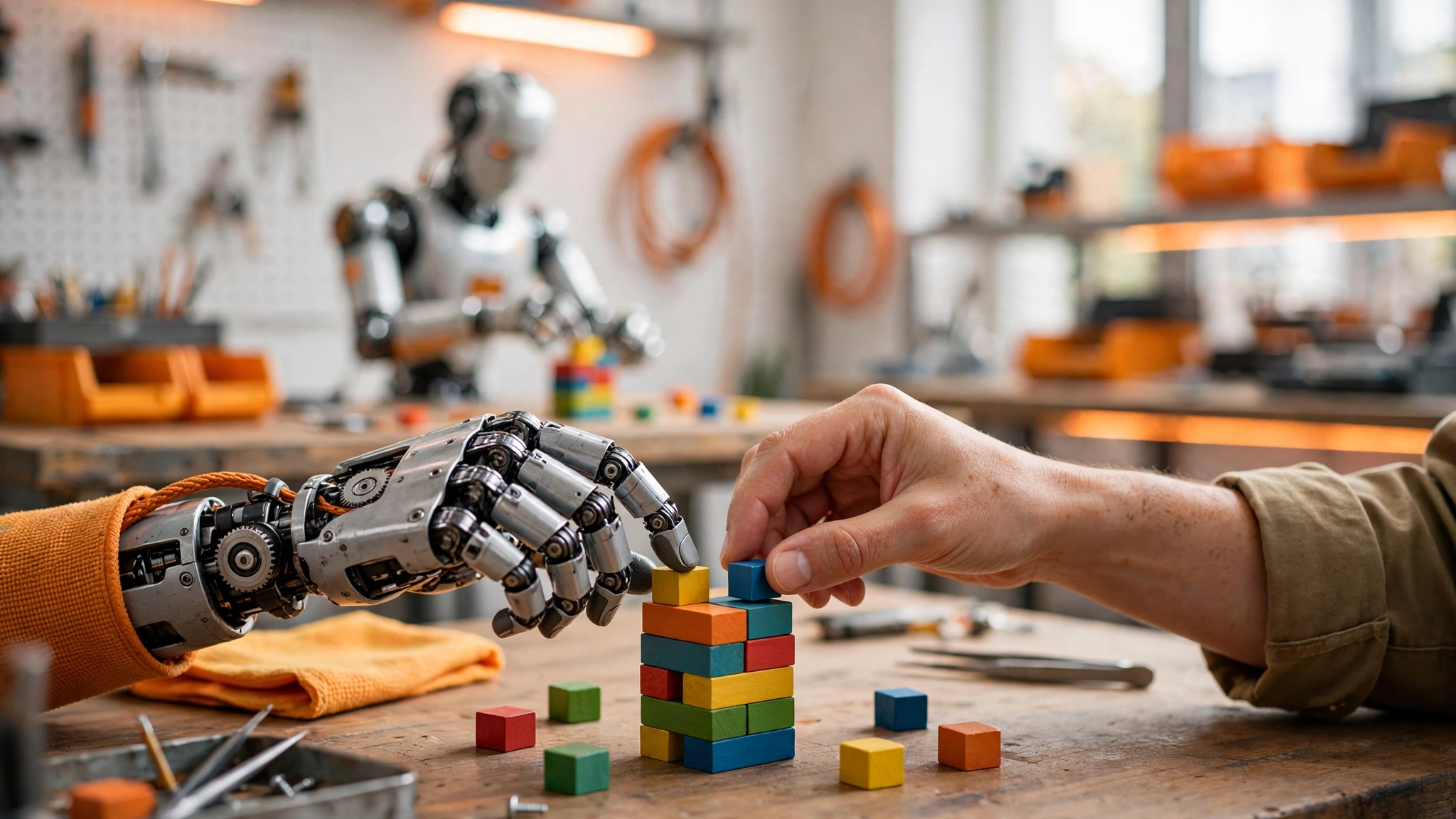
GO-3 also learns from human first-person videos as well as robot trajectories — useful because robot data is scarce while human video is plentiful. AGIBOT claims this gives zero-shot task transfer and few-shot adaptation, illustrated by a LEGO assembly example. Treat both as AGIBOT's claims.
Learning after training — and after deployment
Genie Evolver: the 100-robot fleet
Post-training is where GO-3 departs most clearly from a frozen model. Genie Evolver combines a fleet of 100 physical robots with physics simulation and world models, so learning happens in the real world and in simulation at once. Its Collective Experience Learning (CEL) shares experience across the fleet: what one robot learns, the fleet can use.
AGIBOT's demonstrations here include a tabletop-curling robot that, the company says, beat typical human players after only a few hours of practice, plus block extraction and throwing a ball into a moving basket. Read these as AGIBOT's demos, not verified capability: a narrow demo proves quick learning of one skill, not unsupervised shift work. Fast learning on a narrow, measurable task is still exactly how a pilot should be judged — see our guide to AI agents for small business automation in 2026.
Genie Master: improving on the job
Genie Master is AGIBOT's embodied agent framework for the post-deployment phase — the part of the lifecycle most models simply do not have. Its EEP standardises the interfaces for capabilities, guidance, feedback and continuity, so a deployed robot keeps a coherent thread of experience. Learning runs through two pathways: daily consolidation of operational experience into long-term memory, and turning execution experience into improved action policies.
The showcase is a Genie G2 robot in a real convenience store, which AGIBOT describes as improving autonomously — its term is "Physical RSI" — without a human in the loop. That is AGIBOT's description of its own demo, not an independent finding. But a robot that files each day's work into memory is a fundamentally different purchase from one that repeats its launch-day behaviour.
What this could mean for warehouses, retail and manufacturing
If full-lifecycle learning works outside AGIBOT's demos, the first winners are narrow, repetitive jobs: warehouse picking, sorting and tote handling; retail shelf checks and restocking in a single store format; manufacturing placement and inspection support where the task is stable but parts vary.
The honest version is short: none of this is a product you can buy and deploy at scale today. GO-3 Preview is a preview, and AGIBOT has promised full open-sourcing by end-2026 — a promise, not a delivery. What businesses should do now is prepare the ground: map the physical tasks that are repetitive, measurable and bottlenecked, and cost them. That is the same groundwork behind AI automation for logistics companies.
Demo versus deployable: what is still unproven
Three things separate GO-3 from a buying decision. First, the benchmark first-places are AGIBOT's own claims; until independent labs reproduce them, they are marketing as much as measurement. Second, the demos — curling, block extraction, the moving basket, the convenience store — are narrow, controlled tasks, and AGIBOT's own descriptions are the only public evidence so far. Third, the open-sourcing promised by end-2026 has not happened yet — and open weights and code are what let other teams test a model.
Yesterday's GDPx results showed no software agent clearing roughly 12% on frontier professional tasks — a different benchmark family, measuring office work rather than physical skill, so GO-3's claims neither confirm nor contradict it. The lesson: test every headline number on your own work.
How a business should pilot physical AI
Do not wait for humanoids, and do not buy on demo footage. Pilot like any agent: one narrow task, supervised, measured against a baseline you trust.
Step 1: Pick one task with a clear success test
Choose a job with a countable outcome — items picked correctly, shelves restocked on time, defects caught — and record the human baseline for a month before any robot arrives. If you cannot measure it, you cannot judge a pilot.
Step 2: Keep a human in the loop
Run supervised from day one: a human approves or corrects the robot's work, especially anything touching safety, customers or stock records. Corrections must feed back into the system — the whole point of GO-3's post-deployment phase.
Step 3: Expand only on evidence
Widen the task, hours or site only when the pilot beats the baseline on error rate and cost per completed job. Keep the human check longest where mistakes cost most. This staged rollout is how we deploy AI calling agents and restaurant ERP systems, and the same caution applies doubly with hardware.
What Coheser builds — and how it connects to physical AI
Coheser does not build humanoid robots. What we build is the layer GO-3-style systems will need around them: AI agents that plan, act and check their work, automation connecting those agents to your systems, chatbots and WhatsApp bots for customer-facing work, and voice agents covered in our AI voice calling agent guide. A robot that restocks a shelf still needs ordering and inventory systems automated.
The practical path runs digital first, physical second: automate the workflows around the physical task so that when embodied systems are genuinely deployable, they slot into an operation that already runs on data. Our teams in the United Kingdom, UAE, USA and Pakistan build this way. To scope a pilot, contact Coheser. For the source of GO-3's claims, see AGIBOT's PRNewswire release on GO-3 Preview.
Frequently asked questions
What is AGIBOT GO-3 Preview?
GO-3 Preview is an embodied foundation model unveiled by AGIBOT in Shanghai on 3 November 2026, built on WRAM and designed for "full-lifecycle scaling": learning across pre-training, post-training and post-deployment, not frozen at training time.
Did GO-3 really beat every other model on robotics benchmarks?
AGIBOT claims first place on RoboDojo, RoboTwin and RoboColiseum, but these are its own press-release claims, not independently verified. Treat them as claims to be tested, not settled results.
Can my business buy a GO-3 robot today?
Not as a proven, deployable product. GO-3 is a preview, and AGIBOT has promised full open-sourcing by end-2026. Map and measure a narrow physical task now, and pilot only when a system can be tested supervised against your baseline.