NVIDIA GR00T 2: Robots That Learn by Watching Humans Work

Amir Farid
7 min read
NVIDIA GR00T 2 is a robot model that learns new jobs by watching humans do them. Unveiled on 9 November 2026 at the Conference on Robot Learning (CoRL) in Austin, Texas, it is an open frontier world action model built on NVIDIA Cosmos. For warehouses, factories and retail backrooms, teaching a robot has always been the slowest part of putting one to work. If NVIDIA's claims hold up in real buildings, the training bottleneck shrinks from months of robot demonstrations to a handful of human ones.
What NVIDIA GR00T 2 actually is
GR00T 2 is a 2-billion-parameter transformer built on Cosmos-Predict2.5-2B, presented by Jim Fan, NVIDIA's director of robotics. It is what NVIDIA calls a world action model: it predicts future video frames and the robot's next actions together in one diffusion transformer, then executes them.
This sits in physical AI, a field Coheser has tracked all month — from AGIBOT's GO-3 embodied model to Agility Robotics' Nasdaq debut and Vaetki Vision 3B. NVIDIA's CoRL blog is the primary source for the details in this post.
How a robot learns by watching you
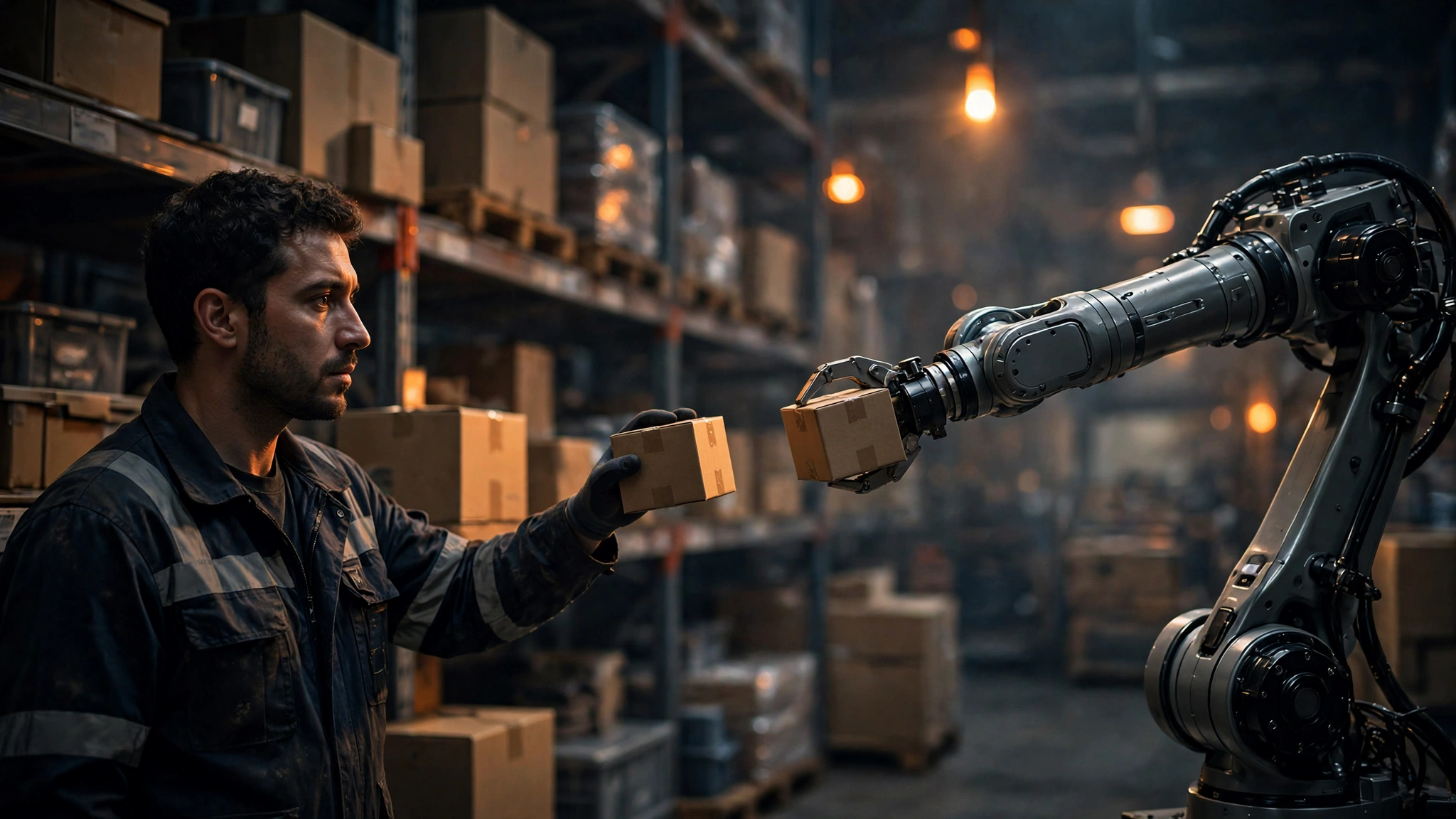
The idea at the centre of GR00T 2 is cross-adaptation, shortened to X-Adapt. Physical intuition transfers from human video to robots with zero robot action labels. It learns from footage of people doing the job.
Watch, imagine, then act
A worker demonstrates a task while a camera records it. The model studies the video, predicts the frames and actions that complete the task, and runs them on the robot. Our AI agents versus chatbots guide makes the same point: the value is in the action, not the answer.
Why zero robot action labels matter
Teaching a robot has usually meant teleoperation: an operator driving the robot through the job again and again. Human video is everywhere: warehouses already have cameras, and workers already know the job. If the robot can learn from that footage, the cost of adding a task collapses. That is the logic behind our AI agents and automation work: use knowledge you already have.
The training data behind GR00T 2
NVIDIA trained GR00T 2 on three piles of data. The largest is 402,730 hours of first-person human video. The second is 10,184 hours of handheld UMI gripper demonstrations across 2,897 tasks. The third is 23,500 hours of robot teleoperation.
The human video teaches physical intuition: how objects move and hands grip. The gripper demonstrations bridge the gap between human and robot hands. One checkpoint covers parallel-gripper arms, dexterous five-fingered hands and humanoids. NVIDIA is also releasing 100,000 hours of that human video as Human-1M-100K, under a CC BY 4.0 licence allowing commercial use, with video, language annotations and motion data.
What NVIDIA says it can do — read the numbers as vendor claims
Every figure here comes from NVIDIA, and none has been independently verified. Treat them as vendor claims: useful direction, not proof. Unite.AI's coverage summarises the same announcement.
NVIDIA reports 40% zero-shot success on 50 tasks absent from the target robot's training data One demonstration brings a reported 71% success; five plus 30 minutes of post-training on one RTX 5090 GPU bring 95%. NVIDIA also claims double the success of previous leading models on new tasks in unfamiliar environments, with top-three places across RoboCasa365, RoboLab, RoboDojo and MolmoSpaces.
The honest reading is narrower: 40% zero-shot means the robot still fails most brand-new tasks on first try. The figure that matters most is the shape of the curve: one demo gets you most of the way, five get you close to reliable. If that curve survives a real warehouse, training a robot starts to look like onboarding a new starter. See our GDPx benchmark coverage: no software agent clears roughly 12% yet.
GR00T 2 Turbo and Isaac Lab 3.0
NVIDIA also announced GR00T 2 Turbo, a lighter variant for faster execution on a humanoid. A smaller, faster model trades some capability for responsiveness.
The other half is Isaac Lab 3.0, generally available since 20 October 2026. It lets AI agents set up training environments with simulation-ready assets, switching between PhysX and Newton physics solvers. NVIDIA reports up to 2.5x the training throughput of Isaac Lab 2.3 with PhysX in a dexterous manipulation benchmark. NVIDIA and UC Berkeley also jointly announced "agentic robotics": treating robot control as a coding problem, with agents automating simulation setup and calibration. Our custom software cost guide for the UK applies the same budgeting discipline, with hardware on top.
Where businesses will see it first
Nobody has announced a production rollout; what exists so far is testing and evaluation. Nexuni is testing GR00T 2 for laundry handling. Foxconn is applying it to server-manufacturing automation. Siemens is evaluating industrial use cases. MicroAGI is using GR00T 2, post-trained with reinforcement learning, for Ethernet cable swapping with a YAM robotic arm.
As our coverage of physical AI in ecommerce returns and AI automation in logistics shows, the first real jobs are repetitive, structured and easy to measure. Nobody is handing a robot the keys to an unsupervised shift yet, and any vendor who suggests otherwise is selling ahead of the evidence.
What this means for warehouses, factories and retail backrooms
The business case is not "robots replace staff": it is "a robot learns a new task the way a new starter does". If five human demonstrations and half an hour of post-training genuinely produce a working skill, adding a task becomes a morning's work.
That changes three things. First, small and mid-sized operations can afford robot help without a robotics team retraining the machine for every product line. Second, seasonal change gets cheaper: teach the robot the new packing pattern by demonstration instead of booking engineering time. Third, knowledge stops walking out of the door when a worker retires — their demonstrations become training data.
It also changes what goes wrong. A robot trained from human video inherits human shortcuts, and five demos cover only five demos' worth of edge cases. Safety, supervision and a clear handover to a human stay non-negotiable. Our coverage of NVIDIA's NemoClaw governed agents and Claude Fable 5.2 shows guardrails coming first, capability second. Physical robots need that discipline even more, because their mistakes have weight.
What to do before December
GR00T 2 is open with a waiting room. NVIDIA promises the weights and the cross-adaptation recipe open in December 2026, with code available in December, but the licence terms for the weights have not been published yet. You cannot download the model today. December is the moment to evaluate, not the moment you are already late.
Pick one narrow, repetitive task and film it properly: fixed camera, consistent lighting, the same worker doing the job right several times. That footage stays useful either way. Price the hardware honestly, and decide who owns safety before a robot arrives, not after.
Then, when the weights land, pilot that one task beside your existing process and score it like a new hire: how often does it complete the job, and how long does retraining take when the task changes? If you want help scoping that pilot, talk to Coheser about an AI agent pilot, see our AI calling agent work, or contact us. Meta's Muse Ember shows how fast cheap agents are moving.
Frequently asked questions
What is NVIDIA GR00T 2?
An open frontier world action model unveiled on 9 November 2026 at CoRL, Austin, Texas. It is a 2-billion-parameter transformer built on NVIDIA Cosmos that predicts future video frames and a robot's next actions together.
Can I download GR00T 2 today?
No. NVIDIA promises the weights and cross-adaptation recipe open in December 2026, with code available then, but licence terms are unpublished. Treat December as the evaluation date, not a download date.
How many demonstrations does a robot need to learn a task?
NVIDIA reports 71% success from one robot demonstration and 95% after five demonstrations plus 30 minutes of post-training on one RTX 5090 GPU.
Which robots can GR00T 2 control?
One checkpoint covers parallel-gripper arms, dexterous five-fingered hands and humanoids; GR00T 2 Turbo is a lighter variant for faster execution on humanoids. No production rollout has been announced.
Is GR00T 2 useful for a small warehouse or factory?
Potentially: five human demonstrations can teach a new task, so smaller operations avoid the teleoperation bottleneck. Start with one narrow task, film it well, and pilot it before committing.