Vaetki Vision 3B: Lightweight Robot Vision for Real Factory Floors

Amir Farid
7 min read
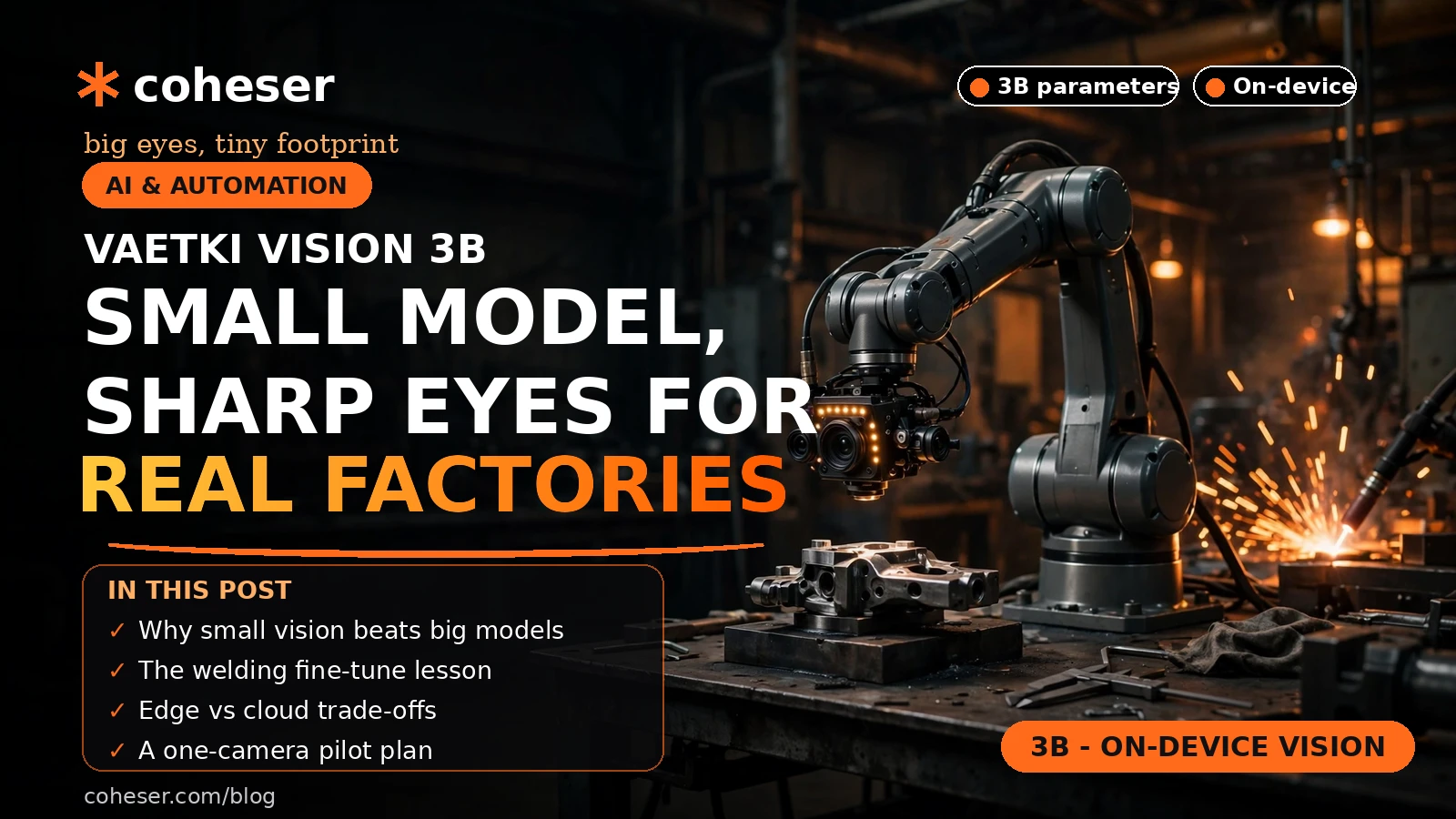
NC AI announced on 3 November 2026 an ultralight vision-language model, Vaetki Vision 3B, built to let robots and industrial machines see on-device rather than sending every frame to the cloud. At just 3 billion parameters, it installs directly on robots and on-site equipment with limited computing power, and NC AI positions it as core technology for vision-language-action models: systems that understand surroundings and object states, then act. For a factory or warehouse, the question is simple: can a small model on your own hardware see well enough to do one job reliably?
This guide covers what it is, what NC AI's numbers prove, where on-device vision pays, and how to pilot it on one camera and one task.
Vaetki Vision 3B: Lightweight Robot Vision for Real Factory Floors
What Vaetki Vision 3B is — and why small is the point
Most headline vision models are enormous, cloud-hosted systems. Vaetki Vision 3B is the opposite bet: a vision-language model (VLM) installed directly on the robot or machine, where computing power is limited and a network round trip is a liability.
It underpins vision-language-action (VLA) models, in which a robot understands its surroundings and object states well enough to act. If the seeing is slow, wrong or offline, nothing downstream can rescue it. Next, per NC AI: follow-up reinforcement learning, then deployment as a core vision engine and VLA model.
One distinction matters. This is not a large embodied foundation model that learns across its whole lifecycle; it is a small vision model that sees accurately on limited hardware, on site, in real time.
Why "lightweight" is a business feature
A model that runs on the machine changes who pays for what: no per-frame cloud bill, no dependence on factory Wi-Fi, and no video stream leaving your site. When you scope AI agent development for physical work, that often closes the business case. See also our guide to AI chatbots versus AI agents.
What NC AI's benchmark numbers actually say
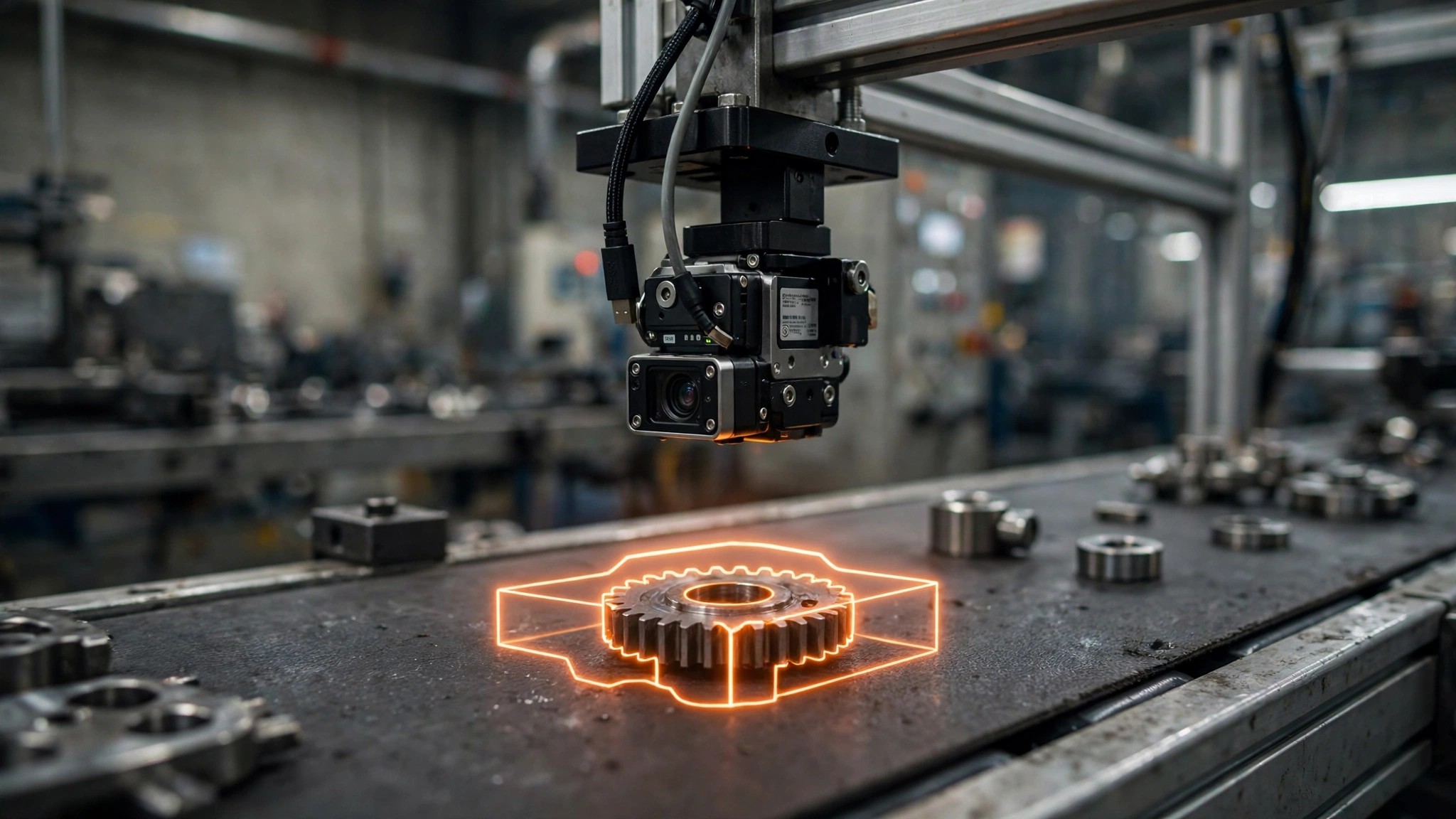
NC AI reports 63.8 across three benchmarks for robot and spatial understanding — BLINK, ERIQ and ERQA — company-reported figures, not independently verified results. The same caution applies to the headline comparison: in general response mode, answering immediately with no separate deep-reasoning step, NC AI says it outperformed major open models of 4 billion and 8 billion parameters, including Alibaba's Qwen and Mistral's Ministral.
Read generously, the claim suggests task-specific training can beat raw size. Read strictly, it proves nothing about your factory: benchmarks test spatial understanding in general, not your welds, lighting or parts. Pilot it on your own footage. See the ChosunBiz report.
How it watches video: 4 seconds, 8 frames, one moving picture
Still images are the easy half of factory vision. The hard half is movement: a robot arm, a weld bead forming, a box on a belt. NC AI says it analyses inter-frame relationships simultaneously in 4-second, 8-frame units, claiming a broader temporal range than similar models, to capture cues such as fine robot movements or a target's trajectory.
The welding variant: why fine-tuning numbers matter as a pattern
The most useful numbers are the fine-tuning results. NC AI produced Vaetki Vision 3B Weld by fine-tuning the base model on welding work:
| Welding task | Before | After |
|---|---|---|
| Welding classification | 41.1 | 80.9 |
| Defect detection and state inference | 39.3 | 69.8 |
| Position and shape recognition | 5.3 | 72.5 |
These are NC AI's own figures, and your mileage will differ. But the pattern generalises far beyond welding: a small base model, fine-tuned on your own task data, can jump from unusable to useful on exactly the job you care about, while keeping its general visual recognition intact, according to NC AI. Position and shape recognition going from 5.3 to 72.5 says it plainly.
The lesson: fine-tuning a 3-billion-parameter model on your own defect photos is feasible; fine-tuning a giant model is a research programme. The same discipline sits behind good custom software development, and our guide to AI agents for small business automation in 2026 makes the same argument for office work.
Where on-device vision pays on a real factory floor
Not every camera needs AI. The jobs where this vision earns its keep share one trait: a human currently watches or checks something repetitive.
Inspection and quality control
Visual inspection is the classic case: welds, surface defects, missing components, wrong labels, damaged packaging. A camera that flags suspects in real time catches problems before they travel downstream, where rework costs multiply. Even at the welding variant's reported 69.8 for defect detection, the model is a tireless first pass, not a replacement for final sign-off — pair it with human review.
Safety monitoring
Zones, barriers, protective equipment and proximity to moving machinery are all visible facts a camera can check continuously. On-device processing matters here most of all: a safety alert that waits on a cloud round trip, or dies with the Wi-Fi, is not a safety system.
Picking, sorting and maintenance
Warehouses run on recognising objects and their states: the right part, the right bin, the right orientation, the right count. Vision that understands object states supports picking arms and sorting lines; see how AI automation is already changing logistics companies. The same logic covers maintenance rounds: leaks, wear, corrosion and gauge readings are all visible, and routine camera checks create a dated record of equipment state, so deterioration is spotted as a trend.
Edge versus cloud: the trade-offs, honestly stated
On-device vision wins where latency, offline working, privacy or high volume matter: milliseconds on the machine, no dependence on connection, video staying on site, and hardware up front instead of per-frame fees. The cloud wins where the job needs a very large model's reasoning, or runs rarely. Most deployments end up hybrid: edge models flag in real time, and only interesting clips go to the cloud — the same architecture behind our AI automation work and our AI calling agent. On security generally, see our analysis of Gemini 4 Carbon for cybersecurity.
How to pilot it: one camera, one task, measured accuracy
Do not start with a site-wide rollout. Start with one camera, one task, and a defensible number.
- Pick a countable task: defects caught, mis-picks prevented, safety incursions flagged, or inspection minutes saved. "Better visibility" is not a pilot.
- Collect your own footage: two to four weeks of normal production, including bad days, labelled good, defective and borderline with today's operators.
- Fine-tune small, then measure: run the model alongside the existing process, report accuracy, false-positive rate and time saved, and expand only where the numbers hold — keeping a human check on safety sign-off and customer shipments until error rates are proven low.
NC AI's roadmap points the same way: reinforcement learning next, then deployment as a core vision engine in physical AI projects, with CEO Lee Yeon-su naming steelmaking, shipbuilding and defence as anchors. He stresses on-site physical AI needs a lightweight model that understands space accurately on limited hardware. When you are ready, our teams in the United Kingdom, UAE, USA, Pakistan and Saudi Arabia run the same staged approach — contact Coheser to scope yours, and see our case studies.
Frequently asked questions
What is Vaetki Vision 3B?
NC AI's ultralight vision-language model, announced on 3 November 2026, running directly on robots and industrial equipment with limited computing power, handling visual perception for vision-language-action systems.
How accurate is Vaetki Vision 3B?
NC AI reports 63.8 across BLINK, ERIQ and ERQA, and says it outperformed larger 4B and 8B open models in general response mode. These are company-reported claims, not independently verified — measure accuracy on your own footage first.
What is Vaetki Vision 3B Weld?
A variant fine-tuned for welding. NC AI reports classification rising 41.1 to 80.9, defect detection and state inference 39.3 to 69.8, and position and shape recognition 5.3 to 72.5, while keeping general visual recognition.
Should my factory use on-device vision or cloud vision?
Choose on-device for instant response, offline working, sensitive footage, or high-volume work. Choose cloud for a very large model's reasoning or central updates. Many sites end up hybrid: edge models flag in real time, and only interesting clips go to the cloud.
How should I start with robot vision?
Start with one camera and one countable task: collect a few weeks of footage, label it with your operators, fine-tune a small model, and measure accuracy, false positives and time saved before expanding.