Runway Praxis-1: A Free Robot Brain You Can Download Today

Amir Farid
7 min read
Runway Praxis-1 is a robot brain you can download today, for free, and fine-tune on your own machines. Released on 11 November 2026, it is a 27-billion-parameter mixture-of-experts diffusion transformer that predicts video and robot actions together, so a robot can imagine what happens next, then act. The weights are open under an Apache 2.0 licence, including for commercial use, so a warehouse, retailer or assembly business can adapt the model to its own tasks and run it on its own hardware. The honest version matters too: on its own benchmark, Praxis-1 still fails more than half the episodes it attempts.
What Runway Praxis-1 actually is
Praxis-1 is what Runway calls a "world action model". Most robot models either understand images or produce movements. Praxis-1 does both at once, predicting the next video frames and the next robot actions together. Runway says this helps it handle new objects and layouts, not just repeat trained movements. It has 27 billion parameters, about 3 billion active per token, so it runs on a single workstation GPU.
Three checkpoints, three starting points
Three checkpoints: a base model; one fine-tuned on the DROID dataset; one fine-tuned for the bimanual YAM robot. Inference and full and LoRA fine-tuning code are on GitHub and Hugging Face, with native LeRobot support, serving through vLLM-Omni, and hosted inference on Reactor.
Why open weights change the maths for a business
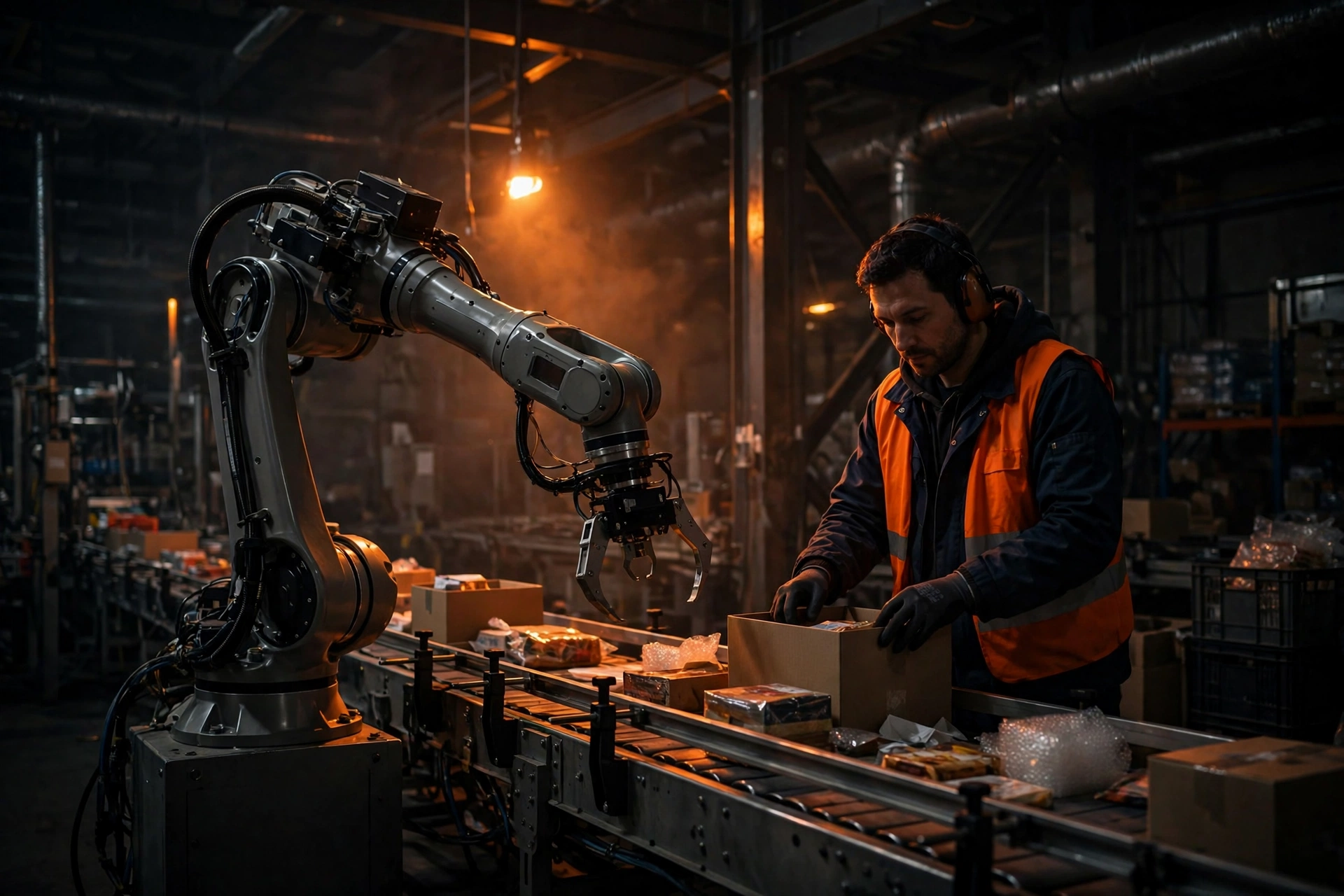
Until this week, the most capable robot models were closed, partner-only, or promised. Gemini Robotics 2.5 is partners-only; NVIDIA's GR00T 2 weights open in December 2026. Praxis-1 is the one you can download now. See our Gemini Robotics 2.5 guide and GR00T 2 guide.
Open weights also change the commercial picture: no per-robot licence fee, no lock-in, and no need to send warehouse video to a third party's cloud. But they remove the licence cost, not the hardware, integration and safety costs, which are usually larger. Businesses weighing AI automation for logistics should treat Praxis-1 as a component, not a finished product.
What it costs to run
The full model is 54.4 GB and fits on a single 80 GB GPU; a 4-bit NVFP4 version is 17.5 GB. Runway lists NVIDIA H100 and B200 cards, RTX 5090 and PRO 6000 workstations, and Jetson Thor on the robot.
A realistic budget for a first pilot
A first test needs one workstation with a high-end GPU, a robot arm, and engineering time for demonstrations. The model file costs nothing, and LoRA fine-tuning needs far less data and compute than training from scratch. But do not budget for the GPU alone: you also need cameras, a safe test cell, and someone to read its failures. Our custom software cost guide covers honest integration budgeting.
Where it could help: warehouses, retail and assembly
Praxis-1 is built for repetitive physical jobs: picking, placing, sorting, moving stock. A robot that works most of the time still needs a human nearby.
Warehouses and packing lines
Picking and packing is the most natural first use: an arm that handles varied box sizes is worth far more than a machine bolted to one product line, and Praxis-1's claim is that video prediction helps it cope with new objects. See our guide to physical AI for returns.
Retail backrooms and shop floors
In retail, the near-term work is backroom work: restocking shelves and moving deliveries. A robot that does the overnight restock is a real saving, but only if it puts the right product on the right shelf.
Small assembly and kitting
Small assembly, kitting parts or sorting them into trays, is another plausible early task: known parts, fixed workspace, visible failures. Note the pattern for a custom AI automation build: fixed workspace, known objects, short tasks.
What the benchmarks do and do not prove
Runway's headline figure is 46.2% success on RoboLab-120, NVIDIA's simulated benchmark: 120 tabletop tasks, 10 trials each, 1,200 episodes, of which Praxis-1 completed 555, ahead of FLUX 3 Action at 42.9%, Cosmos3 Nano at 36.8% and pi0.5 at 28.0%. On SimplerEnv, Runway reports an 80.0% average across four tasks. Runway's own figures, not independently verified: check Runway's Praxis-1 announcement.
Read it honestly: 46.2% means failing more than half the episodes, on simulated tabletop tasks. A simulation is a kind place to fail: perfect lighting, known objects, nothing bumping the table. A factory floor is none of those things. Praxis-1 is competitive with the best openly compared models: a reason to test it, not to buy robots.
What it still cannot do
Safety is not included in the download
An open model knows none of your site's safety rules: where staff walk, which shelves are fragile, what to do when a box splits open. Speed and force limits, emergency stops and keep-out zones are yours to enforce. Never let it move freely around people without those guards.
Ambiguous instructions still confuse it
"Put that over there" is normal human speech and a terrible robot instruction. Praxis-1 cannot resolve vague language on its own, so tasks need tight definitions: which object, which destination, what counts as done.
Long, multi-step jobs are the hardest test
A single pick-and-place is one thing; a ten-minute, twenty-step job is another: errors compound. Long-horizon tasks challenge every current robot model, and the recent GDPx benchmark showed no agent model clearing roughly 12% on them. Do not claim Praxis-1 solves that problem: Runway's release does not say so. See our GDPx AI agent benchmark guide.
Praxis-1 against GR00T 2, Gemini Robotics 2.5 and AGIBOT GO-3
| Model | What you can do today | Openness |
|---|---|---|
| Runway Praxis-1 | Download, fine-tune, run on your own GPU | Open weights, Apache 2.0 |
| NVIDIA GR00T 2 | Plan; weights open December 2026 | Promised, not yet released |
| Gemini Robotics 2.5 | Wait for a partner rollout | Closed, partners only |
| AGIBOT GO-3 | Watch the demos; open-sourcing promised end-2026 | Promised, not yet delivered |
Praxis-1 is the only one of the four a business can download and fine-tune today: a timing advantage as much as a technical one. GR00T 2 may be stronger in December, but neither it nor Gemini Robotics 2.5 helps a team testing this week. See our NVIDIA GR00T 2, Gemini Robotics 2.5, AGIBOT GO-3 and Agility Robotics posts.
How to try Praxis-1 safely in your business
Run a small, honest pilot, not a big launch. Pick one short, repetitive task with a clear definition of success, such as picking one product into a fixed box. Avoid people, fragile goods and long sequences.
Collect your own demonstrations
Record your own staff doing the task, from the robot's camera position, for LoRA fine-tuning. A model trained on someone else's warehouse will not know your shelf heights or lighting.
Measure failures, not just successes
Log every attempt with its outcome and reason for failure. Sort failures by cause, fix the biggest first, then fine-tune again. If the failure rate stops improving, that is a finding, not a defeat. The same discipline applies to software agents: see our governed AI agents guide. For help scoping a pilot, our team builds AI agents and automation for warehouses, retail and service businesses: talk to us. An independent second read is at AI Frontier Post's Praxis-1 coverage.
Frequently asked questions
Is Runway Praxis-1 really free to use for a business?
Yes: the weights are under an Apache 2.0 licence, including for commercial use, so there is no licence fee.
What hardware do I need to run Praxis-1?
The full model is 54.4 GB and fits on a single 80 GB GPU, such as an H100 or B200; a 4-bit version at 17.5 GB runs on RTX 5090 or PRO 6000 workstations and on Jetson Thor.
How good is Praxis-1, really?
On Runway's own figures: 46.2% on the simulated RoboLab-120 benchmark, 80.0% across four SimplerEnv tasks. Unverified, and 46.2% still means failing more than half the episodes.
How is Praxis-1 different from GR00T 2 or Gemini Robotics 2.5?
Availability: Praxis-1 is downloadable today, GR00T 2's weights are promised for December 2026, and Gemini Robotics 2.5 is partners-only. More on Coheser.
Should my business build on Praxis-1 now, or wait?
Start a small pilot now if you have a short, repetitive task and a safe place to test. Do not commit a production line or any task near people yet.