Restaurant ERP Software Cost in Saudi Arabia: A 2026 Breakdown

Amir Farid
7 min read
Restaurant ERP Software Cost in Saudi Arabia: A 2026 Breakdown
For a single-branch restaurant in Saudi Arabia, a cloud restaurant ERP typically costs roughly SAR 300 to SAR 900 a month in 2026, based on ranges we commonly see. A small chain of three to five branches usually lands around SAR 1,500 to SAR 5,000 a month, while a custom-built ERP typically starts around SAR 80,000 and can run well past SAR 250,000. Hardware, setup and training sit on top, and the real cost is the total over three years.
Every figure here is an estimate, not a vendor's list price. Below: what it includes, what pushes the price up, the hidden costs, and what to ask before signing.
What restaurant ERP costs in Saudi Arabia in 2026
These ranges are estimates from quotes we commonly see, excluding VAT at 15%.
- Single branch, cloud SaaS: roughly SAR 300 to SAR 900 a month for one branch.
- Small chain, 3 to 5 branches: roughly SAR 1,500 to SAR 5,000 a month, with multi-branch stock.
- Larger chain or franchise group: roughly SAR 5,000 to SAR 15,000 a month.
- Custom-built ERP: typically SAR 80,000 to SAR 250,000 or more, plus hosting and support.
A cheap-looking fee often covers one branch, one user and no integrations. Still deciding? Our restaurant ERP vs spreadsheets comparison and our guide to POS, KDS and delivery aggregator systems show where a simple till stops and a real ERP begins.
What a restaurant ERP actually includes
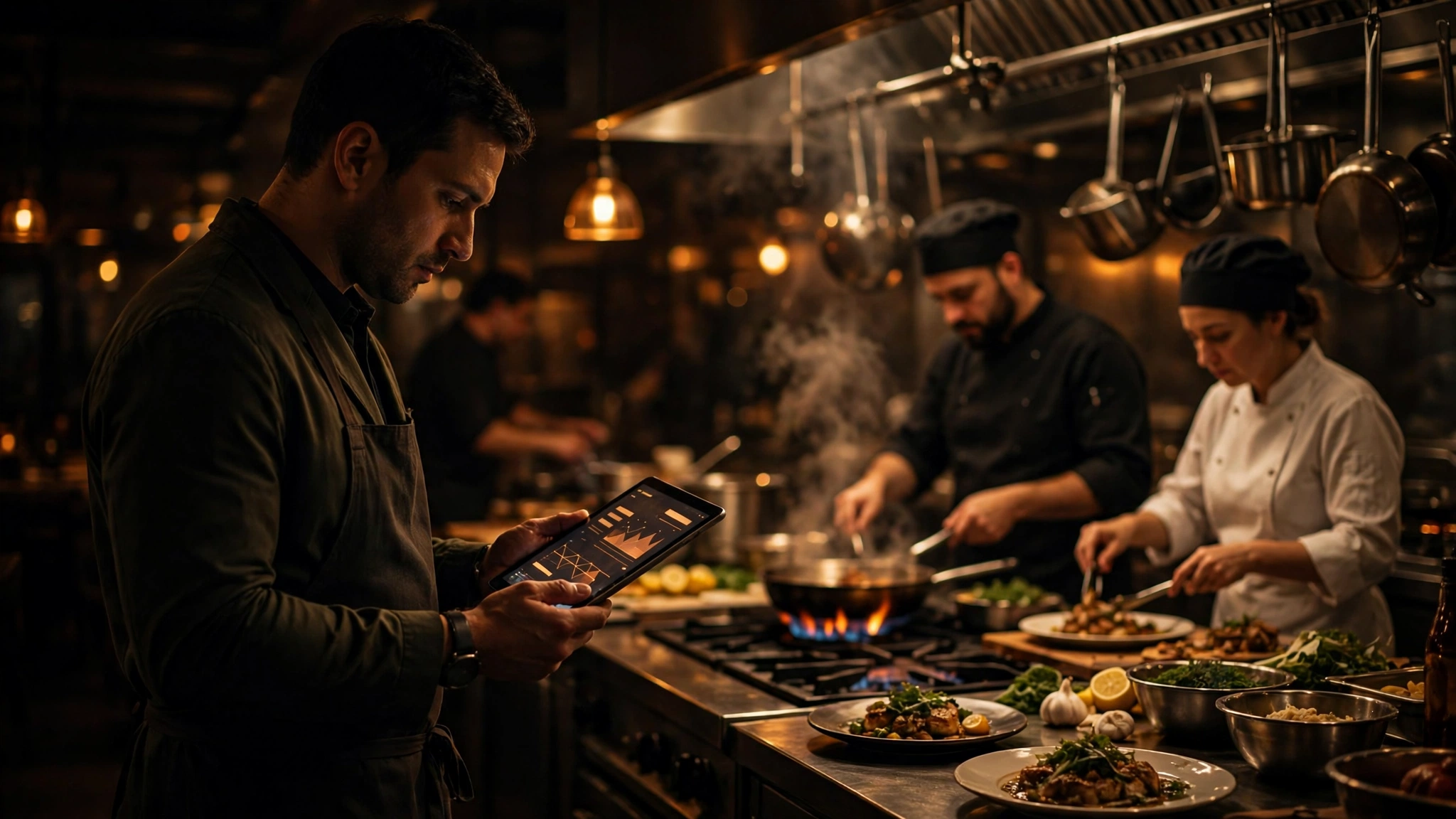
Restaurant ERP is connected modules sharing the same data. Different prices for the same-sounding product usually mean different module sets.
The core modules every system should have
A credible Saudi restaurant ERP should include point of sale, a kitchen display system, inventory with recipe and food costing, staff management, multi-branch management, accounting, and ZATCA-compliant e-invoicing. Delivery aggregators matter too: HungerStation, Jahez and Talabat drive a large share of orders. Arabic and English interfaces are a practical necessity, since kitchen and back-office staff will not all work in the same language.
What is usually an add-on, not included
Loyalty programmes, reservations, QR ordering, a customer app and analytics are commonly add-ons, as are extra branches, terminals and users. Ask for the quote in writing with every module named, and check whether WhatsApp ordering is supported before you sign.
What drives the price up or down
Branches, terminals and users
Most cloud ERP is priced per branch, terminal or user, sometimes all three. Count your terminals honestly, including delivery and takeaway. Growing chains should ask how the price changes at five branches and at ten. The same question applies to scaling software without rebuilding it.
Arabic support, ZATCA and local compliance
ZATCA e-invoicing is mandatory in Saudi Arabia. Phase 1 has applied since December 2021, and Phase 2, the integration phase, has rolled out in waves since January 2023, with businesses connecting to ZATCA's FATOORA platform. Any ERP you buy must handle compliant e-invoicing, including the QR code, in Arabic as well as English. Vendors treating Arabic as a premium add-on are not ready for the Saudi market. For a regional comparison, see our guide to FBR and PRA integrated restaurant POS in Pakistan.
Integrations and custom work
Every integration adds cost, as a monthly connector fee or a one-off build. Standard links with HungerStation, Jahez or Talabat may be included; a custom link to your accounting package almost certainly is not. The same logic applies to automation tools such as n8n, Make and Zapier: straightforward with an open API, expensive without one.
Cloud subscription vs on-premise licence
Cloud means a monthly fee and vendor hosting. On-premise means a larger upfront licence and you host it yourself.
| Factor | Cloud subscription | On-premise licence |
|---|---|---|
| Upfront cost | Low | High |
| Monthly cost | Predictable subscription | Low |
| ZATCA updates | Included | Often charged |
| Internet dependence | Needs offline mode | Runs on your network |
| New branches | Add a subscription | Buy more licences |
| Three-year total | Lower for small chains | Can win for large groups |
When cloud wins
Cloud is the right default for most Saudi restaurants in 2026: ZATCA updates, backups and new features without an IT team, and a new branch means adding a subscription. The one condition is offline mode. Check the POS works without a connection and syncs when it returns. See our mobile app development cost guide for the UAE.
When on-premise still makes sense
On-premise suits large, stable groups with their own servers and IT staff, or operations with strict data policies. Over five or more years with a fixed branch count it can be cheaper. The risk: ZATCA changes, patches and backups become your responsibility.
Off-the-shelf SaaS vs a custom-built ERP
Off-the-shelf SaaS already exists; custom-built ERP is made for your operation.
Buy off the shelf when your operation is standard
If you run dine-in, takeaway and delivery through the usual aggregators, an off-the-shelf system will cover you at a fraction of the cost of a build, and its ZATCA integration has already been tested by other restaurants. Before committing, read our UK custom software development cost guide.
Build custom when the software is your advantage
Custom makes sense when your operation genuinely does not fit a standard product: a central kitchen supplying dozens of branches, or a franchise model with royalty calculations. A custom build typically starts around SAR 80,000 and rises well past SAR 250,000 for multi-brand platforms, with ongoing support of roughly 15 to 20 percent of the build cost per year as an estimate. If you go this route, read our guides to hiring an AI development company in London and in Dubai.
The hidden costs nobody puts in the quote
The headline price is the beginning of the budget: as a rough estimate, these costs can add 30 to 50 percent to the first-year total.
- Data migration: moving menus, recipes and stock. Budget a few thousand riyals per branch.
- Staff training: a day per branch is reasonable, plus slower service while staff learn.
- Integrations: each non-standard connection can cost a few thousand riyals to build, plus a monthly fee.
- Support renewals: premium support is usually charged separately after year one.
- Hardware replacement: terminals and printers wear out. Budget for replacements from year two.
Budget for the first year, not the first month
Compare vendors on a first-year total: twelve months of subscription, plus setup, migration, training and hardware, plus 15 percent VAT. Our WhatsApp chatbot cost guide and AI calling agent cost guide use the same method, and our guide to building an AI voice agent shows how phone automation cuts order-taking costs.
What to ask a vendor before you sign
Take this checklist into every demo.
- Is ZATCA e-invoicing included and tested with Saudi restaurants?
- Does it work fully in Arabic and English, including kitchen screens?
- Which delivery aggregators are integrated, and what does each cost?
- What is included per branch and terminal, and what triggers extra charges?
- Does the POS work offline, and what happens to orders then?
- What does support cost after year one?
- Can we export our data if we leave?
- Is there an open API for our accounting system?
Coheser builds restaurant ERP, including its eRestaurant product. Book a free consultation and bring your quotes: we will tell you honestly whether off-the-shelf, custom, or a mix of the two fits your budget.
Frequently asked questions
How much does restaurant ERP cost in Saudi Arabia?
Rough estimate: a single branch, around SAR 300 to SAR 900 a month; a small chain, around SAR 1,500 to SAR 5,000 a month; a custom build, from around SAR 80,000 one-off. Add hardware, setup, training and 15 percent VAT.
Is ZATCA e-invoicing included in restaurant ERP?
It should be, but not every system includes it in the base price. ZATCA e-invoicing is mandatory, with Phase 2 integration rolling out in waves since January 2023. Ask the vendor to confirm it is live and included.
Should a small restaurant buy ERP or just use a POS?
A POS alone is enough with one branch, a short menu and no delivery aggregators. Once you need recipe costing or multi-branch stock control, an ERP pays for itself in saved manual work.
Is custom-built restaurant ERP worth it?
For most restaurants, no. Off-the-shelf SaaS covers standard operations at a far lower cost. Custom is worth it when your operation is genuinely unusual, such as a central kitchen supplying many branches. Our Flutter vs React Native comparison shows how Coheser approaches custom builds.