Mobile App Development Cost in the UAE: A 2026 Breakdown for Founders

Amir Farid
7 min read

Mobile App Development Cost in the UAE: A 2026 Breakdown for Founders
Quick answer: As a labelled estimate, a straightforward mobile app in the UAE — a booking app, a loyalty app, a company catalogue app — typically costs AED 40,000–80,000 to build in 2026. A mid-size app with accounts, payments, maps and a custom backend usually lands between AED 80,000 and AED 200,000 (roughly $21,800–$54,500, since the dirham is pegged to the US dollar). Complex platforms — marketplaces, ride-hailing, fintech — typically run AED 200,000 to AED 500,000+. These are market ranges we see across agency quotes, not fixed prices: scope, team location and integrations decide where you land.
The UAE is an expensive market to build in, and one of the best markets to launch in. Statista projects the UAE's mobile internet usage penetration at around 96% by 2025, and DataReportal puts the country's internet penetration at 99% — your customers are already on their phones. Below: what an app costs in the Emirates in 2026, where the money goes, and how to spend less without shipping a dud.
What a mobile app costs in the UAE in 2026: the ranges
The ranges below reflect typical UAE agency and studio quotes in 2025–26.
Simple apps: AED 40k–80k
One core workflow: a booking form, a loyalty card, a company profile app with push notifications, a basic community or content app. Static content, a simple backend, payments via a ready-made gateway. A small team builds this in 6–10 weeks, usually with Flutter app development or React Native so one codebase covers both stores.
Mid-size apps: AED 80k–200k
The most common tier: user accounts and roles, in-app payments, maps, chat, and a real admin panel. Think delivery apps, service marketplaces, clinic booking apps — see our chauffeur booking solution and forklift rental booking platform for the shape of this. This is also where most SaaS products start life — our SaaS MVP cost guide covers the comparable numbers.
Complex platforms: AED 200k–500k+
Multi-sided marketplaces, on-demand apps with live tracking, fintech or health apps with compliance work. Our LivoRide ride-hailing app sits in this territory — our guide to the cost of building a ride-hailing app like inDrive shows how rider-side, driver-side and dispatch systems multiply the work. Timeline: 6–12 months with a dedicated team.
Where the money goes in a UAE app build
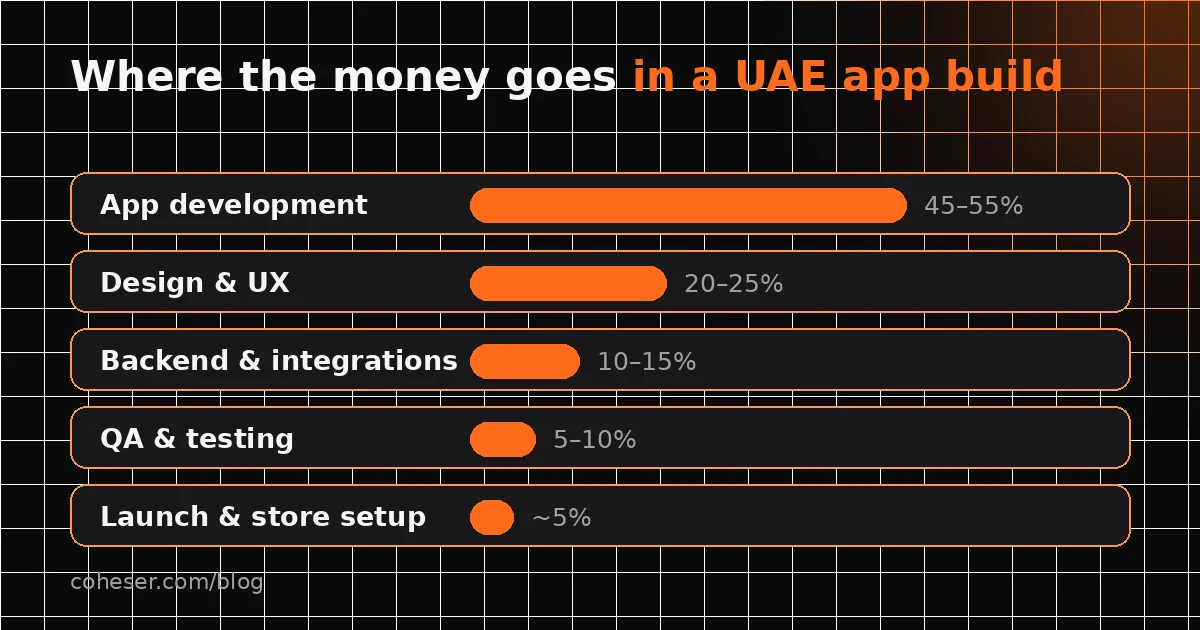
Founders tend to think "development" is the whole bill. In our experience it is roughly half — the rest decides whether the app works in the real world.
Design and UX: roughly 20–25%
UAE users expect a polished, bilingual experience — Arabic RTL layouts add real design hours. Proper UI/UX design — research, wireframes, a clickable prototype — is what separates apps that get kept from apps deleted after one use.
Development, backend and QA: roughly 60–75% combined
App code is the biggest line, followed by the backend — APIs, admin panel, database, integrations — then QA across real devices. Android leads mobile web traffic in the UAE, but iOS share is high among paying customers, so test both properly. Projects with custom CRM or ERP integrations push the backend share up fast.
The factors that move the price most
Two apps can look identical in screenshots and cost five times apart. Here is what actually moves the number.
Platform choice: native vs cross-platform
Native (Swift + Kotlin) means two codebases and roughly 30–50% more build cost than a cross-platform approach. For most business apps, Flutter or React Native is the sensible default — go native only for deep hardware access like AR or heavy Bluetooth.
Payments, integrations and compliance
UAE customers pay with cards, Apple Pay and local wallets. Integrating gateways such as Telr, PayTabs, Network International or Stripe's UAE offering takes days once you add 3D Secure, saved cards and refunds — each extra integration is its own line item. And the UAE's Federal Decree-Law No. 45 of 2021 on Personal Data Protection sets real rules on user data, with regulated sectors adding more. If a vendor quotes a fintech app with zero compliance line, be suspicious.
UAE agency vs remote team: what you actually pay
UAE-based agency
Dubai and Abu Dhabi agencies charge premium rates — you pay for timezone alignment, in-person workshops, Arabic capability and accountability you can drive to.
Remote or nearshore team
Offshore and nearshore teams typically quote 30–50% less than a UAE agency for the same scope. The trade-off is management overhead: clear specifications, regular demos and strong ownership on your side. Our custom software development cost guide compares onshore and offshore day rates in detail — the same maths applies here. Many founders split the difference: strategy and design close to home, development with a trusted remote team — see how we work with UAE clients; the same cost dynamics apply for our Saudi Arabia clients.
The hidden costs founders forget
The build quote is not the total cost of the app.
Store fees, hosting and maintenance
Apple charges $99 per year for a developer account; Google charges a one-time $25 fee — real public fees, not estimates. Backend hosting, databases, push-notification services and map APIs recur monthly and grow with users. Plan for maintenance too: roughly 15–20% of build cost per year in updates and OS compatibility fixes.
Launch and marketing
Nobody finds an app by accident. App store optimisation, launch creative, paid acquisition and influencer seeding in the UAE are competitive and priced accordingly. We have seen founders spend AED 200,000 on a beautiful app and zero on getting downloads. Budget at least a quarter of your build cost for launch marketing.
How to spend less without wrecking the product
Cutting cost is fine — cutting the wrong things is expensive.
Start with a real MVP
Ship one core journey that proves people want the app, then add features based on real usage. Most "phase two" features never get used. A disciplined MVP can land at the bottom of the simple-app band — and validates the business before you spend big.
Lock the scope before you sign
Vague requirements are where budgets go to die. A fixed-scope contract — screens, user flows, integrations, acceptance criteria — protects both sides, and that discipline should extend to the custom software development on the backend. Also consider where AI agents in the UAE — like our real estate lead follow-up agents — could replace manual workflows instead of more screens.
Frequently asked questions
How much does a simple mobile app cost in the UAE in 2026?
As an estimate, expect AED 40,000–80,000 for a simple app — one core workflow, standard design, minimal backend — built with a cross-platform framework. A UAE-based agency will typically quote the upper half of that band.
Is it cheaper to build the app outside the UAE?
Usually, yes — remote or nearshore teams typically quote 30–50% less than a Dubai or Abu Dhabi agency for the same scope. Insist on a fixed scope, weekly demos and a single accountable point of contact.
How long does it take to build a mobile app in the UAE?
A simple app takes 6–10 weeks, a mid-size app 3–6 months, and a complex platform 6–12 months — assuming the scope is locked. The biggest schedule killer is changing requirements mid-build.
What are the ongoing costs after launch?
Budget roughly 15–20% of the build cost per year for maintenance, plus recurring hosting, push-notification and map API costs that scale with users, and the $99/year Apple and $25 one-time Google store fees.
Should I build native or cross-platform for the UAE market?
For most business apps, cross-platform (Flutter or React Native) is the right call: one codebase for iOS and Android at roughly 30–50% less build cost. Go native only for deep hardware features or maximum performance in gaming and media apps.
Get a realistic number for your app
Tell us what you are building — even a rough sketch — and we will give you an honest, fixed-scope estimate with no obligation. Request a free quote and consultation, and we will tell you what it should cost, what it should not include, and where the traps are.