n8n Nod: A Local, Open-Source Personal AI Agent for Your Business

Amir Farid
7 min read
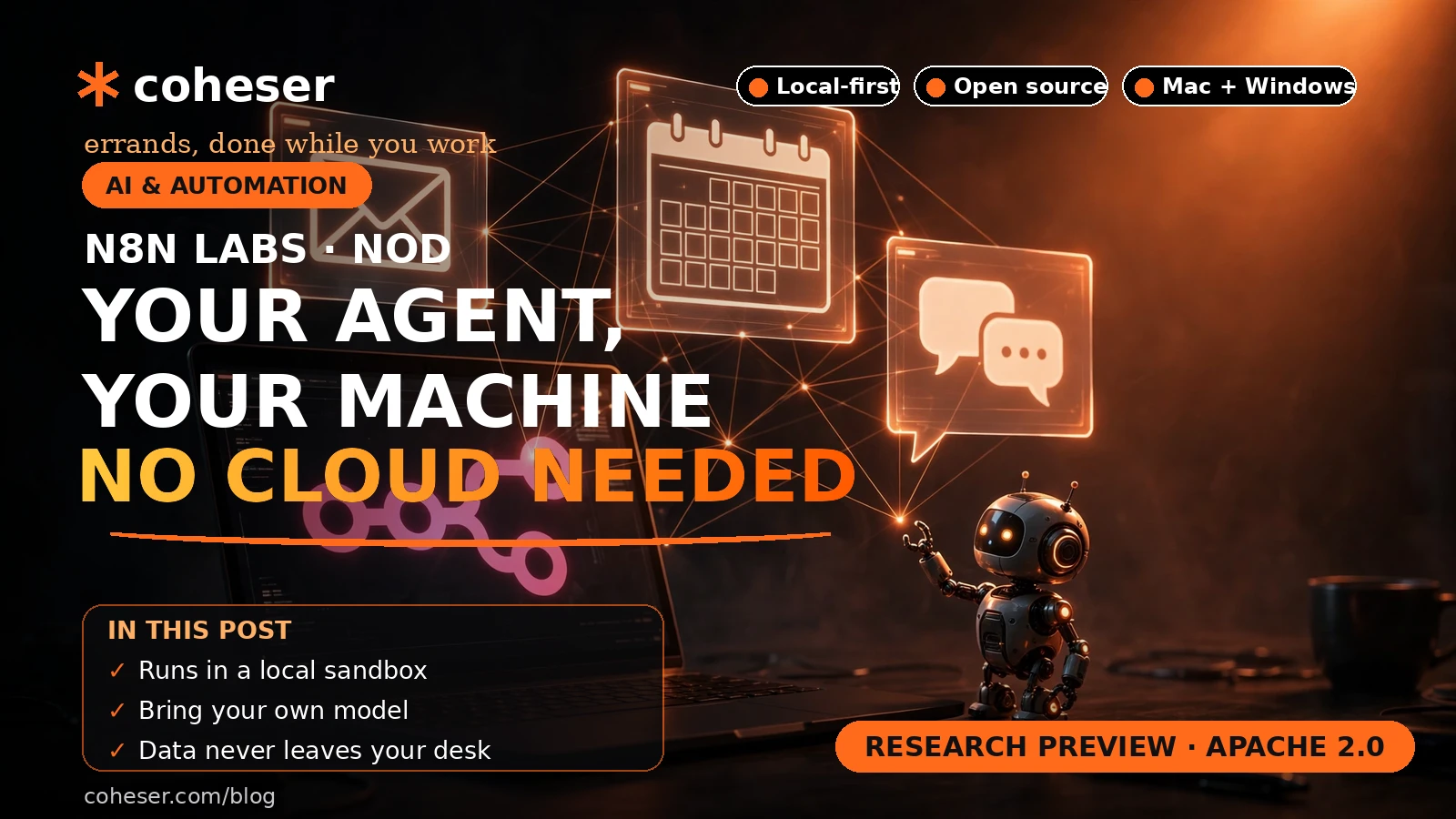
On 10 November 2026, n8n Labs released Nod, a standalone desktop personal AI agent, as a research preview. In n8n's own words, it is a personal agent with its own computer and browser: it runs in a private local virtual machine on your computer, so it can finish jobs on websites with no API. It is free and open source under Apache 2.0; you pay only your model provider.
Nod is not a replacement for n8n workflows, nor the n8n AI Agent node inside workflows: Nod is a personal agent for one person's errands, while n8n workflows are team automation that runs around the clock. This post explains what Nod does, what n8n claims, and when a business still needs hosted workflows.
What Nod actually is
Nod gives an AI agent its own computer. You hand it a job and it works inside a private local sandbox on your machine, using its own browser to click through websites like a person. The key difference: Nod is not limited to tools and APIs, so it can still use a website that has none.
It works across the apps a small business already lives in, including Gmail, Calendar, Drive and Slack, and it is built for personal errands: chasing an unpaid invoice, checking a competitor's price, or cancelling a forgotten subscription. For the wider picture, see our guide to AI agents for small business automation.
How Nod works: your model, your machine

Nod runs on macOS 14 or later (Apple silicon or Intel), Windows 11 in preview, or a server you host yourself for one person, with no n8n account needed. Setup takes about 10 minutes in five stages.
Memory, logs and saved credentials live on your machine, saved logins and cards are encrypted locally, and sensitive actions are gated. When a sign-in needs a human, Nod hands its embedded browser back to you.
Bring your own model
You bring your own model in one of three ways: an API key, a ChatGPT Plus or Pro plan, or a local open-source model, from OpenAI, Anthropic, Gemini, OpenRouter, Bedrock, Vertex AI or Azure. Nod itself is free, so your only cost is whatever your model provider charges. See the official Nod download page for the current platform options; the source is on GitHub under Apache 2.0. For high-volume errands, our Gemini 4 Hydrogen coverage explains the fast, low-cost end of the market.
Nod vs n8n workflows: personal errands vs team automation
Nod and n8n workflows are two tools from the same company, built for two different jobs. n8n is a workflow platform: you build a workflow once and it runs on a server, on a schedule, overnight. Nod is a personal agent on one person's computer.
- Nod: one owner, one machine, jobs on demand, stopping when the laptop sleeps. It works on websites with no API because it has its own browser.
- n8n workflows: team automation, always on, triggered by events and schedules, running while you sleep.
- The n8n AI Agent node: an agent step inside a workflow, not a standalone app. It gives a workflow an agent's judgement; Nod gives a person an agent's hands.
Our n8n vs Make vs Zapier comparison lays out where n8n sits, and our chatbot vs AI agent guide explains the difference between a bot that answers and an agent that acts.
What the 98% benchmark claim really means
n8n reports that Nod completed 98% of errands in its own benchmark, run on 17 October 2026 with GPT-6.1 Sol: 226 distinct errands, each attempted three times, for 678 runs in total, on synthetic accounts. That is n8n's claim, not independently verified fact.
A synthetic benchmark is a controlled test, not proof that Nod will finish 98% of jobs on live websites, with real logins and real payment flows. The number signals Nod is capable at routine errands, but the honest test is your own: give it one of your real jobs and check the result before you trust it with anything that touches money. Our GDPx agent benchmark coverage shows the same caution applies everywhere: even the best models clear only a fraction of long-horizon tasks.
Five business jobs Nod can take on
Nod earns its keep on errands too irregular to automate and too boring to do by hand:
- Chasing unpaid invoices: give Nod the invoice, the customer's details and your usual tone, and it can check whether payment has landed, then draft and send the follow-up.
- Monitoring competitor prices: Nod can visit a competitor's website, note the price, and report back, even with no price API to call.
- Cancelling subscriptions: Nod can log into an account and work through the cancellation flow, handing the browser back to you when a step needs a human.
- Preparing for meetings: before a call, Nod can pull emails, calendar entries and documents into a short brief: who the other person is, what was agreed, and what is still open. Our AI receptionist guide covers handling inbound calls and bookings while you are busy.
- Triaging the inbox: given Gmail and Calendar access, Nod can sort the morning's emails, flag the ones that need a reply, and draft responses for you to approve, like the e-commerce agents handling routine customer work and the AI automation in logistics keeping deliveries moving.
The limits: when a business still needs hosted n8n workflows
Nod has real limits. It stops when the laptop sleeps, so nothing runs overnight, and it has one owner per installation, so it cannot be the shared automation for a team. The hosted, always-on version is on the roadmap, not available now.
If a process has to run while nobody is watching, it belongs in a hosted n8n workflow, not in Nod. Order confirmations, lead follow-up, payment reminders and stock alerts need a server that never sleeps. That is what our AI agents and automation development service builds: hosted systems that keep working when the office is empty. Our guide to building an AI voice agent shows the same split.
Getting started in about 10 minutes
Download Nod, connect your model, and give it one small job. Start with something low risk, such as a price check, and watch it work before you hand it anything that touches money.
Use a model you already pay for, and keep the first week's jobs visible: read the logs and check the results before letting Nod run unsupervised. If you want help deciding which jobs belong in Nod and which belong in hosted workflows, our RAG chatbot guide explains how to ground an agent in your own documents, and our custom software development cost guide covers the system around the agent.
Nod is a small, honest step in the direction AI agents are heading: from chat windows into real work, on your own machine, at a price you control. It will not run your business for you, but for the errands that steal an hour a day, it is worth a try. Give it a real job this week, and if you want help building the hosted workflows it cannot replace, talk to Coheser.
Frequently asked questions
What is n8n Nod?
A standalone desktop personal AI agent from n8n Labs, released as a research preview on 10 November 2026. It runs in a private local virtual machine on your computer with its own browser, so it can finish jobs on websites with no API. It is free and open source under Apache 2.0.
Does Nod replace n8n workflows?
No. Nod is a personal agent for one person's on-demand errands, and it stops when the laptop sleeps. n8n workflows are team automation that runs on a server around the clock.
How much does Nod cost?
Nod itself is free and open source. You pay only your model provider, using an API key, a ChatGPT Plus or Pro plan, or a local model.
Is my data safe with Nod?
Memory, logs and saved credentials stay on your machine, saved logins and cards are encrypted locally, and sensitive actions are gated. When a sign-in needs a human, Nod hands its browser back to you.
What is the 98% benchmark claim?
It is n8n's own benchmark, run on 17 October 2026 with GPT-6.1 Sol on synthetic accounts: 226 errands attempted three times each, 678 runs, 98% completed. It is n8n's claim, not independently verified, and not proof of performance on live websites.