Meta Muse Voice: Real-Time Voice AI With a Face — What It Means for Business

Amir Farid
7 min read
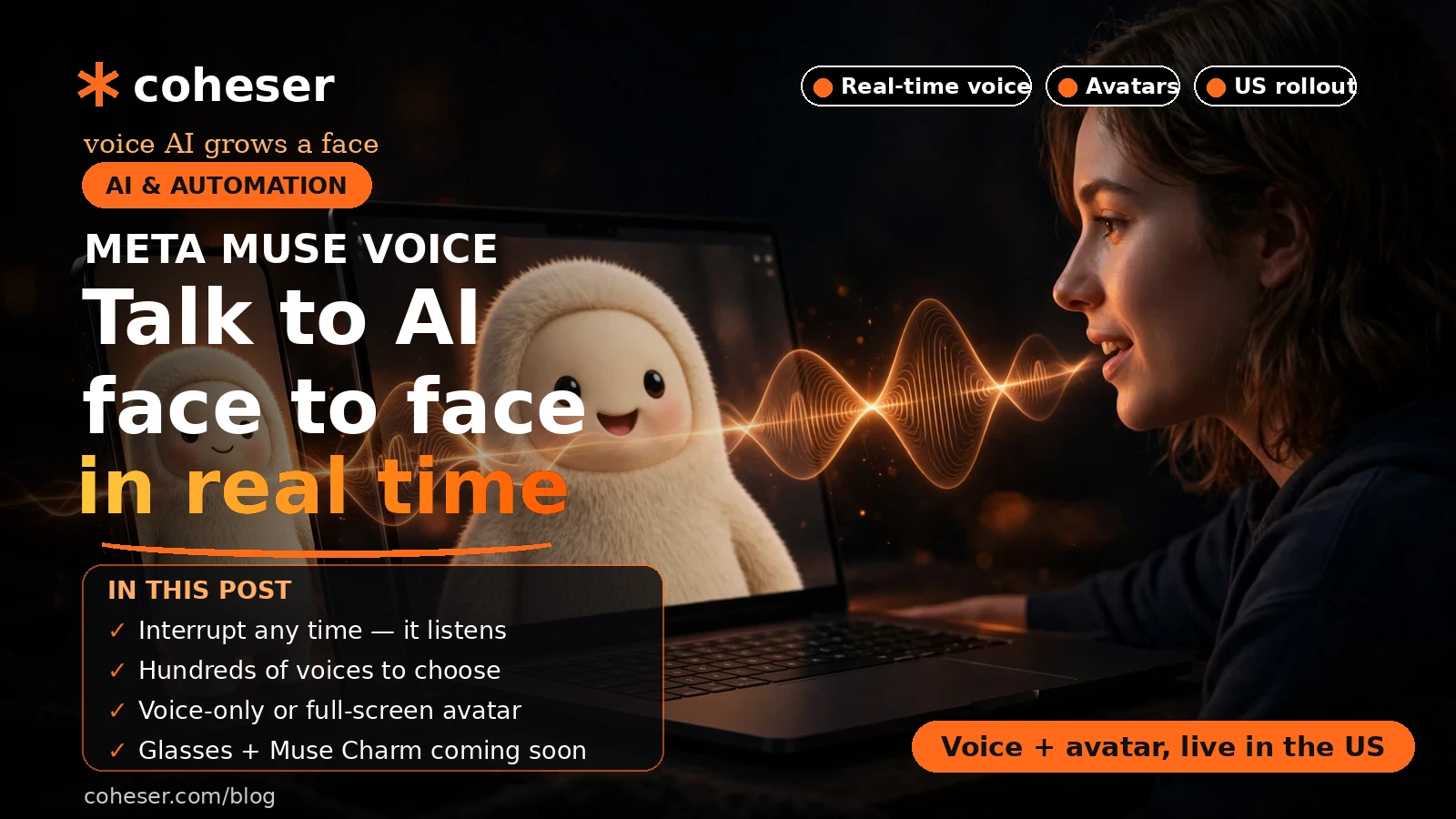
Meta Muse Voice is Meta's new real-time voice mode for Muse, announced on 5 November 2026 and rolling out in the Muse app in the United States on mobile, web and Mac. You speak, it answers straight away, and you can interrupt it mid-answer. If you want, it can answer with a face: an expressive avatar that reacts with expressions and gestures matching the tone of the conversation. It is US-only for now, with no date given for a rollout elsewhere. But the direction is clear: voice is becoming how people expect to talk to AI.
What Meta actually announced on 5 November
Meta announced Muse Realtime Voice and Muse Realtime Avatar: immediate spoken responses you can interrupt, plus an expressive avatar that reacts with expressions and gestures matching the tone of the conversation. There are three views: voice-only, the avatar beside the conversation, or full-screen face-to-face. Users can choose from hundreds of voices, and the default avatar character is nicknamed "Jolly", with customisation available. See Unite.AI's report on the launch.
The launch follows a preview at Meta Connect on 23 September 2026. Muse itself launched on 8 September 2026 in the US, free with a usage limit; paid plans buy more app-wide usage. Voice on AI Glasses and the Muse Charm pocket device is "coming soon". No dates have been given for a rollout outside the US.
How Realtime Voice and the avatar work

Realtime Voice is built for conversation, not dictation. You speak in full sentences, it replies in speech, and if it starts down the wrong track you can cut in. Interruptibility is the most important design choice here.
The research behind the face
Meta AI Research described the underlying system in September 2026: one streaming system producing 448×768 portrait video at 25 frames per second, with about 870 milliseconds from the end of the user's turn to the first byte of synchronised voice-and-video. Generated avatar video also carries an invisible Meta Video Seal watermark. Those numbers describe a research system, not a guarantee of the consumer app experience — real-world latency depends on the device, the connection and Meta's servers, and Meta has not published consumer-app figures. Sub-second response is still the target.
Why a face changes the conversation
A face builds trust faster than a voice alone — people read expressions without thinking. When an avatar reacts in tune with the conversation, the interaction feels warmer and customers explain their problem properly. Avatars will spread quickly in support, sales and onboarding once the technology reaches business tools.
But a face also raises expectations. A voice-only assistant that pauses is forgiven; a face that freezes mid-expression or smiles at bad news feels wrong in a way a text chatbot never does. Test a face in real conversations, not just in a demo.
Be honest about what the face can promise
An avatar that looks like a person invites customers to assume it can bend a rule or approve a refund. If it cannot, say so early and plainly.
What this means for business voice agents
Muse Voice previews what customers will soon expect from every voice interaction — including yours.
AI receptionists
An AI receptionist is the most obvious fit: callers want to say what they need and be guided like a good receptionist would, not listen to a menu. Real-time voice makes that possible, and a face on a website or kiosk makes the greeting feel like a welcome.
Customer support
In support, a customer explaining a fault should not have to finish a long sentence before the agent can ask the one clarifying question that matters. Voice agents that listen, interrupt politely and confirm understanding resolve calls faster. Good transcription and retrieval matter too: the agent needs the right facts before it speaks — see our guides to RAG chatbots for business and Nvidia's Nemotron Transcribe for business voice.
Sales calls and follow-ups
For sales, a voice agent can qualify a lead, answer common questions and book a call with a human — work that eats hours of a sales team's week; our guide to AI calling agent costs in 2026 sets out what that costs. Muse Voice adds the expectation that the agent will sound natural and respond quickly — and, soon, have a face on video calls. A robotic-sounding sales agent feels like a business that does not care.
The lessons to copy now
You cannot copy Muse Voice itself — it is not available in your market yet — but you can copy its four design lessons.
- Interruptibility first. If your voice agent cannot be interrupted, it is a voicemail system with better manners — the lesson of full-duplex voice, covered in our guides to Block's Dessa and Phonic-1.
- Sub-second latency is the target. Aim for a reply that starts in under a second — every extra second of silence makes the caller wonder whether the call has dropped.
- Voice is brand. Choose the voice, pace and phrasing deliberately, and keep them consistent across phone, WhatsApp and web.
- A face is a promise. Do not add an avatar until the voice underneath is reliable — a face on a confused agent makes the confusion more visible, not less.
What to build now while you wait
Build the voice agent your customers need today, in a way that can gain a face later without being rebuilt: start with the conversation, not the avatar. Map your ten most common calls and handle those ten well, with a clean handover to a human for everything else. Our guide to how to build an AI voice agent walks through that scoping, and our guide to AI agents for small business automation shows where voice fits beside chat.
Then prepare the foundations an avatar will need: a consistent brand voice, approved answers to the questions customers actually ask, and a clear escalation path. A clinic needs different guardrails from a restaurant — see our guide to AI chatbots for clinics — and a retailer needs its stock and delivery answers straight first, as in our guide to WhatsApp commerce for retailers. Logistics companies automating dispatch face the same sequence: get the data right, then add the voice. If you want help scoping that build, talk to Coheser about a voice agent pilot or start from Coheser.
What not to do
Do not plan your business around Muse Voice itself. It is US-only, with no announced date for the UK, the Gulf or Pakistan, and voice on AI Glasses and the Muse Charm device is still "coming soon". A roadmap that depends on Meta's timetable is not a roadmap. Do not promise customers a voice avatar next month.
Do not chase the face at the expense of the conversation: the research figures describe a research system, and your customers will judge you on your own calls, not Meta's demo. Capability keeps improving, as our guide to Cognition's SWE-2 Flash coding agents shows — but the businesses that win ship something reliable. Meta has shown where voice AI is heading: immediate, interruptible, with a face. Build the voice agent that meets that standard now; the face can follow.
Frequently asked questions
What is Meta Muse Voice?
Meta's real-time voice mode for Muse, announced 5 November 2026: immediate spoken responses you can interrupt, plus an optional avatar that reacts to the tone of the conversation.
Is Muse Voice available in the UK, UAE, Saudi Arabia or Pakistan?
No — US only, on mobile, web and Mac, with no dates for a rollout elsewhere. Voice on AI Glasses and the Muse Charm device is "coming soon".
What is the Muse avatar called, and can I change it?
The default avatar is nicknamed "Jolly", and users can customise it. Three views — voice-only, avatar beside the conversation, full-screen — and hundreds of voices to choose from.
How fast is the avatar, really?
About 870 milliseconds from the end of your turn to the first byte of synchronised voice-and-video, at 448×768 and 25 frames per second — research-system figures, not a guarantee of the consumer app experience.
What should my business build while Muse Voice is US-only?
Build a voice agent for your own channels now — interruptible, replying in under a second, with a quick human handover. Get the conversation right first; add a face later.