Nvidia Nemotron 3.5 Transcribe: 40-Language Voice for Business

Amir Farid
7 min read
On 28 October 2026, Nvidia released Nemotron 3.5 Transcribe, a free open-weight speech model that turns recorded audio into transcripts, translations, speaker labels and spoken answers — in up to 40 languages, from a single checkpoint. For businesses, the important shift is not another accuracy claim. It is promptable, deployable transcription: you can tell the model what transcript you want, and run it yourself.
That matters because transcription is the unglamorous layer underneath almost every voice product. Meeting notes, dictation, call-centre quality checks and voice-agent records all start as audio that must become reliable text. When that layer is open and promptable, voice economics change — provided you respect one hard limit: recorded audio only, not live streams.
Nvidia Nemotron 3.5 Transcribe: 40-Language Voice for Business
What Nvidia actually released
Nemotron 3.5 Transcribe arrived alongside Granary v2, an open speech dataset and curation pipeline covering 463,062 hours across 48 languages. The model is a roughly 30-billion-parameter mixture-of-experts system — reports vary between 30 and 34 billion in total, including the audio encoder, with about 4 to 4.3 billion active per token — which is why Nvidia says it runs on a single GPU or chip, from Jetson AGX Thor edge to Blackwell datacentre.
One checkpoint combines several jobs usually bought separately: transcription in up to 40 languages, translation between English and 31 languages, speaker attribution in 13 languages for up to eight speakers, and spoken question-answering in English, with word-level timestamps, for recorded audio up to an hour long. Commercial use is permitted under the OpenMDW-1.1 licence, via Hugging Face and ModelScope, with hosted endpoints reported from Baseten, DeepInfra and Simplismart. Nvidia claims the top open-weight position on Hugging Face's Open ASR Leaderboard; reported figures differ by leaderboard — around 5.33% average word error rate on one and 2.8% on another, as reported by Artificial Analysis — so treat any figure as a benchmark snapshot, not a guarantee.
Why promptable transcription is different
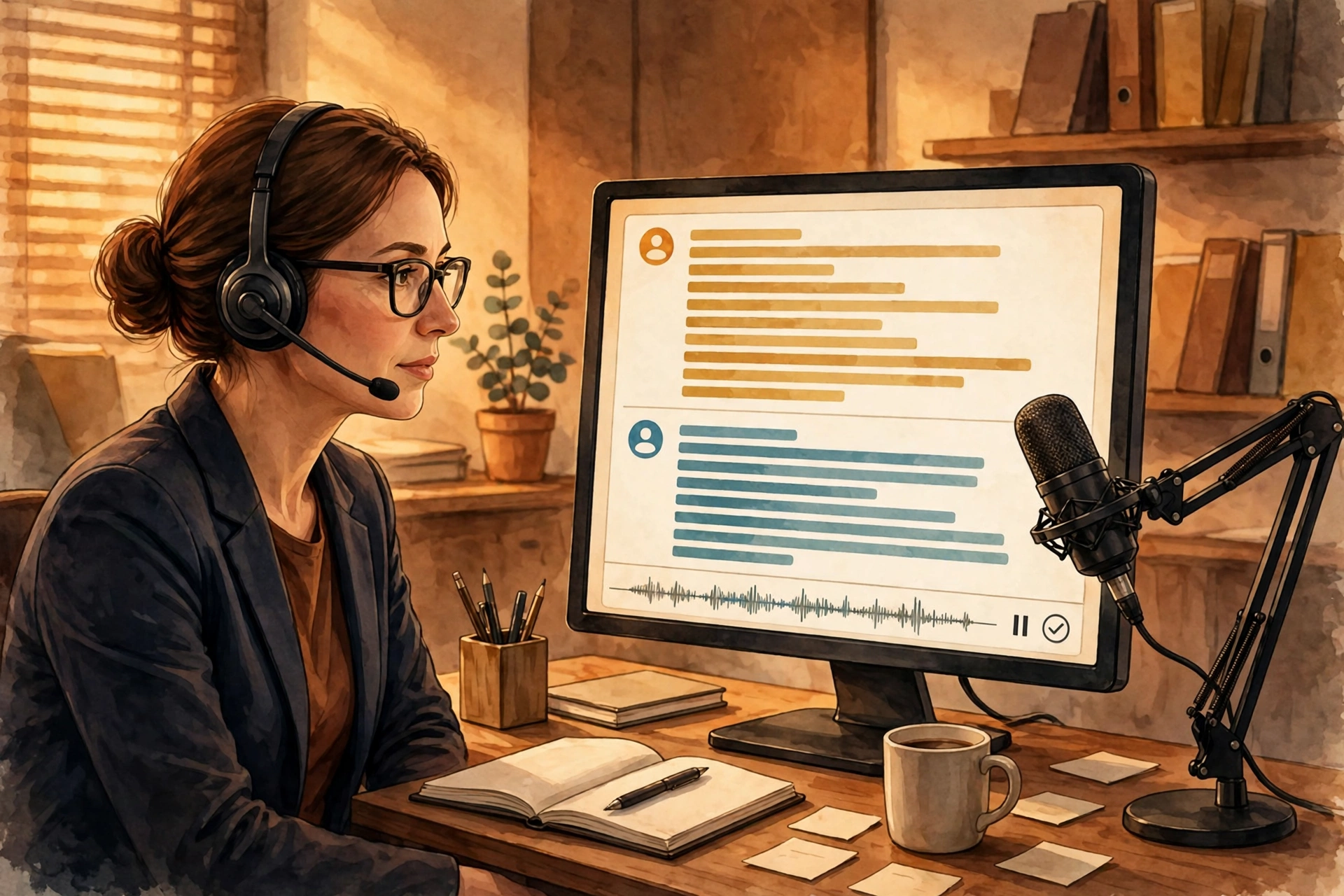
Traditional transcription tools give you one output: a transcript, usually verbatim, in the vendor's formatting. Nemotron 3.5 Transcribe accepts natural-language instructions, so the same recording can produce different outputs: a verbatim transcript for a legal record, a cleaned transcript for reading, a summary for a manager, or answers to specific questions.
You can also supply product terms and formatting conventions in the prompt — the feature with the most practical value for specialist work. Healthcare, finance and legal speech is full of terms generic models mangle: drug names, procedure codes, contract clauses, product names. Giving the model your glossary up front should reduce corrections afterwards, though not remove them.
Meeting notes that people actually use
Most meeting transcription fails not on accuracy but on usefulness. A 45-minute verbatim transcript is a document nobody reads. A promptable model changes the deliverable: a short summary with decisions and owners, plus a verbatim record for reference. Word-level timestamps let you jump to the exact moment a commitment was made.
The practical test is simple. If your meeting notes still need someone to listen again and rewrite them, the bottleneck is the output format, not the microphone. Prompting for decisions, actions and open questions, in your company's format, turns transcription from archiving into follow-up. That is where AI agents earn their keep: an agent can take a structured transcript and draft and route follow-up tasks. See our guide on how to build an AI voice agent.
Medical and legal dictation, with a human in the loop
Dictation is where promptable transcription looks most valuable — and where careless deployment looks most dangerous. A clinician or lawyer needs specialist vocabulary handled correctly, in a consistent format. Supplying terms in the prompt helps, and Nvidia's own demo shows the headroom: fine-tuning on Indian medical speech cut errors on unseen speakers by 45.8%, from 22.44% to 12.17%, after about 14 hours on one GPU. That is Nvidia's demo claim on its own test data, not a promise for your clinic or firm.
The rule for regulated work stays unchanged: a transcript is a draft until a qualified person checks it. Self-hosting helps, because sensitive dictation need not leave your infrastructure, but it does not remove checking. Pilot on real recordings and keep human sign-off — the same discipline behind good AI automation in any regulated process.
Call-centre quality checks and multilingual records
Call centres generate more audio than any team can listen to. Transcribing a sample — or, with cheap open-weight inference, a much larger share — lets managers search for the calls that matter: complaints, compliance phrases, missed upsells, repeated objections. Speaker attribution separates agent from customer, and translation turns multilingual operations into one searchable record.
For businesses in the UAE and Saudi Arabia, where customers switch between Arabic, English, Urdu and other languages, that matters commercially, not just operationally. The same applies in the United Kingdom and USA for multilingual customer bases, and in Pakistan for Urdu and English service operations. A WhatsApp bot or chatbot can answer routine follow-ups from the transcript, while a person handles disputes — see chatbots versus AI agents. An AI calling agent pairs naturally with transcription; see AI calling agent costs in 2026.
The recorded-only limit, and the privacy choice
Be clear about the boundary: Nemotron 3.5 Transcribe is for recorded audio, not live streams, and will not power a real-time conversation by itself. Live, low-latency voice — a receptionist that answers and interrupts naturally — needs a streaming architecture, such as the full-duplex approach in our guide to Block's Dessa voice AI. Transcription still belongs in that pipeline, but after the call: for records, quality checks and follow-ups.
Self-host or use a hosted endpoint
Deployment is the second decision, and open weights make it a real choice rather than a vendor default. Self-hosting keeps recordings inside your own systems, suiting healthcare, legal and financial work and contracts restricting third-party processing. Hosted endpoints start faster and scale easier, but audio leaves your premises under someone else's terms. Decide on data obligations and volume first. Where transcripts must land in business systems, CRM development and custom software development connect the pipeline to the customer record, and restaurants can use their restaurant ERP the same way.
Build or buy: a practical checklist
Start with a pilot
- Start with your worst audio: noisy calls, accented speech and specialist terms are where models fail.
- Define the output first: verbatim, cleaned, summary or answers, in the exact format each team needs.
- Build a glossary of product, drug and legal terms and formatting rules, supplied in the prompt.
- Measure on your own recordings, including errors on the terms that carry risk.
- Keep a human check for regulated, disputed or high-value transcripts, and log corrections.
- Decide hosting on data rules first, cost second: self-host for sensitive audio, hosted for fast pilots.
October 2026 has been busy for voice AI — Mistral's Voxtral 3, ElevenLabs Realtime and Salesforce's Launa-Omni among the announcements — but most excitement sits on top of transcription. Get the transcript layer right, and every voice product above it gets better; get it wrong, and you automate confident-sounding errors. SaaS development and ecommerce development can embed transcription into the product, and Flutter app development can put voice capture in customers' hands. The announcement is covered by TechCrunch and Unite.AI.
Frequently asked questions
What is Nvidia Nemotron 3.5 Transcribe?
A free open-weight speech model released on 28 October 2026 that transcribes recorded audio in up to 40 languages, translates between English and 31 languages, attributes speakers in 13 languages, and answers spoken questions in English.
Can it transcribe live calls as they happen?
No. It handles recorded audio up to an hour long, not live streams. Use it for meeting records, dictation and post-call analysis; live voice needs a separate streaming architecture.
How accurate is it?
Nvidia claims the top open-weight position on Hugging Face's Open ASR Leaderboard, but figures vary by leaderboard. Test on your own recordings, accents and specialist terms before trusting it in production.
Can a business use it commercially?
Yes, under the OpenMDW-1.1 licence, via Hugging Face or ModelScope, or through hosted endpoints. You may self-host to keep recordings inside your own infrastructure.
Where does a human still check the transcript?
Everywhere the cost of an error is high: medical and legal records, disputed calls, compliance checks and customer commitments. Use the model for volume; keep qualified people on decisions.