Genie 4 Is Now in the Gemini API: Playable Worlds at 10 Cents a Second

Amir Farid
7 min read
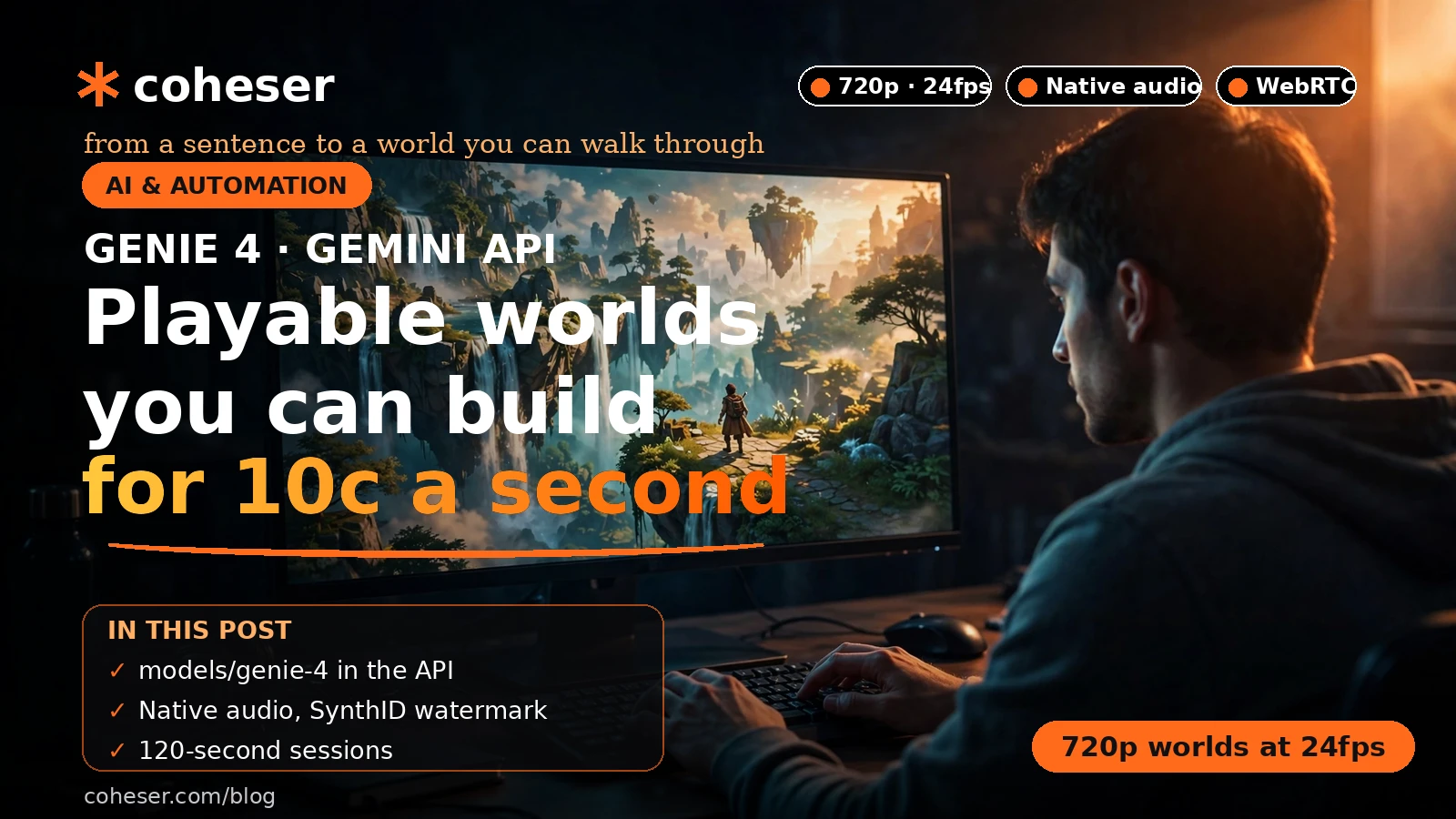
Google opened Genie 4 to developers on 19 November 2026, through the Gemini API (the Interactions API) and Google AI Studio. The model, called as models/genie-4, turns a text prompt, a reference image, or both into a continuous interactive 720p world at 24 frames per second, with synchronised native audio: ambient sound, effects and dialogue. You steer it live with keyboard controls and mid-stream text prompts.
The short version: a full 120-second session costs about $12, at roughly $0.10 a second — a prototyping and training tool today, and an expensive way to ship a finished product. Below: the prices, how sessions work, and what you can build. All launch facts are from Google's own announcement and the Genie 4 developer documentation.
Genie 4 Is Now in the Gemini API: Playable Worlds at 10 Cents a Second
What Genie 4 in the Gemini API actually is
This is the developer launch, not the consumer debut. Genie 4 first appeared on 18 November 2026 inside Project Genie, for Google AI Ultra subscribers — covered in our Google Genie 4 world model guide. A day later it reached the API. Start with a text prompt, a reference image, or both — a photo of a real showroom becomes a walkable world.
A world model, not a video generator
Genie 4 is not a clip generator. A video model renders a fixed clip and stops; Genie 4 renders frames on the fly as you act. Walk with the W and arrow keys and the world moves with you; type "make it snow" mid-stream and the weather changes. Google says Gemini reasoning keeps the world consistent — Google's claim.
What you start with
A reference image is the practical option for business use: upload a photo of a real showroom or warehouse and the model builds a walkable version of it. Google also provides starter apps in AI Studio, so developers can try it before writing code.
The price: what 10 cents a second really means

Google's docs list approximate rates of $1.50 per 1M input tokens, $9 per 1M text output tokens and $17.50 per 1M video output tokens. Video is where the money goes: 240 tokens per frame, or 5,760 a second at 24fps — about $0.10 a second with stereo audio included.
The cost maths, in plain numbers
- A 10-second interactive demo costs about $1.
- A 30-second product walkthrough costs about $3.
- A 60-second training scenario costs about $6.
- A full 120-second session costs about $12.
Scale it: 100 customers on a 30-second demo costs about $300; 1,000 users on a one-minute scenario, about $6,000. Cheap for a pilot, ruinous as an always-on feature. Price the whole workflow, not the single session — the discipline behind our AI agent development cost guide.
How a Genie 4 session works in practice
Every session follows four steps on the v1beta API. First, your server creates the interaction: interactions.create with model models/genie-4. Second, connect over WebRTC (browser) or WebSockets (server). Third, seed the world with world_setup, then steer it with movement or text inputs. Fourth, you call complete() to end the session — the step that costs money if you forget it. Browser clients get a single-use ephemeral token from your server, so your API key never leaves the backend — the same discipline we apply in any custom software development project.
What businesses can actually build now
Google names three uses: prototyping interactive experiences, visualising designs for spatial concepts, and training robotics and AI agents. All three are real today, with a pilot-sized budget, inside the 120-second limit.
Interactive product demos and virtual showrooms
A customer walks a virtual showroom, changes a sofa's finish, opens a car door — from a prompt and a reference image, with no 3D team and no game engine. Where one converted visitor is worth hundreds of pounds, $3 for 30 seconds is trivial. Pair it with our ecommerce AI agents guide and the demo becomes a salesperson, not a screensaver.
Training simulations that react
Training is the strongest business case. A warehouse worker practises a picking route, a restaurant team rehearses a busy service — and the world reacts to their choices instead of playing a fixed video. The same pattern powers AI voice agents for restaurants and AI chatbots for clinics. It also works for onboarding: a new starter explores a virtual office, built as a Flutter app — see our Flutter vs React Native guide.
Then there is the use Google is pushing hardest: training worlds for robots and AI agents, for thousands of scenarios no warehouse could stage. It joins the physical-AI wave of Nvidia GR00T N1.5, Gemini Robotics 2.5 and the open Runway Praxis 1 robot model — alongside fast Gemini 4 Hydrogen agents and frontier Gemini 4 Carbon reasoning. For most businesses, a research pilot for now.
Where Genie 4 is still a demo toy
Honesty first: Genie 4 is a world generator, not a game engine. Sessions cap at 120 seconds, and Google's docs say quality can degrade past 60–90 seconds. Output is 720p, and no state survives between sessions. Use it to prototype in days; if the idea works, rebuild it properly. Prove value small, then invest — our AI agents for small business automation guide.
The catches: cost control, regions and the watermark
Three things to get right before you hand Genie 4 to users. First, the cost trap: closing a browser tab does not stop generation or charges on Google's servers. Your app must call complete() or cancel() on every exit path — tab close, idle timeout, navigation — or a forgotten session keeps billing at $0.10 a second.
Second, access needs a paid-tier Gemini API key — set usage limits and alerts first. Third, every output carries an imperceptible SynthID watermark — say so to users. Serving runs from the United States, Western Europe and Japan, with under 150ms round-trip in-region; elsewhere, test first — a world that responds half a second late feels broken.
Who should pilot now — and who should wait
Pilot now if you sell high-value products, train staff in physical spaces, or build robots and agents — a two-week experiment costs a few hundred dollars at most. Wait if you need long sessions, exact 3D precision, or thousands of daily users: the maths does not work yet.
A two-week pilot plan
- Week 1: one 60-second scenario in AI Studio, tested with five real users.
- Week 2: rebuild the winner on the API with ephemeral tokens and a hard 60-second cap.
- Then decide: scale the pilot, rebuild the winner in a real engine, or park it and revisit in six months.
Want help scoping the pilot — the scenario, the cost model, the build? Our AI agents development team builds exactly this kind of thing, with the same AI automation discipline. Voice-led instead? See our guide to building an AI voice agent, or contact Coheser.
Frequently asked questions
When did Genie 4 come to the Gemini API?
19 November 2026, through the Gemini API (Interactions API) and Google AI Studio, a day after its consumer debut on 18 November inside Project Genie for Google AI Ultra subscribers.
How much does Genie 4 cost on the API?
Approximately $1.50 per 1M input tokens, $9 per 1M text output tokens and $17.50 per 1M video output tokens — roughly $0.10 per second with stereo audio included, so a full 120-second session costs about $12.
How long can a Genie 4 session last?
Sessions are capped at 120 seconds, and Google's docs say quality can degrade past 60–90 seconds. Design in short scenes of 30–60 seconds rather than long continuous experiences.
What do I need to build with Genie 4?
A paid-tier Gemini API key and the Google GenAI SDK, on the v1beta Interactions API. Browsers connect over WebRTC, servers over WebSockets, with single-use ephemeral tokens keeping your API key on the server. Serving regions: the United States, Western Europe and Japan. See our Gemini 4 Neon guide.
Can I use Genie 4 worlds in a commercial product?
You can prototype and pilot with it now, but check Google's current terms for your use case before shipping, and remember every output carries an imperceptible SynthID watermark. Pilot a short scenario first, measure whether users complete the task, then commit budget.