AI Voice Agents for Healthcare: Patient Calls, Reminders and Bookings

Amir Farid
7 min read
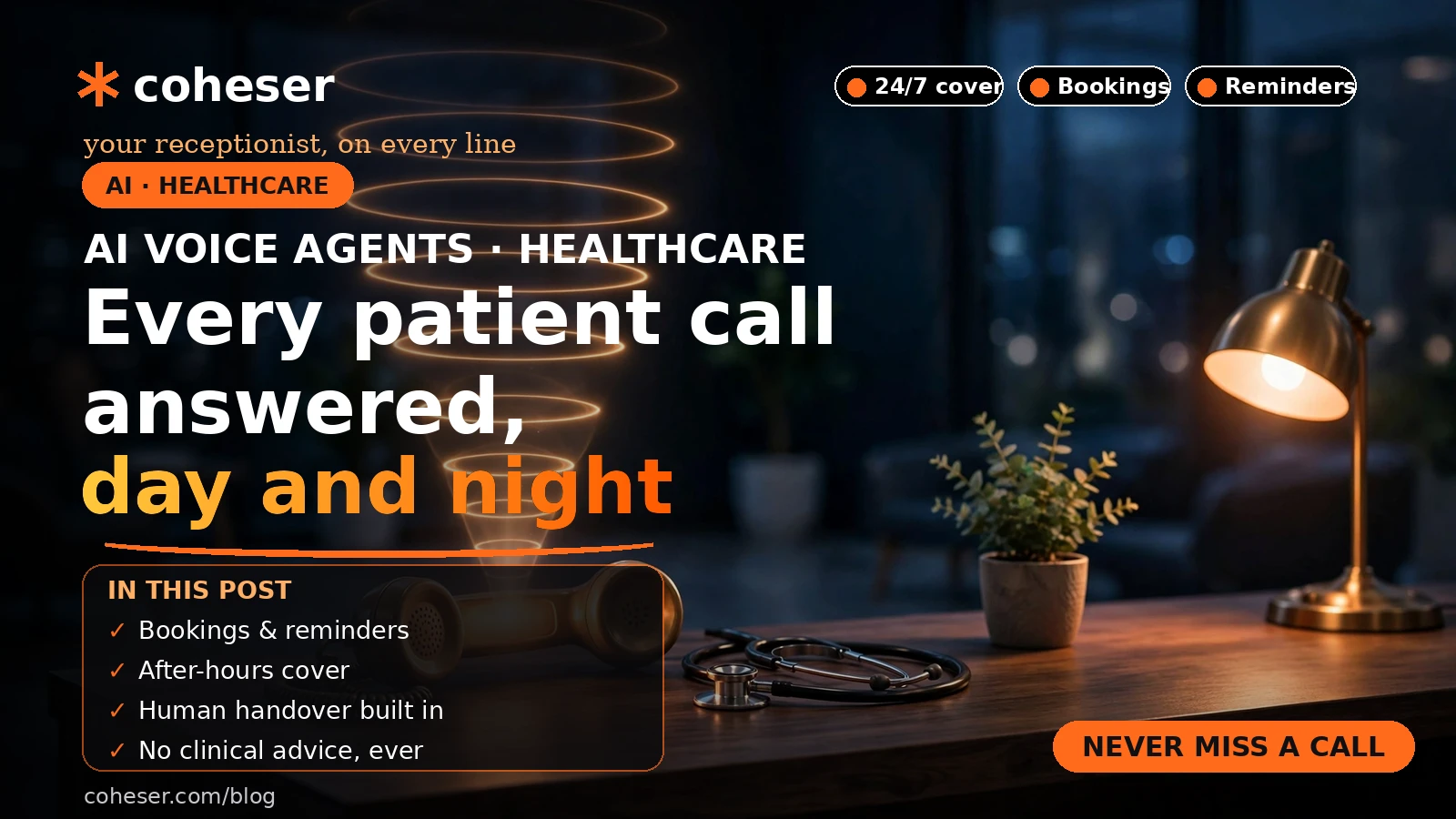
AI Voice Agents for Healthcare: Patient Calls, Reminders and Bookings
An AI voice agent for healthcare answers patient calls, books, cancels and reschedules appointments, sends reminders, and routes prescription-refill requests — without a receptionist picking up every call. It works around the clock and hands over to a human whenever a call is clinical, urgent or unclear.
What a healthcare voice agent actually does day to day
Most patient calls are routine: booking a check-up, moving an appointment, asking opening hours, or checking a prescription. None needs a clinician.
The agent checks the booking system, offers two or three slots, and confirms the booking by text or WhatsApp. If the patient cancels, it frees the slot for the next person waiting. When a call falls outside its remit, it transfers the caller to a human, with a short summary of what has already been said. A good one sounds unhurried: one question at a time, names and dates confirmed back.
Speaking the patient's language
A patient who is unwell should not struggle in a second language to book an appointment. A good voice agent can switch languages mid-conversation — Urdu and English for clinics in Pakistan, Arabic and English in the Gulf, and the main community languages in the UK. Clinics in the United Kingdom and the UAE should plan multilingual cover from the start.
Appointment booking, reminders and no-shows

Booking is the core job. Connected to the clinic's booking software, the agent sees real availability and applies the clinic's rules — longer slots for a first visit, no double-booking. It can also cancel and reschedule — a slot rebooked the same day is not wasted.
Reminders are the second half of the job. After booking, the agent — or the clinic's WhatsApp bot — sends a confirmation, then a reminder the day before, with an option to confirm or reschedule by reply. Missed appointments cost real time: an empty room and a waiting-list patient who could have taken the slot. See our AI receptionist guide for small businesses, our guide to AI voice agents for restaurants, and our guide to AI chatbots for clinics.
After-hours and overflow cover
Clinics do not stop receiving calls at 5pm. Patients phone in the evening to book for the next morning or because something is worrying them. An unanswered phone at 7pm is a patient who books elsewhere the next morning. A voice agent answers after hours with the same booking flow — but it cannot give clinical advice, and must say so. Overnight, it should give a clear emergency redirect — the local emergency number or the clinic's out-of-hours service. It also covers the Monday-morning rush.
Prescription refills and repeat requests
Repeat prescriptions suit a voice agent well, if the boundaries are strict. The agent takes the name, date of birth and medicine requested, checks the record, and routes it to the pharmacy team for approval. It never changes a dose, suggests an alternative, or approves a request. Approval stays with a clinician or pharmacist.
Three rules keep this safe. First, only repeats of medicines already prescribed — never a new medicine. Second, any mention of a new symptom, side effect or missed dose goes straight to a human. Third, the patient always gets a clear confirmation. Clinics already using agentic tools can compare with Suki OS and agentic AI in healthcare.
What it must never do — and how escalation works
Stated plainly: it must not give clinical advice or diagnoses, must not replace triage by a clinician, and must not handle emergencies. It is a booking and routing tool, not a doctor.
Every call needs a clear escalation path. First, trigger words — chest pain, breathing difficulty, bleeding, a child who is unwell — that transfer the caller immediately, with an emergency redirect spoken first. Second, a confidence rule: if the agent is unsure, it hands over rather than guessing. Third, a human actually available to take the transfer — an escalation path that ends in voicemail is not one.
The same care applies to post-discharge follow-up calls: the agent asks scripted questions written by the clinical team, and any answer outside the expected range goes to a nurse or clinician the same day. The agent asks; it does not interpret. For the difference between a simple chatbot and an agent that can act, see AI chatbot vs AI agent.
Integration and data-safety checklist
- Booking system integration: the agent must read and write real availability in the clinic's booking software.
- Data minimisation: ask only for the details the task needs — name, date of birth, appointment type.
- Consent for recordings: if calls are recorded, tell the caller at the start and offer a way to opt out.
- Human review: a named member of staff should review transcripts regularly at first.
- Where data lives: ask where recordings are stored, who can access them, and how they are deleted — under UK GDPR the clinic stays responsible.
- Messaging: confirmations should go through the clinic's own messaging setup — see our WhatsApp AI agent vs human support comparison.
Rules differ by country — check your own regulator's guidance before going live, and do not take a vendor's word for compliance.
How it works, in plain English
A patient phones. Speech-to-text turns their words into text. The agent checks the booking system, decides what to do, and replies in a natural voice. The booking is confirmed by SMS or WhatsApp, and the transcript is saved for human review. The speech steps often run on a real-time speech API such as the OpenAI Realtime API.
What it costs — a rough guide only
There is no published price list for a custom healthcare voice agent, so these figures are rough-guide estimates — not quotes. Our AI calling agent cost guide puts a typical small to mid-sized business at roughly $300 to $2,500 a month. Our AI calling pricing guide puts the per-minute cost at roughly $0.10 to $0.30 all-in for a standard voice.
Expect a one-off setup fee too: roughly $500 to $2,000 templated, or $3,000 to $15,000-plus custom. Healthcare adds two costs other sectors do not: multilingual testing, and the compliance work around recordings and patient data. See also our UK agent development cost guide.
How to start in five steps
- Count your calls for two weeks. Log volume, peaks and reasons — if half are booking and reminders, it will pay for itself quickly.
- Pick one job first. Start with booking and reminders only; add prescription routing once booking works well.
- Write the escalation rules with your clinicians. Agree the trigger words, the emergency redirect and who takes a transfer, then test them with role-played calls.
- Run a small pilot. Put the agent on one line, or after hours only, for two to four weeks, reviewing transcripts daily.
- Expand slowly, and keep a human in the loop. Add languages, refills and follow-ups one at a time. If you are building rather than buying, read our guide on how to build an AI voice agent. Coheser builds voice and WhatsApp agents for clinics in the UK, UAE, Saudi Arabia and Pakistan — see our AI agent development and chatbot development services, or contact Coheser.
Also read today's Kolibri 1.1 and Strands Decider v2 posts.
Frequently asked questions
Can an AI voice agent replace a clinic receptionist?
No. It handles the routine part — answering, booking, reminding and routing — while a human stays for clinical questions and anything the agent is unsure about.
Is it safe for patients to book appointments with an AI voice agent?
Yes, for routine booking, if it uses the clinic's real booking system and hands over when unsure. It must never give clinical advice or triage.
How much does an AI voice agent for a clinic cost?
As a rough guide only, roughly $300 to $2,500 a month, plus setup of roughly $500 to $2,000 templated or $3,000 to $15,000-plus custom.
Can a healthcare voice agent speak Urdu or Arabic?
Yes — a good agent switches languages mid-conversation. Each language needs its own voice and testing, so plan multilingual cover from the start.
What happens to call recordings and patient data?
Callers must be told if a call is recorded, with a way to opt out. Recordings should be stored securely and open only to authorised staff.