Amazon Strands Decider v2: The Small AI That Decides for Your Agents

Amir Farid
7 min read
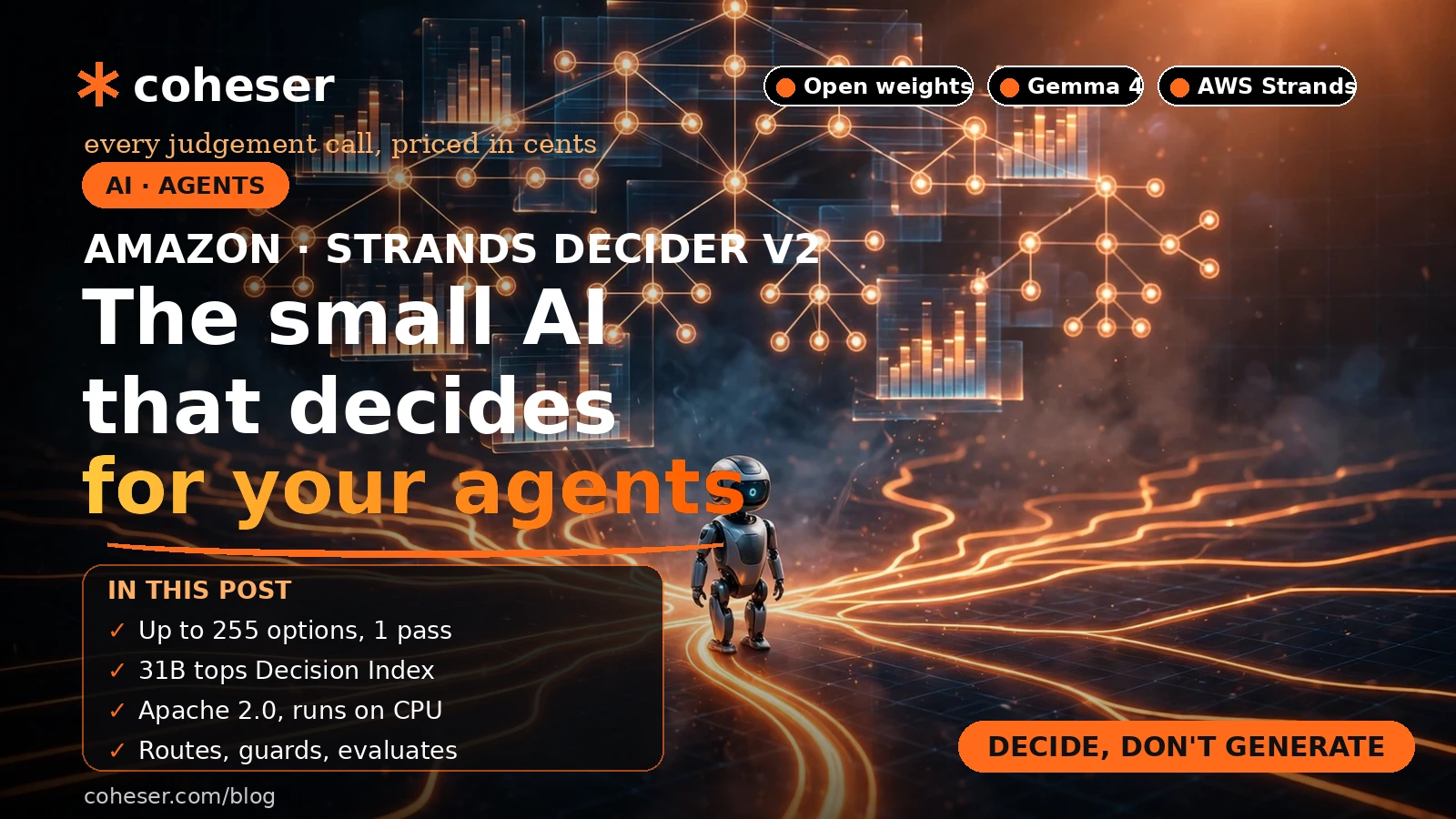
Amazon Strands Decider v2: The Small AI That Decides for Your Agents
Amazon released Strands Decider v2 on 23 November 2026: five open-weight decision models that choose between options rather than generating text. Give it up to 255 options and it returns a probability for each in a single forward pass. That matters: most of what an agent does is deciding which tool to call, which model to use, when to escalate.
Coheser covered Google's Gemini Decision 1 earlier this month, and Baseten's Bison-1 and Groundhog-1 the same week; the category is suddenly crowded. Amazon's answer: Decider is open-weight under the Apache 2.0 licence, weights on Hugging Face, so you can run it yourself rather than renting every judgement call.
What Strands Decider v2 actually is
A decision model is not a chatbot. A large language model generates text token by token — slow and expensive when all you need is a choice. Decider takes a question and options — tools, departments, models — and scores them all at once. The highest score wins, and the spread of probabilities is your confidence signal: a low-confidence call should go to a human.
Five sizes — E2B, E4B, 12B, 26B-A4B and 31B — built on Google's Gemma 4, designed for long inputs like agent traces. Amazon calls these "system one" models: fast, instinctive judgement.
What changed from v1

Decider v1 arrived on 1 October 2026, so v2 follows less than two months later. Two architecture changes: prefix-bidirectional attention, reading the whole situation both ways, and direct option scoring through a 255-row readout layer, replacing v1's pointer head. Amazon says v2 was trained on 17.5 million examples.
The numbers — Amazon's claims, not verified facts
All figures here are AWS's, not independently verified. On six public text benchmarks, AWS says the 31B averages 82.1, up from 70.0 for v1's 26B-A4B; on its Decision Index 0.3 it scores 71.5, against 48.8 for the largest v1 model. AWS says the average puts it ahead of Gemini Decision 1 at 79.4 — test the models on your own decisions before trusting a vendor chart.
Why the cost argument is the real story
Amazon's best evidence is an internal case study, not a benchmark: AWS says its engineers replaced Claude Sonnet 4.6 with Decider for labelling support tickets, cutting cost by 98% and making each call 78% faster. Those are AWS's own figures — but the shape of the claim is what to expect: labelling a ticket is classification, not writing, and frontier-model prices for it were always wasteful.
The same logic applies across an agent's workload: every tool selection, routing choice and guardrail check is a small decision, and routing each through a large model makes the bill grow with every step. A small decision model makes those calls near-free. Same discipline as in our AI agent development costs in the UK: build price is half the story; running cost decides survival in month one.
Where Decider fits inside a business AI agent
Routing: cheap model or frontier model?
Not every request needs your best model: a password reset does not need frontier reasoning; a contract dispute does. A decision model routes the request — easy work to a small model, hard work to the expensive one — the single biggest saving in a deployment, done well. Our AI agents vs RPA comparison covers when an agent earns its keep.
Tool selection and confidence scoring
An agent with twenty tools chooses at every step, and the wrong pick wastes a call — or updates the wrong record. Decider scores all tools against the situation, and its confidence score gives a natural escalation rule: above a threshold, proceed; below it, ask a human. That turns a demo into something trusted. The same applies to AI agents for small business automation, where nobody watches every step.
Guardrails and evaluation without frontier prices
AWS also says Decider powers custom evaluators in Bedrock AgentCore Evaluations — a small model judging a bigger model's output — and has been used for guardrails and steering robot arms. These are AWS's accounts, not verified deployments. See our AWS Nitro sandboxes for AI agent safety piece.
How to run it: from a laptop to Lambda
Install with pip install strands-decider, then run strands-decider ask for one-offs or strands-decider serve for an HTTP server. The smallest model, E2B, runs on CPU, including on a Mac; the family also runs on CUDA, SageMaker endpoints, or Lambda, where the quantised arm64 build costs nothing between requests. Box CLI arrived the same day, adding Strands Box support to Claude Code, Codex and Kiro CLI.
GPU guidance from the model cards: E2B 24 GB, E4B 40 GB, 12B 48 GB, and the 26B-A4B and 31B 80 GB. Start small; reach for larger models only where decision quality is worth the hardware. Running your own model keeps decision data in-house. Our guide on how to build an AI voice agent and the chatbot vs AI agent comparison cover the same ground.
Decider v2 vs Gemini Decision 1: a real race now
Gemini Decision 1 is an API service; Decider v2 is open-weight and self-hostable — rent the decision, or own it. Renting is simpler — no GPU or hosting — and for a few hundred decisions a day the bill is trivial. Owning it is cheaper at scale, keeps data in-house, and lets you fine-tune on your own decisions. Clinics may prefer patient data never to leave their own systems — see our AI voice agents in healthcare guide. Aleph Alpha's Kolibri 1.1 shows the same current running through the industry.
On performance, AWS claims the lead — 82.1 against Gemini Decision 1's 79.4. But benchmarks measure text decisions, not your tickets or customers: run both against a few hundred of your own real decisions and compare accuracy and cost. The trend is bigger than one release: Mistral Large 4 made the same bet, and Anthropic's self-hosted Claude shows closed labs following suit.
What this means for Coheser's clients
Decider v2 changes the maths of an AI agent, not the pitch: the agent — workflows, integrations, escalation rules — is still the product. What changes is that the judgement calls inside it can be made for a fraction of the old price, on hardware you control, with a confidence score on every decision.
Limits remain: a decision model cannot fix a badly designed workflow, and the 98% saving is AWS's own case study, not a promise about your workload. But the direction is clear: generation is the expensive part now, and decisions around it are becoming cheap and ownable. Coheser builds agents with this decision layer baked in — see our AI agents development service, chatbot development and custom software development. UK businesses can start with our UK page, or contact Coheser to talk through a pilot.
Read the release first-hand in the Strands blog announcement, with context from VentureBeat. The Agents SDK launched in May 2025, the Harness that September.
Frequently asked questions
What is Strands Decider v2?
Five open-weight decision models released by Amazon on 23 November 2026. Instead of generating text, a decision model scores up to 255 options you supply and returns a probability for each, so an agent can pick its next step in one forward pass.
How is Decider v2 different from a normal language model?
A language model writes text token by token — slow and costly when you only need a choice. Decider scores every option at once, returning probabilities and a confidence signal for escalating uncertain calls.
Can I run Strands Decider v2 myself?
Yes — Apache 2.0 licensed, weights on Hugging Face. Install with pip install strands-decider; use ask for one-offs or serve for an HTTP server; run the E2B model on CPU, or host larger models on CUDA, SageMaker or Lambda.
Is Decider v2 really 98% cheaper than Claude Sonnet 4.6?
That figure is AWS's own account of its internal ticket-labelling deployment, not an independently verified fact or a promise about your workload. Test it on your own decisions first.
Should my business use Decider v2 or Gemini Decision 1?
It depends on renting or owning the decision layer. Gemini Decision 1 is an API service and simpler to start with; Decider v2 is open-weight, self-hostable and cheaper at scale. Run both against a few hundred real decisions first.