Aleph Alpha Kolibri 1.1: Open-Weight AI Your Business Can Self-Host

Amir Farid
7 min read
Aleph Alpha Kolibri 1.1: Open-Weight AI Your Business Can Self-Host
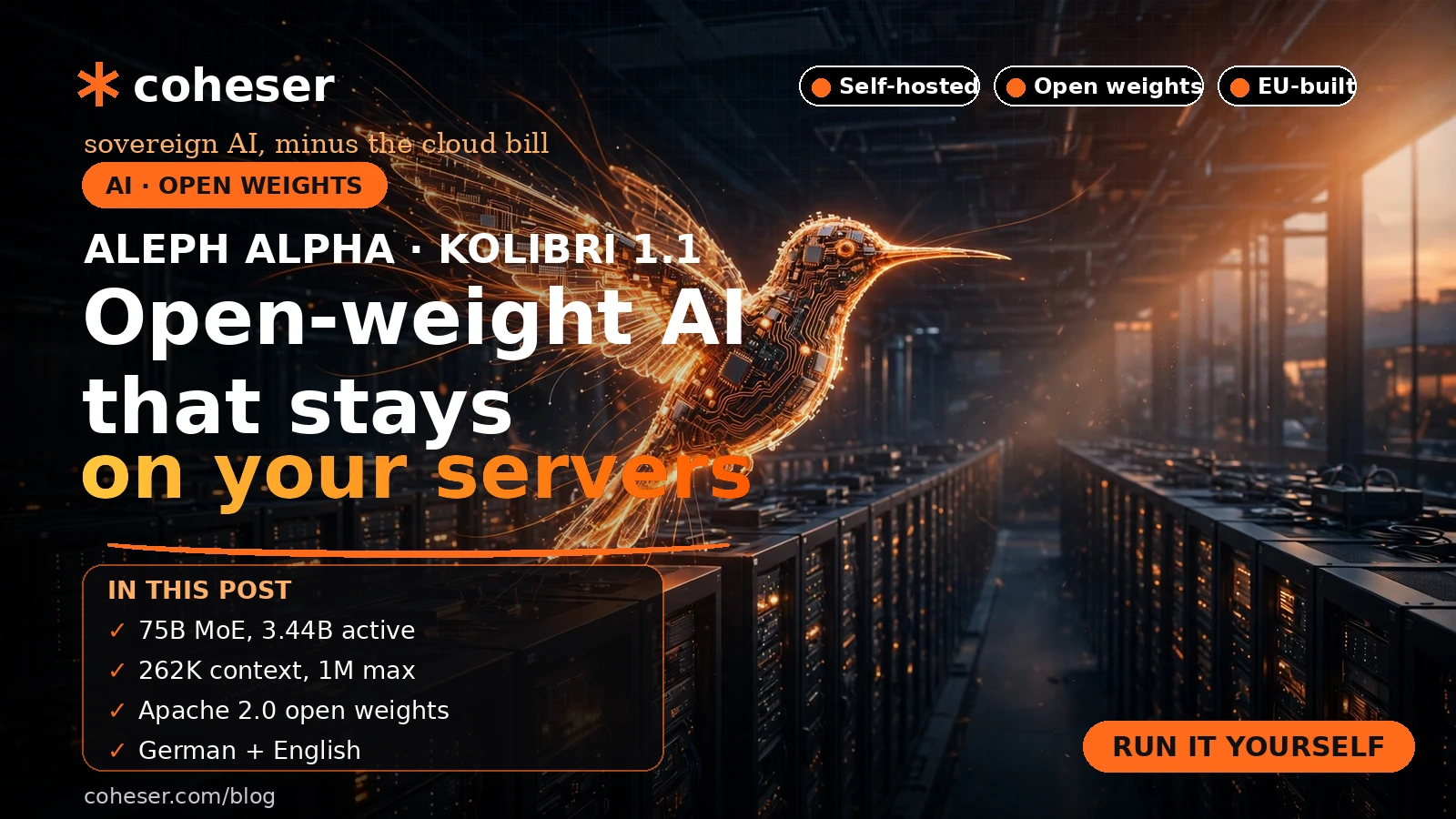
Aleph Alpha released Kolibri 1.1 on 23 November 2026, an open-weight model for businesses that want serious AI capability on their own servers. It is a mixture-of-experts model: 75 billion total parameters, only 3.44 billion active per token. It works in German and English only, has a native context window of 262,144 tokens, and is released under the Apache 2.0 licence — download the weights, host them yourself, and build on top. For a UK or European business handling sensitive documents, that mix of capability, low cost, and full control is why it is worth a look.
Kolibri 1.1 succeeds Kolibri 1, from early October 2026. Aleph Alpha, the Heidelberg company behind it, positions the model as European sovereign AI and is a signatory of the EU GPAI Code of Practice.
What Kolibri 1.1 actually is
Kolibri 1.1 is a mixture-of-experts (MoE) model: instead of activating all 75 billion parameters for every token, it routes each token to a small subset — 384 routed experts, 6 selected per token, plus one shared expert. Only 3.44 billion parameters are active per token.
It ships with what business use needs: an explicit reasoning mode (low, medium, high, or none); tool calling, the foundation of agentic workflows; structured output such as JSON; and a native context of 262,144 tokens, extendable to 1,048,576.
The weights are open under Apache 2.0 on Hugging Face, with official GGUF quantizations for llama.cpp and a vLLM plugin. Run it on a workstation, a rented GPU server, or your own infrastructure.
An honest limit: human review required
The knowledge cutoff is 18 June 2026. The model card states it is intended for human-reviewed workflows — a person checks the output before it is acted on — not unsupervised autonomous operation.
The benchmark numbers — and what they really mean

On Aleph Alpha's own evaluations, Kolibri 1.1 scores 73.2 overall, up from 66.6, and uses 0.21 GPU-hours per 1,000 evaluation tasks against 0.72 for version 1.0 — 3.4 times less GPU time. These are the vendor's own figures, not independently verified.
Qwen3.8 Flash Next scores 80.1 overall on the same chart, ahead of Kolibri 1.1's 73.2 — so Kolibri 1.1 is not the top scorer; its pitch is cost-efficiency. Secondary reports also claim up to 14x faster decoding at 1M context and 41% fewer output tokens — vendor claims, not verified facts.
For a business, that trade-off is often the right one: a model that scores a few points lower but costs a third as much to run, on your own hardware, usually beats a smarter model you can only rent by the token.
German and English only — a feature, not a gap
Kolibri 1.1 works in German and English, and nothing else — deliberate depth over breadth, with a tokenizer tailored to German word structure. German compounds are hard for English-built tokenizers, so it should handle German contracts better than a general multilingual model.
For a UK business, the English side is what you will use. But if you trade with Germany, Austria, or Switzerland, Kolibri 1.1 was built for German, not merely adapted to it. Compare it with Mistral Large 4, the other European open-weight flagship — Kolibri 1.1 is the specialist to Mistral's generalist. If your business needs French, Arabic, or Urdu, it is simply the wrong model.
What it costs to run
Self-hosting only works if the hardware bill is manageable — and here the MoE design pays off. The model needs roughly 77.6 GB of memory: a minimum of 2x H100 SXM5 GPUs or 1x B200, with 4x H100 or 2x B200 recommended — far less than the eight-GPU clusters dense models demand.
There is no per-token price: the weights are free under Apache 2.0. Your cost is infrastructure, engineering time, and maintenance. Rent GPU time for a predictable monthly cost — the sensible starting point. Buy hardware only if you run the model all day, every day. Or use a managed host, at the cost of some control. Compare the options in our guide to AI agent development costs in the UK.
What your business can actually do with it
Retrieval over your own documents
The 262K-token native context means you can feed the model whole contracts, policy manuals, or bundles of files in a single pass. Combined with a retrieval-augmented generation setup — answering from your own knowledge base — you get a system that answers questions from your documents, in your words, on your servers.
Document work and agents with a human in the loop
Long contracts, tender documents, and German correspondence are its home turf: summarise, extract terms, compare versions, and draft replies — always with a human reviewing the output first. Tool calling and structured output also make it a viable engine for AI agents for small business automation: an agent that looks up an order, checks stock, and drafts a reply for approval. See our AI agents vs RPA guide for a comparison against simpler automation.
It is not a coding specialist, not multilingual, and not the strongest reasoner — and it is text-only. If coding help is your main need, a coding-focused model will serve you better.
Kolibri 1.1 vs the alternatives
There is no single best model, only the best fit for your constraints.
- Vs Qwen3.8 Flash Next: Qwen scores higher on Aleph Alpha's own chart (80.1 vs 73.2), but as a Chinese-origin model it raises data-governance questions for some European buyers.
- Vs Mistral Large 4: Mistral covers more languages — choose it for multilingual work, Kolibri 1.1 for German depth.
- Vs Tencent Hy4: Hy4 is another recent open-weight release for self-hosting — see our Hy4 guide.
- Vs hosted frontier models: Hosted models such as Claude remain stronger on reasoning and coding — see our guide to self-hosted Claude managed agents — but your data leaves your servers.
- Vs decision-focused models: Gemini Decision 1 and Amazon's Strands Decider v2 are built around decision-making; Kolibri 1.1 is a general model — pair it with your own logic.
Should you self-host Kolibri 1.1?
Self-hosting is not right for everyone. Check yourself against this list:
- You handle sensitive data. Data that should never leave your servers is the strongest reason to self-host. Healthcare voice agents face exactly this constraint.
- You have steady, high-volume usage. All-day use favours flat GPU costs.
- You have (or can hire) the engineering. Someone must deploy, monitor, and secure it — or use a managed host.
- Your users speak German or English. Language fit is a hard requirement.
- You can live with human review. If a person checks output before it acts, it fits; fully autonomous operation does not.
If you tick most of those boxes, run a pilot: rent a GPU setup, load the model, connect it to your documents, and measure it on your real work for two to four weeks. If you want help scoping it, our custom software development team builds self-hosted AI systems for UK businesses — read our guide to building a custom AI chatbot first, or talk to us directly.
Frequently asked questions
Is Kolibri 1.1 free to use commercially?
Yes. It is released under the Apache 2.0 licence with open weights on Hugging Face, so you can use it commercially, modify it, and fine-tune it without a licence fee.
What hardware do I need to run Kolibri 1.1?
The model needs roughly 77.6 GB of memory: a minimum of 2x H100 SXM5 GPUs or 1x B200, and 4x H100 or 2x B200 recommended. Quantized GGUF versions can lower the requirement, but plan around the recommended setup for production.
How good is Kolibri 1.1 compared to other models?
On Aleph Alpha's own evaluations it scores 73.2 overall, up from 66.6, and uses 3.4 times less GPU time. But Qwen3.8 Flash Next scores 80.1 on the same chart, so Kolibri 1.1 is not the top scorer — its edge is cost-efficiency, European provenance, and German depth. All figures are the vendor's own; see the Aleph Alpha blog.
Can Kolibri 1.1 run fully autonomously as an agent?
No — not as intended. The model card says it is designed for human-reviewed workflows, where a person checks the output before it is acted on. It supports tool calling and structured output, so it can power agentic workflows with a human in the loop.