Baseten Bison-1 and Groundhog-1: Decision AI That Costs Pennies Per Million

Amir Farid
7 min read

Baseten's bison-1 is the highest-scoring decision model on the independent Artificial Analysis Decision Index v2.1, scoring 76. Its smaller sibling, groundhog-1, costs $0.035 per million tokens. Both take text and image input, both offer 128k context, and neither writes a word of output: they answer bounded questions with a probability. If your team spends hours sorting tickets or scoring leads, that is the job they do — for pennies.
What bison-1 and groundhog-1 actually are
Baseten announced the pair on 20 November 2026. They are decision models: they answer a bounded question — yes or no, pick an option, give a score — and return a probability. They do not draft replies or hold conversations. A general model can classify a ticket too, but it charges for the words it writes back, which you still have to parse.
Bison-1 is a 31-billion-parameter dense model, post-trained from Google's Gemma 4 31B. Groundhog-1 is a 26-billion-parameter mixture-of-experts model with around 4 billion active parameters, built from Gemma 4 26B-A4B. Both accept text and image input; Baseten trained them on 6.71 million decision examples.
The first pair on an "American backbone"
Baseten's earlier decision models — mammoth-1 (27B), elephant-1 (9B), joey-1 (2B) — were built on Qwen backbones. This pair is the first on what Baseten calls an "American backbone": Google's Gemma 4 (Apache 2.0), with Baseten's modifications under MIT. The open BF16 weights are on Hugging Face, so you can self-host.
The benchmark result that matters
The Artificial Analysis Decision Index v2.1 scores 19 decision models. Bison-1 ranks first at 76, ahead of Liquid AI's d1.2-ultra (75) and Baseten's own mammoth-1 (71). Groundhog-1 has no official Artificial Analysis score yet.
The more useful number is the Brier score, which measures how honest the model's probabilities are. Bison-1's is 0.14, the lowest on the index, ahead of d1.2-ultra at 0.15. Trustworthy probabilities let you set a threshold — auto-approve above 0.9, send everything below 0.7 to a human — and know it means something. As our Snowflake Decision post notes, a probability beats a paragraph your software must parse.
Baseten's own LongMemEval figures at 128k (bison-1 84.8/87.1, groundhog-1 77.4/79.3) are vendor figures.
What they cost — pennies per million
Bison-1 costs $0.10 per million tokens; groundhog-1 costs $0.035. Decision models produce no output tokens, so you only pay for input — which makes them cheaper than they look. A general model charges for the answer it writes; a decision model returns only a probability.
Prices also match Baseten's existing decision models, so current users can swap without repricing. At $0.035 per million tokens, a million short ticket-classification calls costs a few pounds. When each decision costs a fraction of a penny, you can afford to run one on everything. Our AI agent development cost guide for the UK and our guide to AI agents for small business automation show where cheap, high-volume decisions pay off first.
128k context: why it changes the job
Both models take 131,072 tokens of context — eight times the previous generation's 16k. That changes what you can hand the model in one call. With 16k you had to summarise first, and every summary loses detail. With 128k you can pass the full policy, history and record and ask against all of it.
- Full policies. Send the whole returns policy or escalation matrix.
- Full histories. Judge a ticket against the whole conversation.
- Images plus text. A damaged-parcel photo or error screenshot can be judged in the same call as the complaint.
Long context is not free — you pay per input token — but at $0.035 per million tokens, even a very long call is cheap.
Where decision models earn their keep
The jobs that suit these models are the ones your team already does by pattern-matching: read something, compare it with a rule, pick an outcome — ticket triage, spam detection, jailbreak guardrails and LLM routing, per Baseten.
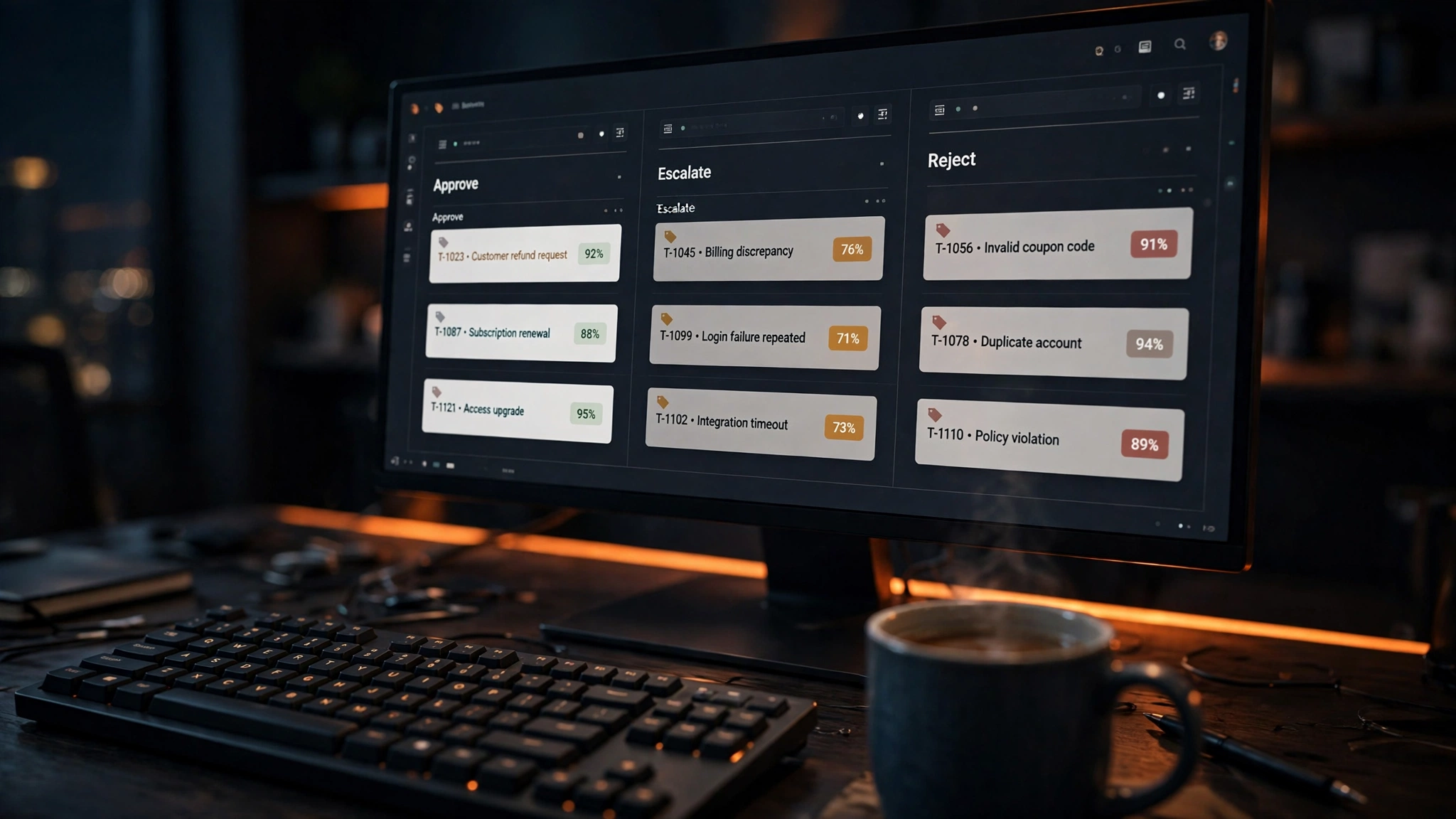
- Ticket triage. Every ticket gets a department, priority and urgency probability in one pass. Our chatbot development team builds this pattern into support systems; our real-estate lead follow-up guide shows the same routing for enquiries.
- Lead scoring. Score enquiries against your rubric; route the hot ones to sales first. Our CRM development service puts those scores where your team works.
- Spam and abuse detection. Judge every message before it reaches a human — at these prices you can score everything, not just a sample.
- Jailbreak guardrails. Check input against your safety rules before it reaches your main model, and check the output before it reaches the user — a small, fast gatekeeper for a large model.
- LLM routing. Send easy requests to a cheap model and hard ones to a strong model, cutting your inference bill without touching quality. Our AI automation service builds this routing into client workflows.
Guardrails are not optional: set a confidence threshold, send low-confidence cases to a human, and sample decisions weekly at first. A decision model is only as good as the criteria you give it. Our RAG chatbot guide and n8n versus Make versus Zapier comparison cover the same discipline and plumbing.
Baseten, Snowflake and Gemini Decision: three shapes of one idea
Decision models are now a category, and the three we have covered come in three shapes. Snowflake Decision, covered yesterday, runs inside the warehouse: call it from SQL and your data never leaves Snowflake. Gemini Decision 1, covered on 13 November, is Google's hosted Decisions API.
Baseten's pair is the third shape: API models you call from anywhere, with open weights you can run yourself, tied to no warehouse, cloud or vendor stack. That independence is the selling point, and the trade-off: you manage the integration, thresholds and monitoring yourself. Our custom software development team builds these integrations, and our custom software development cost guide for the UK covers what that work costs.
What decision models cannot do
The honest limit matters more than the pitch. Decision models answer bounded questions. They do not run multi-hour tasks. Yesterday's GDPx post found no model clears roughly 12% on long-horizon agent tasks — and bison-1 does not change that, because it is not trying to. A decision model is a judge, not a worker: it tells you which ticket is urgent; it does not resolve the ticket. The sensible split, per our guide to AI chatbots versus AI agents: a decision model sorts, scores and routes; a general model or an agent writes, talks and acts. Our AI agent development service builds systems that combine both; our AI agents for ecommerce and AI automation for logistics companies show where the combination pays off.
Frequently asked questions
What is Baseten bison-1?
A 31-billion-parameter decision model, post-trained from Google's Gemma 4 31B. It answers bounded questions — classification, scoring, routing — with a probability, and ranks first on the independent Artificial Analysis Decision Index v2.1 at 76. It takes text and image input with 128k context.
How much do bison-1 and groundhog-1 cost?
Baseten's published prices are $0.10 per million tokens for bison-1 and $0.035 for groundhog-1. You pay for input only — decision models produce no output tokens — and prices match Baseten's existing models, so current users can swap without repricing.
What is the difference between bison-1 and groundhog-1?
Bison-1 is the larger, more accurate model: a 31B dense model, top of the Decision Index, with the lowest Brier score at 0.14. Groundhog-1 is a 26B mixture-of-experts model with around 4B active parameters, roughly a third of the price, and no official Artificial Analysis score yet. Use bison-1 where a wrong decision is expensive, groundhog-1 where volume matters and humans review borderline cases.
How do Baseten's decision models differ from Snowflake Decision?
Snowflake Decision runs inside the warehouse and is called from SQL. Baseten's models are API models you call from anywhere, with open BF16 weights on Hugging Face for self-hosting. Choose Snowflake if your data lives in the warehouse, Baseten if you want a model not tied to one platform.
Can I run these models myself?
Yes. The open BF16 weights are on Hugging Face — Gemma 4 is Apache 2.0, Baseten's modifications MIT. Both are also live on Baseten Model APIs as decision-models/baseten-bison-latest and decision-models/baseten-groundhog-latest.
Want to test whether decision AI fits your workflow? Book a free AI consultation with Coheser. Full benchmark and pricing detail is on Baseten's blog.