Suki OS: The Agentic Operating System for Healthcare

Amir Farid
7 min read
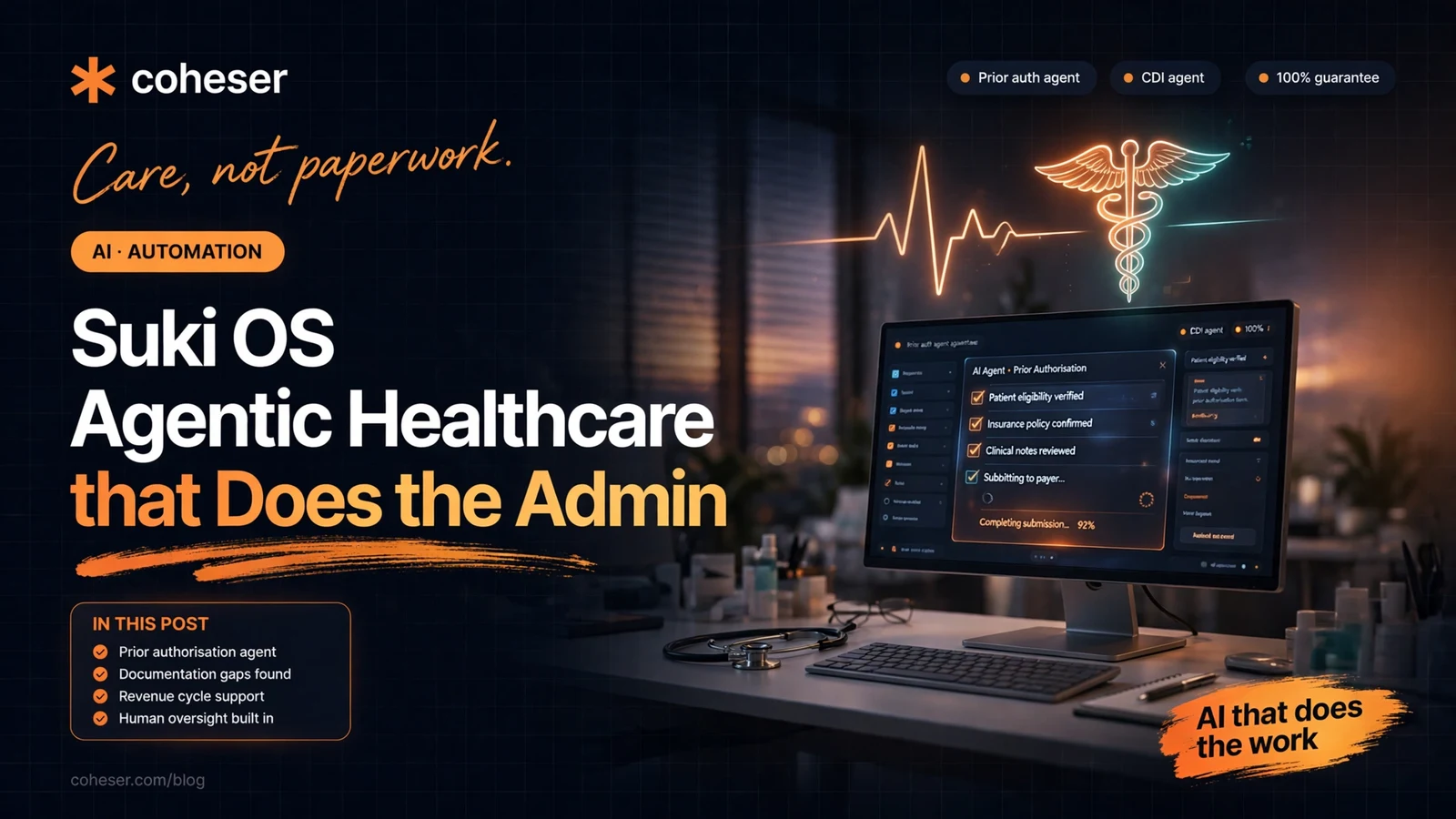
Suki OS is an agentic operating system for healthcare, unveiled by Suki at HLTH 2026 in Las Vegas on 16 November 2026. Built on Suki's ambient clinical intelligence platform, it connects a health system's fragmented technologies and turns clinical intelligence into action — not just documenting a consultation, but doing the follow-up work across patient care, operations and revenue cycle management.
That is the honest frame for this post. Suki OS is aimed at US health systems, and prior authorisation — one of its two launch use cases — is mainly a US insurance workflow. Clinics in the UK and Pakistan should read Suki OS as the direction clinical AI is heading, not as a product they can buy tomorrow. The facts below come from Suki's BusinessWire release, and the claims are Suki's own.
What Suki OS actually is
Suki OS sits on top of Suki's ambient clinical intelligence platform — the technology that listens to a clinical conversation and turns it into structured documentation. Suki OS adds a layer that acts on that output: checking whether a referral needs authorisation, spotting a gap in the documentation, or preparing material a coding team needs. Suki says its agents coordinate work before, during and after patient encounters.
A documentation tool records what a clinician said and did; an agentic system takes that record and starts the next task. It is the same idea at the heart of modern AI agent development, applied to clinical administration, where the work is repetitive, rule-bound and expensive to staff.
The three pillars of Suki OS

Suki structures the operating system around three pillars: a partner ecosystem, unified AI agents, and a commercial guarantee.
1. A partner ecosystem
Healthcare software is fragmented: scheduling in one system, records in another, billing in a third. Insight Partners integrate their intelligence with Suki's patient context, while Platform Partners embed Suki AI into their own products. New partners named at launch include Stellar Health and ECLAT. Any clinic weighing AI automation should ask first which systems it will actually connect to.
2. Unified AI agents
The second pillar is the agents themselves: software that carries out multi-step clinical and administrative tasks with clinician oversight. Suki says security, governance and clinician oversight are built into its agents at the core, not added afterwards. In healthcare, an agent without a clear audit trail or a human in the loop is a liability, not a feature.
3. The Suki Guarantee
The third pillar is commercial, and the most unusual part of the announcement. The Suki Guarantee is a performance-based framework: Suki says eligible customers can receive up to a 100% refund if agreed performance targets are not met. Outcome-based pricing is still rare in healthcare software. Clinics evaluating custom software should note the principle.
The two agents launching first
Suki announced two initial AI agent initiatives, both targeting administrative work that consumes clinical and back-office time.
Suki Prior Authorization Agent
Prior authorisation is the process of getting an insurer's approval before a treatment, test or procedure goes ahead. Suki's Prior Authorization Agent is designed to identify authorisation requirements, gather supporting clinical documentation, and streamline the authorisation process. This is a US workflow, but the underlying problem is universal: a clinician's decision creates a pile of administrative follow-up. See our guide to AI chatbots for clinics and healthcare for how similar systems work.
Clinical Documentation Improvement (CDI) Agent
The second agent targets documentation quality. The CDI Agent identifies documentation gaps, improves accuracy, and supports downstream coding and revenue cycle workflows. In plain terms, it reads the record, spots what is missing, and flags it for coders and billers. Incomplete documentation causes rejected claims, delayed payments and rework.
Why a refund promise matters
Software vendors rarely offer their money back, so the guarantee deserves a closer look. First, it shifts risk: the vendor shares the risk that the product under-delivers, instead of the buyer carrying it alone. Second, it forces measurement: both sides must be able to measure the agreed targets. Third, it signals a wider shift: as AI agent development costs fall, buyers will ask vendors to stand behind outcomes. Targets are agreed per customer, so treat the guarantee as a commercial framework, not a blanket promise.
What Suki OS means for clinics outside the US
For a clinic in the UK or Pakistan, the direct answer is simple: Suki OS is not a product you can buy tomorrow. Prior authorisation is a US insurance workflow, and Suki's launch is aimed at US health systems. Do not expect UK pricing, NHS availability or a local rollout — none of that has been announced, and this post does not invent it.
But the indirect lesson is real: clinical AI is moving from tools that write notes to agents that do the work around the note. UK GPs spend hours on paperwork; Pakistani clinics juggle records, billing and follow-up with small teams. Clinics should take three things from Suki OS: shared patient context across systems, human oversight from the start, and a commercial model built on measured outcomes. Clinics that want to start smaller can already automate the front door with an AI receptionist or a healthcare chatbot — see our comparison of AI chatbots versus AI agents.
Suki's momentum behind the launch
Suki secured $90 million in Series E funding in October 2026, bringing its total raised to more than $250 million. Patient encounters supported by Suki's tools grew more than 190% year over year in 2026, according to Suki, and its revenue doubled in 2025. Suki is also collaborating with Google Cloud on agent innovation, and a patient research agent is planned to debut at Google Cloud's Cancer AI Symposium in December 2026.
If you run a clinic, start by mapping where your team's time goes — our guide to AI agents for small business automation walks through that exercise, and Coheser's team can help scope a first project.
What clinics can do now
You do not need Suki OS to start. The practical steps are the same everywhere.
- Audit where the hours go. Track one week of admin work. The biggest time sink is your first automation target.
- Automate the front door first. Patient enquiries and appointment booking are the lowest-risk place to start.
- Keep a human in the loop. Any automation that touches patient records or money should have a clear approval step.
- Measure before and after. Record turnaround times and staff hours now, so you can judge the result.
- Check costs honestly. Read our custom software development cost guide for the UK before committing.
- Plan for data, not just features. Agents need clean, connected data — see our RAG chatbot guide.
The same pattern shows up elsewhere — see our guide to AI voice agents for restaurants and AI agents for recommendations and support.
Frequently asked questions
What is Suki OS?
Suki OS is an agentic operating system for healthcare, unveiled by Suki at HLTH 2026 in Las Vegas on 16 November 2026. Built on Suki's ambient clinical intelligence platform, it connects fragmented healthcare technologies and turns clinical intelligence into action, with human oversight.
What does the Suki Prior Authorization Agent do?
According to Suki, the Prior Authorization Agent identifies authorisation requirements, gathers supporting clinical documentation, and streamlines the authorisation process. Prior authorisation is mainly a US insurance workflow, so this agent is aimed at US health systems rather than UK or Pakistani clinics.
What is the Suki Guarantee?
The Suki Guarantee is a performance-based commercial framework. Suki says eligible customers can receive up to a 100% refund if agreed performance targets are not met. It is a commercial framework, not a blanket money-back promise.
Can UK or Pakistani clinics buy Suki OS?
No — not on the basis of anything announced so far. Suki has not announced UK pricing, NHS availability or a rollout outside the US. Clinics elsewhere should treat it as a sign of where clinical AI is heading, and start with proven AI automation for appointment handling.
How is Suki OS different from an AI scribe?
An AI scribe listens to a consultation and writes the note. Suki OS adds agents that act on that documentation — chasing authorisations, flagging gaps and supporting coding and revenue cycle work. The difference is action, not just transcription.