Qwen-Audio-3.1 Now Speaks 65 Languages: Multilingual Voice Agents for Business

Amir Farid
7 min read
Qwen-Audio-3.1 Now Speaks 65 Languages: Multilingual Voice Agents for Business
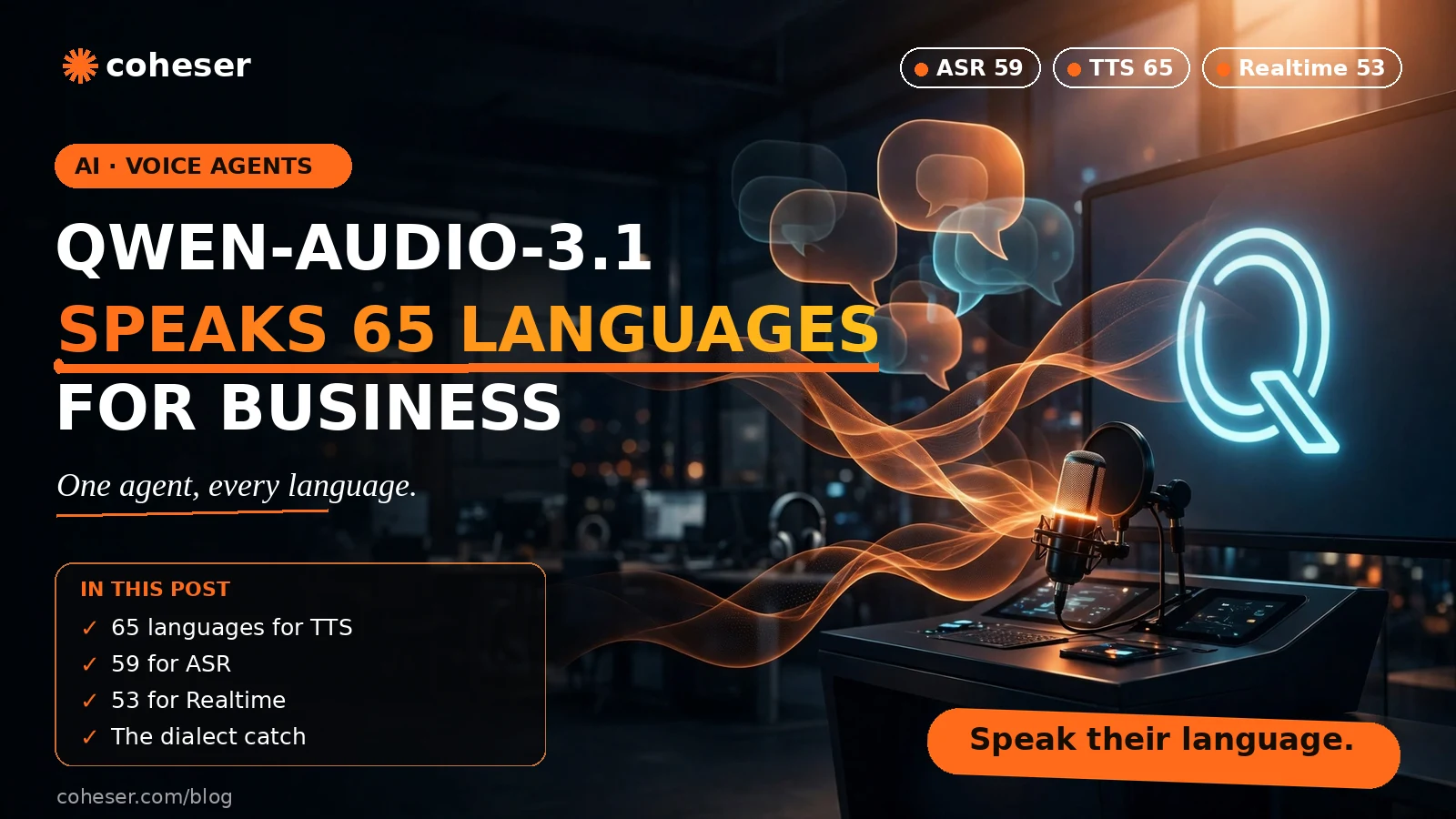
On 26 November 2026, Alibaba's Qwen team expanded language coverage across Qwen-Audio-3.1: speech recognition now covers 59 languages, text-to-speech reaches 65, and the real-time conversational endpoint covers 53. That means one voice agent can answer, book and take orders in the caller's language — Urdu and English in Pakistan, Arabic and English in the Gulf, and the UK's main community languages.
There is a catch: the published count of Chinese dialects fell at the same time, from 16 to 8, and Alibaba has not explained why. Figures below are Alibaba's own claims, not independently verified facts.
What changed on 26 November
Qwen-Audio-3.1 debuted in September 2026 as a five-model family; the November update touches three hosted endpoints on Alibaba Cloud. The new coverage, as reported by AlphaSignal, is:
- ASR (speech recognition): 59 languages and 8 Chinese dialects.
- TTS (speech synthesis): 65 languages and 6 Chinese dialects.
- Realtime (full-duplex conversation): 53 languages and 6 Chinese dialects.
The three numbers are not the same: check the endpoint that does the job you need. A wider list does not guarantee quality. Our healthcare voice agent guide shows how this works for patient calls, and our restaurants guide covers bookings and orders.
The honest catch: Chinese dialects fell from 16 to 8

At launch, Qwen-Audio-3.1 ASR covered 30 languages and 16 Chinese dialects. The update adds 29 languages — and cuts the published dialect count to 8. Alibaba has not explained whether it reflects reclassification, consolidation, or removed coverage.
Do not present the dialect drop as an improvement. Dialect coverage is where voice systems most often fail: a recogniser that handles Mandarin well can still struggle with Cantonese, Shanghainese, Sichuanese or Hokkien. The only honest test is representative audio: real calls, in the real dialect, from the real conditions your customers use.
The three endpoints, explained in plain English
The three updated endpoints are hosted, API-only services — you cannot self-host them.
ASR-Flash: listening and transcribing
ASR-Flash turns speech into text across 59 languages, removing fillers, and can return speaker labels and timestamps. Compare it with our Nemotron Transcribe guide.
TTS-Flash: speaking in the caller's language
TTS-Flash generates speech in 65 languages, with cross-lingual voice transfer — the same voice across several languages — and instruction-based control over emotion, speed, accent and delivery. See our Phonic 1 guide.
Realtime-Flash: holding the conversation
Realtime-Flash is the conversational endpoint. It is full-duplex — it listens while it speaks and can respond to interruptions, so the caller can cut in or change their mind mid-sentence. It supports function calling, web search, cloned voices and eight new system voices. See our Block Dessa guide on why interruption handling is the hardest part of a voice agent to get right.
What multilingual voice agents unlock for your business
The Coheser angle is simple: language is the unlock for businesses whose customers do not all speak the same language. A clinic in Lahore takes calls in Urdu and English; a restaurant group in Dubai in Arabic and English; a law firm in London in English plus its clients' community languages. Until now, covering all of that usually meant separate phone lines — or telling the caller to ring back in English.
One multilingual voice agent changes that. The caller speaks their language; the agent answers in it, switches mid-call if the caller switches, and books in that language. For a restaurant, that is a booking taken in Arabic at 9pm with no bilingual staff on shift. For a clinic, it is a patient booking in Urdu without struggling in a second language while unwell. None of this removes the need for humans: anything the agent is unsure about still goes to a person. For the difference between a simple chatbot and an agent that can act, see AI chatbot vs AI agent.
What it costs — pricing did not change
The update changed coverage, not prices. Alibaba says launch pricing cut prior rates by about 85% for Realtime, about 70% for TTS and up to 95% for ASR — Alibaba's claim. The rates to plan around are:
- ASR: ¥0.8 per million input tokens and ¥2.7 per million output tokens in Beijing; $1.094 input and $3.427 output in Singapore.
- TTS: $0.212 in and $1.696 out per million tokens in Beijing.
- Realtime-Plus tier (Singapore): $6.40 per million audio-input tokens and $24 per million audio-output tokens.
- Qwen-Audio-3.1-Live SKU (introduced 23 November): billed by wall-clock time: $0.000471 per second in Beijing, $0.000710 in Singapore, with a three-second billing floor.
Two things to note: token metering is not the same as per-minute pricing, so estimate from your real call lengths, and prices vary by region. See our AI calling agent cost guide and AI calling pricing guide for turning these rates into a monthly figure.
Under the hood: architecture, latency and the paper's numbers
Qwen-Audio-3.1 uses a mixture-of-experts backbone, six training stages and roughly 20 million hours of multilingual audio, according to the Qwen team. Streaming latency is about 160 milliseconds to first token. The Qwen team's earlier vendor comparison reported about 100 milliseconds to first character for message-mode ASR, against 570 for Doubao Streaming ASR 2.0 — Alibaba's own benchmark, not updated for this release.
The Realtime-Plus tier, added on 20 September 2026, brings a 262,144-token context window, full-duplex conversation, function calling, web search, voice cloning and eight new system voices. One limit: web search and function calling cannot be enabled at the same time. The technical paper, published on arXiv, reports task success rising from 78.4% to 82.0% on τ-Voice, and the response rate to background speech falling from 73.0% to 13.0% on Full-Duplex-Bench v1.5 — the paper's own figures, not independent verification.
What to check before you build one
Before you build on Qwen-Audio-3.1 — or any voice stack — check these four things.
- Dialect coverage, tested with your audio: run real calls in the dialects your customers speak.
- Latency from your region: measure complete turns, not just time-to-first-token.
- Cost at your call lengths: model the bill from your real average call duration and audio mix.
- Data residency: hosted, API-only services with no weights to self-host. Ask where recordings and transcripts are stored, who can access them, and how they are deleted.
Businesses in the UAE, Saudi Arabia, Pakistan and the United Kingdom face the same question in different forms — answer it from your own call logs.
How to start in five steps
- Count your calls by language for two weeks. Log volume and language mix — if most calls are in two languages, start with those two.
- Pick one job first. Start with booking and confirmations only; add the rest once booking works in every language.
- Test each language with real audio. Measure error rates per language, and test code-switching.
- Run a small pilot. Put the agent on one line, or after hours only, for two to four weeks.
- Expand slowly, and keep a human in the loop. Add languages one at a time. If you are building rather than buying, read our guide on how to build an AI voice agent. Coheser builds voice and WhatsApp agents — see our AI agent development and chatbot development services, or contact Coheser.
Frequently asked questions
How many languages does Qwen-Audio-3.1 support now?
Alibaba reports 59 languages for ASR, 65 for TTS and 53 for Realtime. Check the endpoint that does the job you need.
Why did the Chinese dialect count fall from 16 to 8?
Alibaba has not explained it. It may reflect reclassification, consolidation, or removed coverage — we do not know. If your callers speak a Chinese dialect, test it first.
Can I self-host Qwen-Audio-3.1?
No. The three updated endpoints are hosted, API-only services on Alibaba Cloud, with no downloadable weights. Check data residency and deletion rules before going live.
How much does a multilingual voice agent built on Qwen-Audio-3.1 cost?
Pricing did not change with this update. As a rough guide, ASR is about $1.09 per million input tokens in Singapore, TTS about $0.21 in Beijing, and Realtime-Plus $6.40 per million audio-input tokens in Singapore — but your real cost depends on your own call logs.
Is 65 languages enough to serve Urdu, Arabic and English customers?
On paper, yes. In practice, what matters is accuracy in the specific languages and dialects your callers use, plus latency and cost from your region. Pilot with your two biggest languages first.