DeepSeek Opens Its App Tools to Developers: Cheap AI Agents, With a Catch

Amir Farid
7 min read
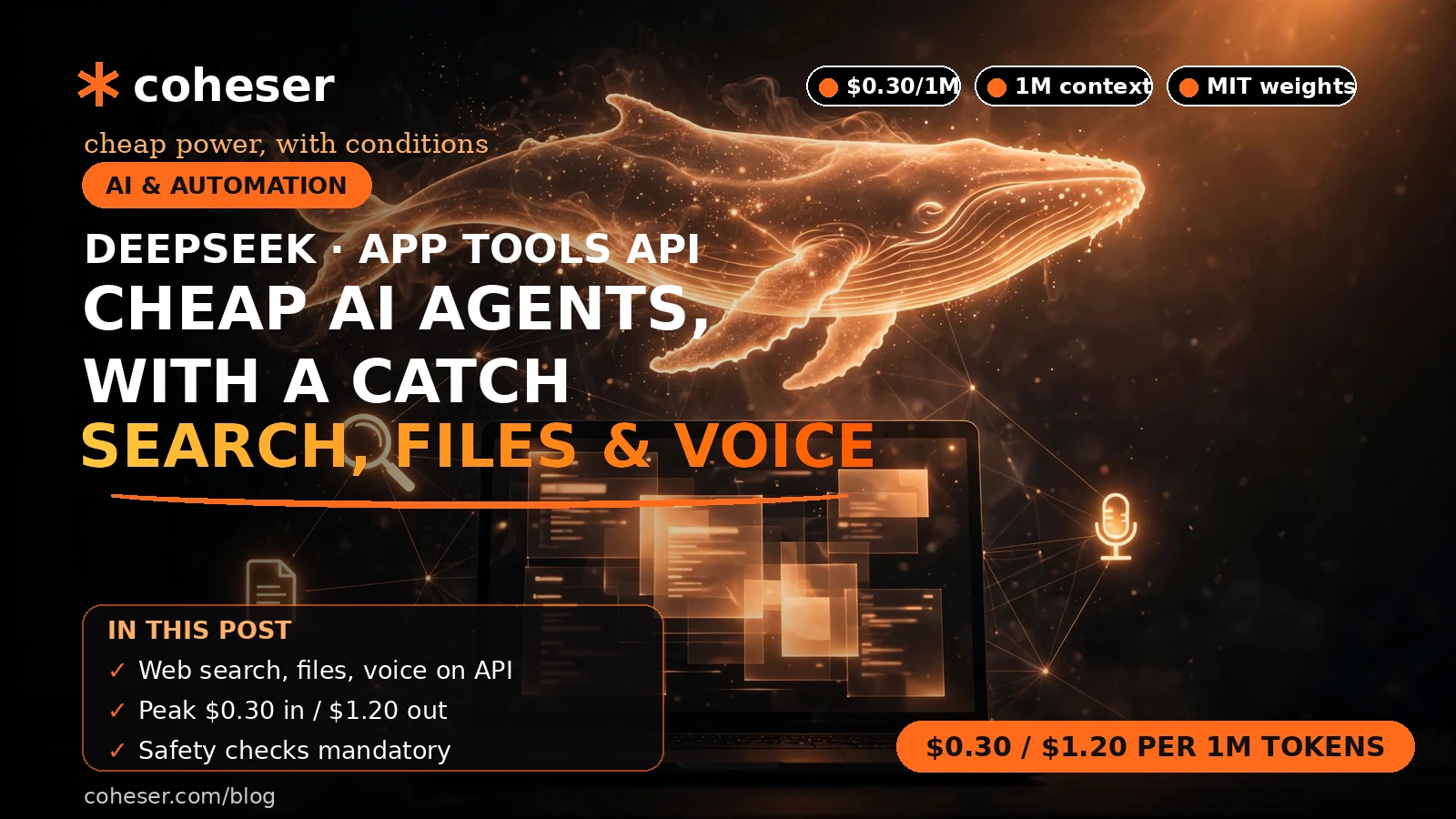
On 13 November 2026, DeepSeek opened the capabilities behind its consumer app to API developers. Web search, image search, deep-thinking search, file parsing, URL reading, safety checks and voice functions are now available through the API on deepseek-flash, across the Messages, Responses and Chat Completions endpoints. The price is $0.30 per 1M input tokens and $1.20 per 1M output at peak, half that off-peak.
For a business that wants a search-and-file-capable AI agent, that is the cheapest route we have seen from a frontier-class lab. This post explains what you get, what it costs, and the catch.
What DeepSeek actually opened up
Until now, the useful parts of the DeepSeek app — search, file reading, voice — stayed inside the app. The 13 November release moves them into the API so outside developers can build them into their own products. Crypto Briefing's report on the release sets out the same feature list.
The tools work with deepseek-flash, served by DeepSeek-V4.1-Flash-1017 — the 17 October 2026 update of the September V4.1 Flash release. They reportedly do not work with deepseek-v4-pro.
The built-in tools
- Web and image search: look things up rather than answering from training data.
- Deep-thinking search: a slower, more careful pass for questions that need digging.
- File parsing: upload documents for the agent to read.
- URL reading: point the agent at a page and it uses the contents.
- Safety checks: built-in moderation, required for public-facing apps.
- Voice functions: speech in and out, for phone calls and voice interfaces.
The standalone APIs
DeepSeek also broke several capabilities out as separate APIs: Search, Fetch, OCR, ASR and TTS. OCR turns images of text into usable text; ASR converts speech into words; TTS turns text into a spoken voice. Search finds information on the web; Fetch pulls a specific page's contents. An open-source frontend demo was released alongside.
The price: why $0.30 and $1.20 changes the maths

Deepseek-flash costs $0.30 per 1M input tokens and $1.20 per 1M output at peak, halving to $0.15 and $0.60 off-peak. Peak hours are 01:00 to 04:00 and 06:00 to 10:00 UTC on weekdays. Cache hits are reported at $0.003 per 1M tokens. The context window is 1M tokens, with up to 384K output tokens, and the weights are MIT-licensed, per the Hugging Face model card.
One warning: the tools are billed separately from the tokens, so budget for both.
An AI receptionist that reads 20,000 tokens and writes 2,000 costs about a cent per conversation at peak, half a cent off-peak. A thousand a day costs roughly $10 — the kind of price that lets a small business leave an agent running instead of rationing it. Voice is usually where agent budgets die, because speech is billed per minute on top of the model — check our AI calling agent cost guide first.
What you can build with it
The bundle matters because it removes the plumbing: building an assistant that searches, reads files and speaks has traditionally meant stitching together four or five services. DeepSeek now offers most of that in one place, cheaply. Our DeepSeek SuperAgent coverage looks at the open-source coding agent from the same lab.
Support agents that actually check things
A support agent that can search the web and read your own documents stops guessing. Give it your help centre, price list and returns policy as files, and it answers from those sources, not from memory. Our RAG chatbot guide explains how grounding stops invented answers.
The catch: safety checks, data location and the Pro gap
Cheap has conditions — three decide whether this API fits your business.
Public apps must include safety checks
Public-facing apps built on the API are required to include safety checks — a condition of using the tools, not an optional extra. You cannot ship a bare model call and call it done.
Your data is processed and stored in China
DeepSeek's privacy policy says personal data is processed and stored in China — the single biggest reason to pause before using the hosted API for customer data. If you handle regulated data, or serve UK or EU customers under GDPR, keep that data off the hosted API. The MIT licence on the weights means self-hosting is an option, but that is a different project. Our healthcare chatbot guide shows how strict the rules get with patient data.
The tools do not work with the Pro model
The built-in tools work with deepseek-flash and reportedly not with deepseek-v4-pro. If a task needs the heavier model's reasoning, you lose the tools. NIST's CAISI placed V4 Pro roughly eight months behind the frontier, according to reports — DeepSeek's strength is price and packaging, not leading-edge capability. Older DeepSeek agents were found far easier to hijack in testing, according to reports, so treat prompt-injection defences as a requirement. Our GDPx agent benchmark coverage shows no model clears roughly 12% on long-horizon tasks.
When DeepSeek fits — and when it does not
The decision is not about the model, but the data, the customer and the cost of a mistake.
DeepSeek fits when
- High volume, low sensitivity: public information, marketing content, internal research, lead triage.
- Cost is the constraint: thousands of runs a day, where flagship models eat the margin.
- Speed matters more than depth: classification, drafting, summarising, first-pass answers.
- You can self-host later: the MIT-licensed weights are an exit route.
DeepSeek does not fit when
- Data is regulated: health, finance, legal or children's data, or anything GDPR keeps in the UK or EU.
- Your customers are UK or EU businesses: many will ask where data is processed, and "China" ends the conversation.
- A mistake is expensive: safety-critical work, or a wrong answer reaching a customer unreviewed.
- You need the strongest reasoning: long-horizon planning and hard coding belong on a frontier model — see the cost in our Claude Fable 5.2 coverage and Cognition SWE-2 Flash coverage.
Think of it as a division of labour: Flash handles high-volume routine work, a frontier model handles decisions where quality justifies the price. Our chatbot vs AI agent guide helps you decide which system you are building first.
How to start this week
DeepSeek's own docs confirm the model name is deepseek-flash, served by V4.1-Flash-1017, on an OpenAI-compatible API. Start small and measure.
Day 1: pick one high-volume, low-sensitivity job
Choose a job that is repetitive, easy to check and uses no personal data: triaging public enquiries, drafting first replies, or summarising public web pages. Our e-commerce agent guide is a good template.
Days 2 to 7: measure cost, accuracy and latency
Run the same workflow at peak and off-peak and record the full cost, including tool calls, not just tokens. Test accuracy against questions you already know the answers to, and check the safety checks trigger when they should. Our n8n vs Make vs Zapier comparison shows how to wire a model into the tools you already use.
DeepSeek has made the cheapest capable agent stack cheaper still, and bundled the hard parts into one API call. It is not a reason to put regulated data on a hosted API in China, or to expect a budget model to do a frontier model's job. The businesses that benefit first will give it a real job this week, on low-stakes work. If you want help choosing that first job, see our AI agents and automation service or talk to Coheser.
Frequently asked questions
What did DeepSeek open to developers on 13 November 2026?
The consumer app's capabilities — web search, image search, deep-thinking search, file parsing, URL reading, safety checks and voice — on deepseek-flash, plus standalone Search, Fetch, OCR, ASR and TTS APIs.
How much does deepseek-flash cost?
$0.30 per 1M input and $1.20 per 1M output at peak, halving to $0.15 and $0.60 off-peak. Peak hours are 01:00 to 04:00 and 06:00 to 10:00 UTC on weekdays. Tools are billed separately; cache hits are reported at $0.003 per 1M tokens.
Is it safe to send customer data to the DeepSeek API?
DeepSeek's privacy policy says personal data is processed and stored in China, so keep regulated and UK/EU customer data off the hosted API. Public-facing apps must include safety checks.
When should I use DeepSeek instead of a frontier model?
Use DeepSeek Flash for high-volume, low-sensitivity work where cost matters most. Use a frontier model for regulated data, UK/EU customers, safety-critical work or long-horizon reasoning.