ChatGPT Wallet: AI Agents That Can Pay — What Businesses Must Do Now

Amir Farid
7 min read
OpenAI announced ChatGPT Wallet on 13 November 2026. It lets OpenAI's "dots" agents pay on a user's behalf, without the agent or the business ever seeing the card details. Every purchase needs a security check, such as Face ID or a fingerprint, before the money moves.
For now it is a small, US-only launch: ChatGPT Pro subscribers, aged 18 and over, with eligible US-issued cards. Agents are moving from answering questions to spending money. This post explains how it works, who can use it, and what your store should do.
What ChatGPT Wallet actually is
ChatGPT Wallet is a payment wallet for AI agents, used by OpenAI's "dots" agents — the always-on agents introduced on 29 September 2026. A dots agent can compare options and prices, then complete the purchase; the wallet is the part that pays.
OpenAI describes it as the first wallet that lets agents pay without access to users' actual card details and that requires a security check for every purchase. That is OpenAI's claim, not a verified fact: the wallet is brand new. What is concrete is the mechanism — a network payment token replaces the card number, so neither the business nor the agent sees the card details. See OpenAI's announcement.
Built with American Express, Mastercard and Visa; fraud prevention from Forter, Riskified, Sardine and Signifyd; processing from Adyen, Checkout.com and Stripe. Mastercard launched its own Agent Pay the day before, on 12 November.
How a purchase works
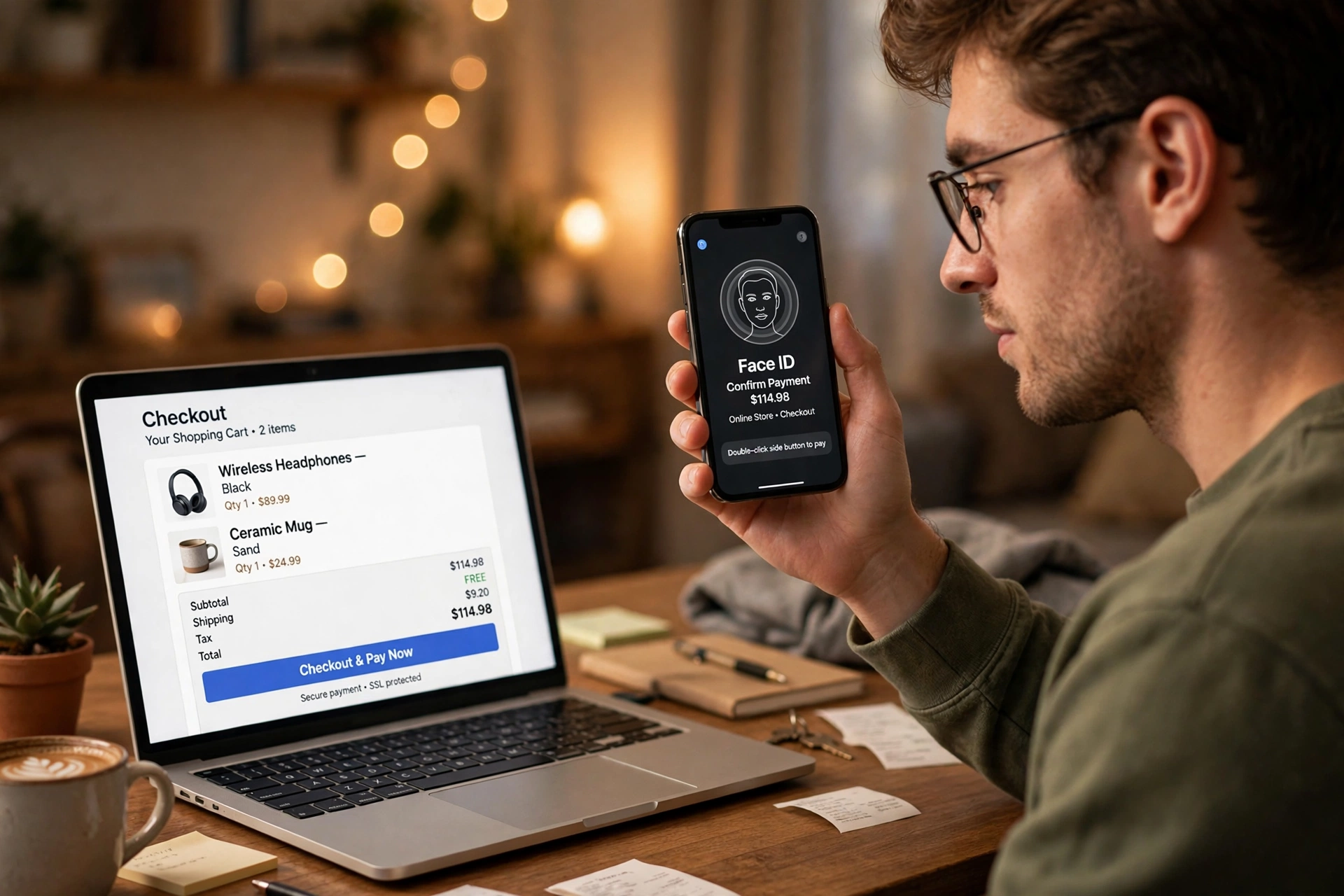
The token replaces your card
When a user adds a card, the number is replaced by a network payment token, which the business charges exactly like a card. The agent never handles the real number. A token can be revoked without cancelling the card.
A security check on every purchase
Every purchase needs a security check, such as Face ID or a fingerprint. There is no "approve once and spend freely" mode: the user stays in the loop for each transaction, so an agent cannot run up a bill on a vague instruction such as "buy the best one". That check limits how autonomous purchases can be — an agent needing a fingerprint for every order shops with supervision. See our AI agents for small business guide.
Who can use it today, and who cannot
The launch is narrow: US ChatGPT Pro subscribers, 18 or older, with eligible US-issued cards. No debit cards. The rollout is gradual.
There is no fee at launch, and OpenAI takes 0% commission, according to CNBC reporting — reported, not confirmed by OpenAI. That narrow start is normal: cards, fraud rules and regulations differ by country. US retailers selling to ChatGPT Pro subscribers matter most.
What changes for retailers
The most important fact for retailers is what you do not have to do: the wallet works with existing checkout pages, with no Wallet-specific integration to build. If your checkout already accepts the card networks involved, an agent can pay through it.
The barrier to agent commerce was never the payment rails; it was trust. A wallet that hides card details and asks the user to approve each purchase removes the two biggest objections. Our AI agents for e-commerce guide covers the other half: agents that recommend products and recover abandoned carts. Our WhatsApp commerce guide for retailers makes the same point for conversational selling.
No integration needed, but visibility matters
The practical question is whether an agent can reach your checkout at all: agents browse your site, read product pages and fill in checkout like a customer. If your product information is clear, your prices are current and your checkout works without a login wall, an agent can complete a purchase. If your site hides prices behind a form, the agent fails and buys from a competitor instead. See our Shopify agentic commerce coverage and our guide to getting cited by ChatGPT.
The United Airlines problem: permission, not payment
Here is the catch. ChatGPT Wallet does not work on sites that block agents, and some businesses are choosing to block them. United Airlines revised its Contract of Carriage on 11 November 2026 to ban unauthorised AI-agent bookings. The wallet can pay; the airline will not let the agent buy.
That makes permission, not payment, the real bottleneck. A business can refuse agent purchases for good reasons — scalping, fraud, or not wanting a third party between it and its customer — but a blanket ban also turns away legitimate customers who prefer to shop through an agent.
The wallet's per-purchase security check suggests OpenAI expects trust to build slowly, one approved order at a time. Businesses that ban agents may dodge the early risks and miss the early customers. No model yet clears roughly 12% on long-horizon agent tasks — see our GDPx agent benchmark coverage.
Getting your store ready for agent checkouts
You do not need to rebuild your store. Check four things.
1. Decide your position on agent purchases
Do you accept purchases made by AI agents on a customer's behalf? Say so in your terms either way, and be clear about what happens when an agent tries. Review your terms of service — United's move shows that terms are where this fight will happen.
2. Make your checkout agent-readable
Can a product page be understood without JavaScript tricks? Is the price, including delivery, visible before checkout? Does guest checkout work, or does the flow demand an account first? Fix the friction a human would also hate. Our AI agents and automation development service can review your checkout and feeds, and our AI agent development cost guide covers the cost. Our n8n vs Make vs Zapier comparison shows how to wire automation into the tools you already use.
3. Keep your product feed honest
Agents buy what your feed says you sell. If prices, stock or delivery times are stale, the agent orders something you cannot fulfil, and the refund lands on you. An accurate, daily-updated product feed is the cheapest agent-readiness investment there is. Our RAG chatbot guide applies the same discipline: ground the AI in your real data and it stops inventing answers. See also our e-commerce returns automation guide.
4. Watch fraud and refunds, not just sales
The wallet's tokenisation and per-purchase checks help, and OpenAI's named fraud partners — Forter, Riskified, Sardine and Signifyd — exist because agent orders need screening. Track chargeback and refund rates on agent-originated orders separately from human orders. If the numbers diverge, tighten your rules before the volume grows. See our AI receptionist guide.
What to watch before you bet on it
Three things will decide whether this becomes a real sales channel or a launch-day headline. First, the rollout: how fast it moves beyond US Pro subscribers, and whether debit cards and non-US cards follow. Second, the economics: whether the reported 0% commission survives, and what the card networks charge once volume grows.
Third, the bans: if more big sellers follow United Airlines, the wallet's reach shrinks no matter how good the technology is. Reuters covered the launch, including the rollout limits, in its report on ChatGPT Wallet. If you want help getting ready, talk to Coheser — we build AI agents and e-commerce systems ready for customers however they shop. See our chatbot vs AI agent guide if you are still deciding which agent your business needs.
Frequently asked questions
What is ChatGPT Wallet?
A payment wallet announced by OpenAI on 13 November 2026 that lets its "dots" agents pay for purchases on a user's behalf. A network token replaces the card number, and every purchase needs a security check such as Face ID or a fingerprint.
Who can use ChatGPT Wallet?
At launch, ChatGPT Pro subscribers in the United States who are 18 or older, using eligible US-issued cards. Debit cards are not supported, and the rollout is gradual.
Does my store need a special integration to accept ChatGPT Wallet?
No. The wallet works with existing checkout pages. The practical requirement is that an agent can reach and complete your checkout: clear product information, visible prices, no unnecessary barriers.
Can a business block AI agents from buying?
Yes. The wallet does not work on sites that block agents, and United Airlines revised its Contract of Carriage on 11 November 2026 to ban unauthorised AI-agent bookings. Each business should write its position into its terms.