Z.ai GLM-5.4: The AI That Reads Its Own Work Twice

Amir Farid
7 min read
Z.ai GLM-5.4: The AI That Reads Its Own Work Twice
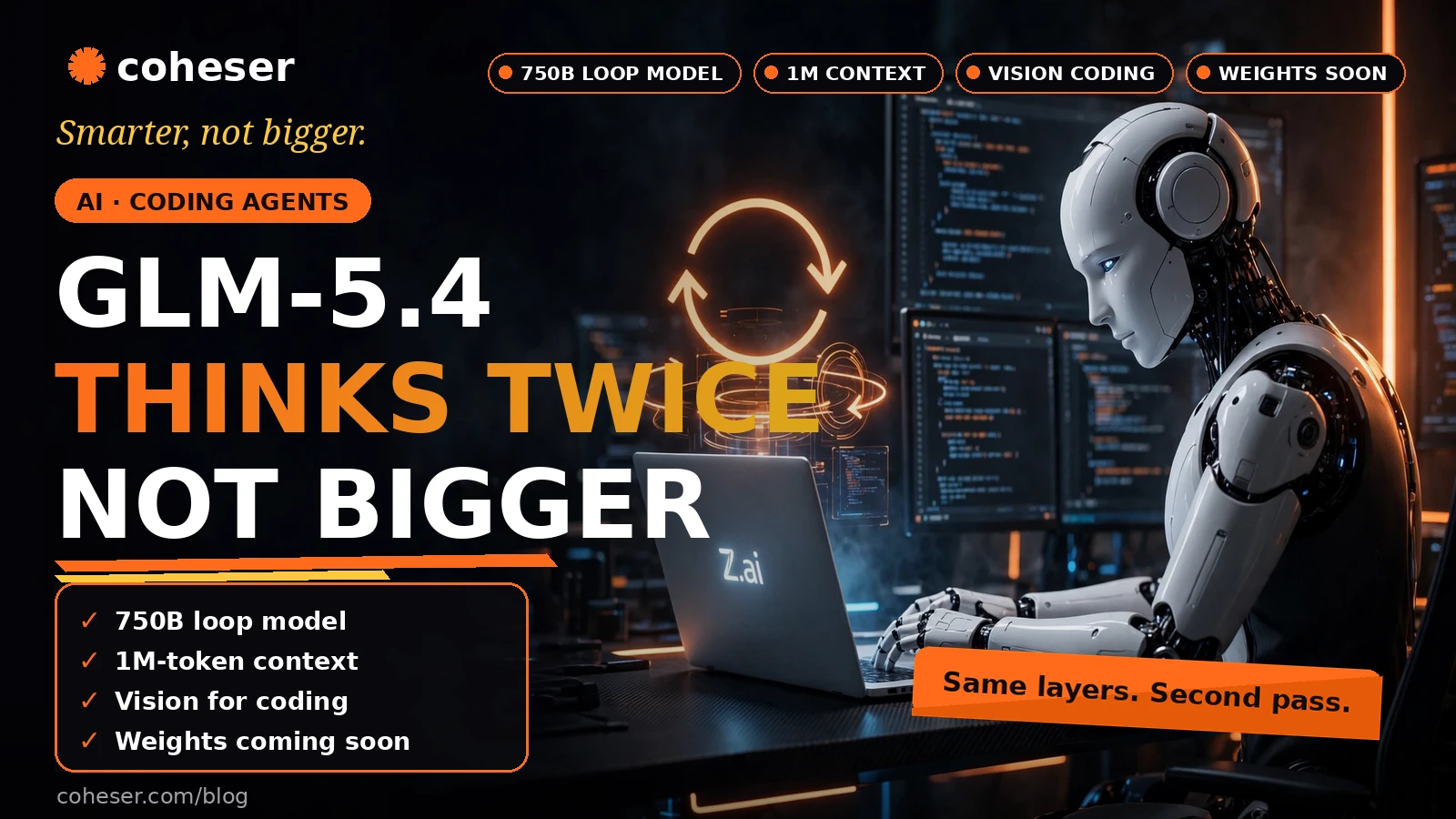
Z.ai's GLM-5.4, announced on 23 November 2026, is a 750-billion-parameter flagship that does something unusual: instead of simply getting bigger, it runs 28 of its layers twice on every answer, re-reading its own work before it responds. Z.ai calls this a Loop Transformer, and claims the result performs like a model two to four times its size. The catch is that the claim is unverified — Z.ai has published no benchmark scores for the 750B flagship — and there is no public API or open weights yet. For businesses, the story is the architecture trend, not a tool to switch to today. GLM-5.4 is worth understanding because it points at a shift: doing more with the same weights, rather than adding more weights.
What GLM-5.4 actually is
GLM-5.4 is the new flagship from Z.ai, the Chinese AI lab formerly known as Zhipu AI, announced on 23 November 2026 as the first flagship built on a Loop Transformer. It is 750B-scale, with a 1M-token context window, aimed at coding and long-horizon agent work. Read Z.ai's own announcement on the Z.ai blog for the full version of its claims.
It arrives in a crowded field: Claude Fable 5.2, Cognition's SWE-2 Flash and Kimi K3.1 Pro all pitch for the same job — an AI that writes, tests and fixes software with less hand-holding.
Why coding is the test that matters
Coding is the most commercially serious use of large models, because the work is measurable: code either runs or it does not. Keep the GDPx benchmark in mind — no model cleared roughly 12% on long-horizon agent tasks.
How the Loop Transformer works
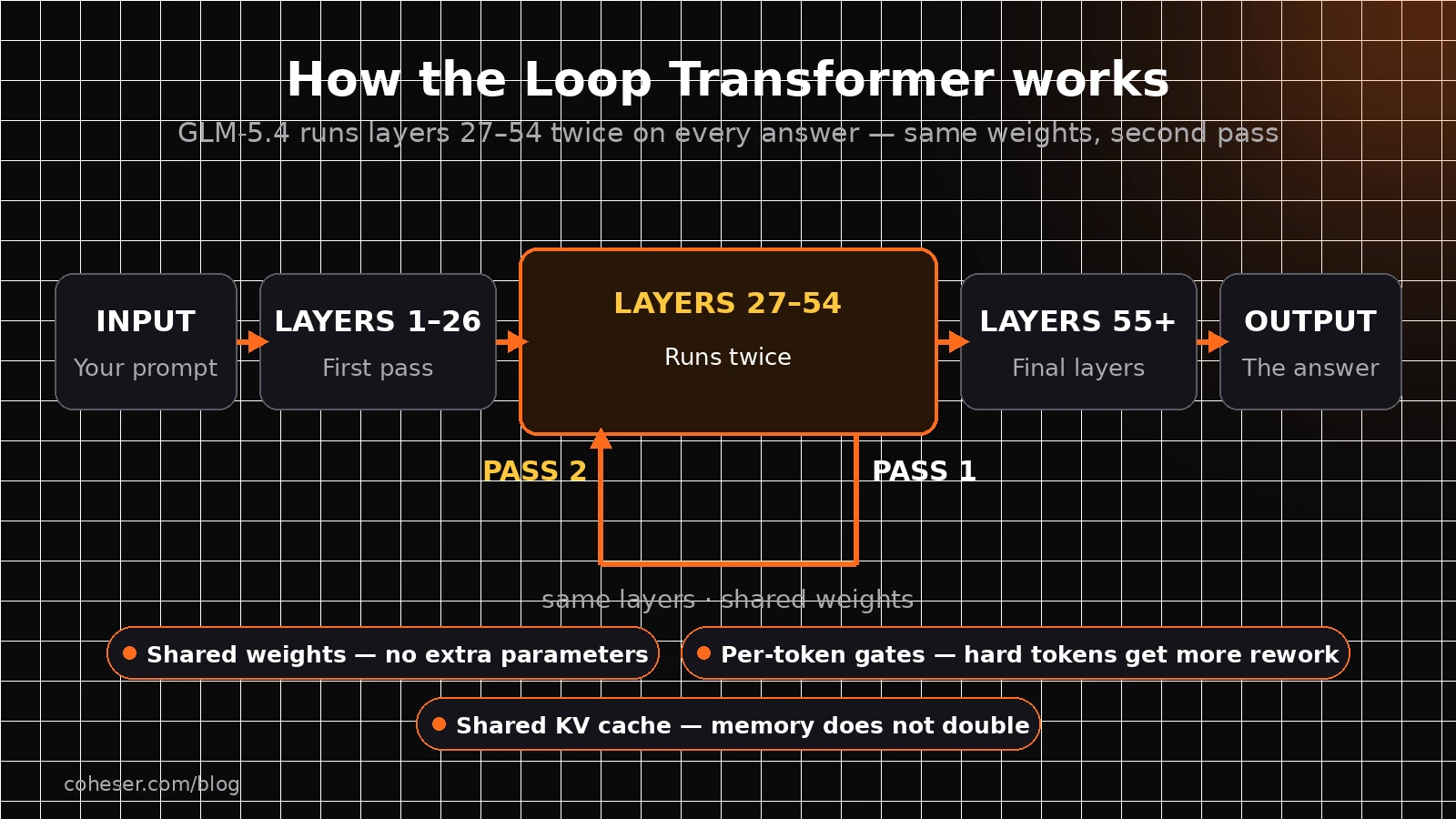
A standard transformer passes information through its layers once. GLM-5.4 takes 28 layers of its GLM-5 base — layers 27 to 54 — and runs them twice on every forward pass. The weights are shared between passes, so the model does not double in size. Per-token gates decide how much of the second pass each token needs, and a shared KV cache means memory does not double either.
The intuition is closer to how a person works: instead of hiring a larger team, you ask the same team to review its own draft before handing it over. The first pass produces a draft; the second pass refines it.
What the 750B number does and does not mean
Z.ai claims GLM-5.4's intelligence is comparable to models with 2 to 3 trillion parameters. That is Z.ai's claim, and it is unverified: the company has published no benchmark scores for the 750B flagship itself. The figures in its announcement blog come from a 30B test model, not from GLM-5.4.
That does not make the claim false. It makes it unproven. A 30B test model is a legitimate way to validate an architecture idea, but it is not evidence about a 750B flagship. Until independent benchmarks appear, treat the 2–3T comparison as marketing, not measurement.
Vision, 1M context and "Generalized Coding"
Beyond the loop, GLM-5.4 adds vision: it can read screenshots and images, which matters for visual coding. With a 1M-token context window, it can hold a large codebase and its history in one session. The model appears as glm-5.4[1m] inside Claude Code and as glm-5.4 elsewhere.
Z.ai calls its direction "Generalized Coding": code as the base for tasks beyond software. The demos include a self-narrated Hello World music video, a 6-axis robotic arm in FreeCAD, a complete game with physics, maps and combat, and an interactive 3D bird-watching scene from geometry and custom GLSL shaders.
Speed, cost and how to get it
GLM-5.4 is available now through the GLM Coding Plan, ZCode and Z.ai Chat. There is no public API yet — that follows after a safety evaluation — and the weights come only after further safety testing, with no date given.
The Coding Plan prices are Lite at $12.6 per month, Pro at $56 and Max at $117.6. Z.ai says prices may change, so treat those as launch prices. Z.ai reports up to 200 tokens per second off-peak and 70 to 80 at peak load — vendor-reported figures, not independently measured.
The honest weaknesses
Z.ai deserves credit for disclosing a real weakness: overly long "marathon thinking" loops. The same self-checking that improves accuracy can keep going too long.
One large benchmark run took 431 minutes with GLM-5.4, against 109 minutes for the comparison model, per Z.ai's own blog — roughly four times slower.
What is still missing
- No flagship benchmarks: no published scores for the 750B model, only figures from a 30B test model.
- No public API: access is limited to Z.ai's own products until a safety evaluation is complete.
- No open weights: release is promised after further safety testing, with no date.
- No independent verification: nobody outside Z.ai has yet confirmed the 2–3T comparison or the speed figures.
None of this is a reason to dismiss GLM-5.4 — it is a reason to treat it as a development to track. The independent coverage is worth reading alongside the vendor announcement: see The Decoder's report on the launch.
What this means for your business
For most businesses, the correct response is to track the loop-architecture trend rather than switch tools today. Labs are finding that doing more with the same weights can beat simply training a larger model.
Practically, nothing changes this week. If you are planning an AI agent development project, or scoping custom software development, the decision that matters is the system around the model: the evaluation harness, the guardrails, the human review step.
Three things worth doing now
- Watch the benchmarks, not the launch: when independent scores for the 750B flagship appear, they will tell you more than the announcement did.
- Test on your own code: when the API or weights arrive, run the model on your real codebase — a GPT-6.2 Astra comparison only means something against your own tasks.
- Build the system, not the model bet: a good harness lets you swap models when a better one appears. Our guide to how to build a custom AI chatbot makes the same point.
Four milestones will decide whether GLM-5.4 matters beyond the announcement: flagship benchmark scores, the public API, the open-weights release, and real-world reports from developers using it in Claude Code and ZCode. Until then, the loop is a good idea with an unproven flagship. That discipline is also what keeps a SaaS MVP scalable without rebuilding, and it sits behind our SaaS development and AI automation work. For a broader view, see the n8n Nod local personal agent, the WhatsApp AI agent versus human support comparison, and Gemini 4 Neon. If you want help choosing the right model and building the system around it, talk to our chatbot development team.
Frequently asked questions
What is Z.ai GLM-5.4?
GLM-5.4 is Z.ai's flagship AI model, announced on 23 November 2026. It is a 750B-scale model built on a Loop Transformer, which runs 28 of its layers twice per answer. It has a 1M-token context window and vision for reading screenshots.
What is a Loop Transformer?
A Loop Transformer runs part of the network more than once per forward pass. In GLM-5.4, layers 27 to 54 run twice, with shared weights, per-token gates and a shared KV cache — more work from the same parameters.
Is GLM-5.4 really as good as a 2–3 trillion parameter model?
That is Z.ai's claim, and it is unverified. Z.ai has published no benchmark scores for the 750B flagship; the figures in its announcement come from a 30B test model.
Can I use GLM-5.4 today?
Yes, but only inside Z.ai's own products: the GLM Coding Plan, ZCode and Z.ai Chat. There is no public API yet, and the weights come only after further safety testing, with no date given. The Coding Plan costs Lite $12.6, Pro $56 and Max $117.6 per month, though Z.ai says prices may change.
Should my business switch to GLM-5.4?
Not yet. With no public API, no open weights and no independent benchmarks, there is nothing to switch to today. Track the loop-architecture trend, keep your evaluation harness model-agnostic, and test GLM-5.4 on your own code when access opens up.