GPT-6.2 Astra and Sol: OpenAI's Cheaper Frontier Models, Explained for Business

Amir Farid
7 min read
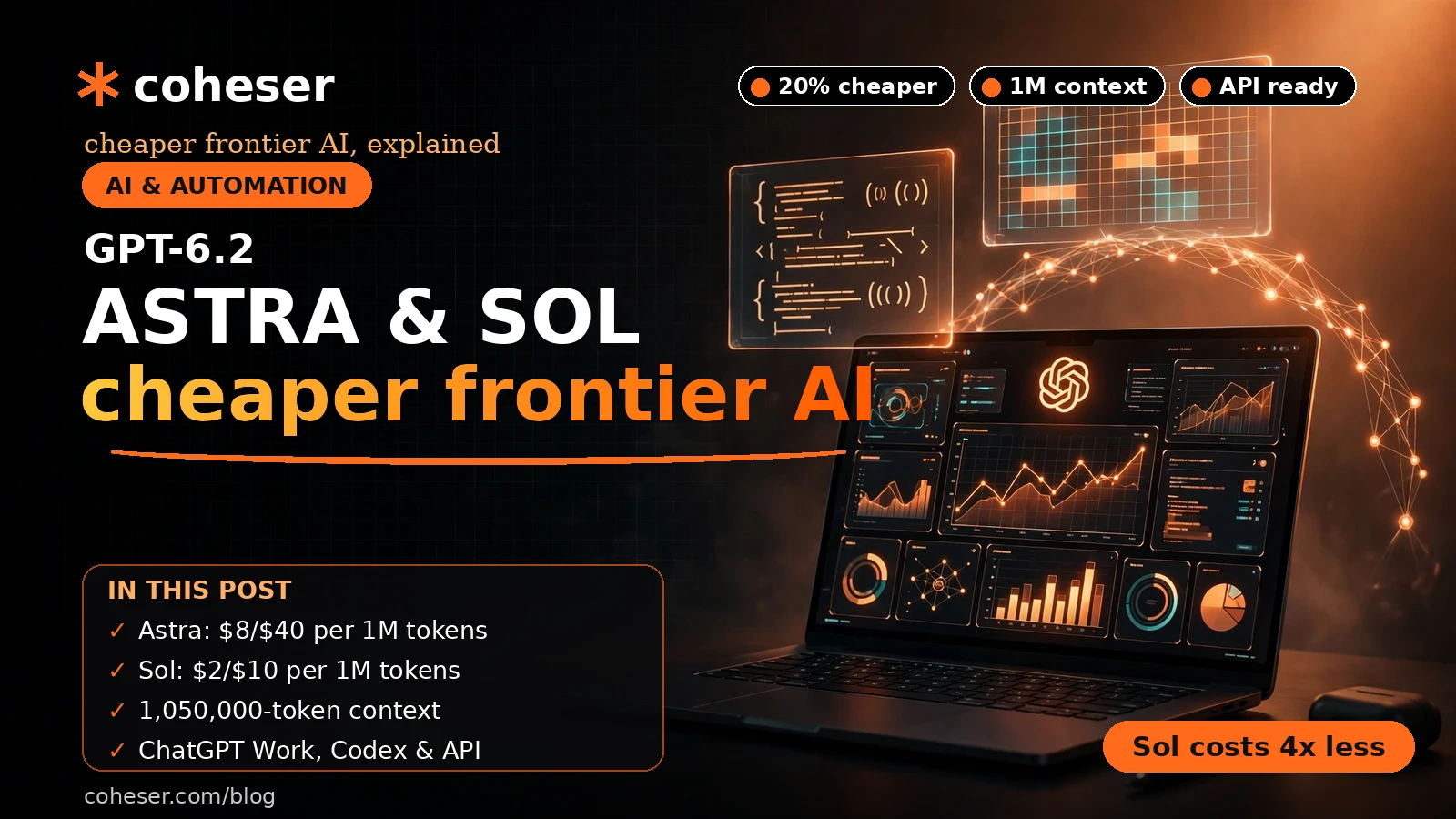
OpenAI launched GPT-6.2 Astra and GPT-6.2 Sol on 17 November 2026: two new models aimed squarely at business work. Astra is the new frontier model for your hardest projects; Sol is the efficient, versatile model for everyday work. Both are available now in ChatGPT Work and Codex for Plus, Pro, Enterprise and Edu users, and through the API as gpt-6.2-astra and gpt-6.2-sol — but not in regular Chat. The headline for businesses is price: Astra costs 20% less than GPT-6 Astra, while Sol holds the GPT-6.1 Sol prices. This post explains what each model does, what the numbers mean, and how to route work.
The short version: use Sol for routine work, and reserve Astra for jobs where accuracy justifies the higher price. Below: the pricing maths, OpenAI's benchmark claims, the safety picture and a routing plan — full details in OpenAI's own announcement.
GPT-6.2 Astra and Sol: OpenAI's Cheaper Frontier Models, Explained for Business
What GPT-6.2 Astra and Sol actually are
GPT-6.2 Astra is OpenAI's new frontier model for the hardest projects: long, multi-step work where the model plans, uses tools and checks its own output. GPT-6.2 Sol is the efficient sibling for everyday work. Both share a 1,050,000-token context window, according to OpenAI's API model listing.
Two models, one family
The split follows the pattern OpenAI set with GPT-6.1 Terra: a cheaper workhorse for volume, a stronger model for the hard jobs. Terra, launched on 26 October, halved the cost of everyday automation; Sol plays a similar role now, while Astra pushes the frontier forward for less than its predecessor cost. Sol is the default, Astra is the upgrade — see our GPT-6.1 Terra guide.
The price: what Astra and Sol actually cost

API pricing is where the launch is most concrete. Astra costs $8 per 1M input tokens, $0.40 cached input and $40 output — 20% lower than GPT-6 Astra, with a 60% discount on cached input. That cut matters for agent workloads, where documents get re-read on every step. Sol keeps GPT-6.1 Sol prices: $2 input, $0.10 cached and $10 output per 1M tokens.
The cost maths, in plain numbers
- Cached input is where Astra's 60% discount bites: $0.40 per 1M against Sol's $0.10 — still 4x, but the gap shrinks on long agent runs.
- Worked example: 1M input tokens (half cached) plus 200k output costs about $12.20 on Astra, $3.05 on Sol — same 4x ratio, so routing is about value, not pennies.
Price the whole workflow, not the single call: agent jobs burn tokens on reading, reasoning, acting and re-checking, so measure cost per completed task — the same discipline behind any serious AI automation project.
What the benchmarks claim — and what they don't prove
Every figure here is OpenAI's own claim from its launch announcement, not an independent result — pilot before you believe any of it. On Agents' Last Exam, OpenAI says Astra scored 5.2 points above GPT-6 Astra at less than a third of the cost, and 5.5 points above Claude Fable 5.2 at 5% of the cost, and by 9 points on Terminal-Bench-Science. On GDPval v2, OpenAI claims Astra scored 6.2 points higher than GPT-6 Astra with 22% fewer output tokens.
Where Sol punches above its price
OpenAI says Sol comes within 0.5 points of Astra on FrontierCode 2.0 at about one-fifth of the cost, and outscores GPT-6 Astra on LifeVal at about one-seventh of the cost. On AA-3D, OpenAI reports Astra first at 1,318 Elo, ahead of Claude Fable 5.2 at 1,271 and Sol at 1,259. On AA-AnalystAgent, OpenAI claims Astra got 62.5% of tasks correct on all five attempts. See our Claude Fable 5.2 guide.
What to measure instead
Benchmarks measure test tasks, not your invoices or codebase. Pilot both models on your own tasks and measure success rate with a human reviewer, cost per completed task, and how often staff must intervene. Our GDPx agent benchmark post showed even the best AI agent scores only around 12% on long-horizon business tasks.
Where Astra earns its price — and where Sol wins
Astra is for jobs where getting it wrong costs more than the tokens: research spanning many sources, code changes across a whole codebase, analysis that must survive a partner's review. Sol is for the volume: drafting, summarising, first-pass analysis, customer replies, routine coding. Easy to check and cheap to redo means Sol; hard to check or high-stakes means Astra earns its 4x price — see our guide to AI agents for small business automation. Escalate on failure: if Sol fails a check twice, re-run the step on Astra.
A simple routing rule
- Sol first: drafting, summaries, triage, first-pass code, customer-facing replies — anything a human reviews quickly.
- Astra when it matters: final code review, complex analysis, professional documents, multi-step agent jobs, anything where a mistake reaches a client.
Professional work: slides, spreadsheets, documents — and CAD
The most business-relevant claim is about professional outputs: slides, spreadsheets and documents that follow templates and field conventions in law, sales, finance and accounting. That means output that respects the formats your clients and regulators expect, not a plausible-looking document you must rebuild. OpenAI also points to computer use, CAD and 3D design, with the AA-3D result above as its evidence — again, OpenAI's own figure.
Where this helps first
The fastest wins are documents your team already produces in volume: sales proposals on a house template, finance packs in fixed formats, legal drafts matching a firm's conventions. For law firms, the Harvey LAB-AA v1.1 claim is a reason to pilot, not to buy: OpenAI says Astra more than doubles Claude Fable 5.2's pass rate at about one-sixth of the cost. CAD and 3D work is newer: pilot one contained task with a human engineer checking outputs.
Safety, and how to pilot both models
OpenAI says both models meet the Critical threshold for cybersecurity and High for biological and chemical capabilities under its Preparedness Framework, and Astra is the first externally released OpenAI model rated High for AI self-improvement. It also announced a Control Room system, tighter safeguards for higher-risk cybersecurity help, and Daybreak access for defenders. See our GPT-6 Cyber guide.
Pilot before you commit. Pick one routine workflow, run it on Sol for two weeks, then test Astra on the hardest jobs. Compare cost per completed task, reviewer effort and exception rate, and scale only what the evidence supports. If you need help, read our guides on chatbots versus AI agents and how to build an AI voice agent, and apply the same logic to CRM development, restaurant ERP, SaaS development and custom software development.
Frequently asked questions
When did GPT-6.2 Astra and Sol launch, and where are they available?
They launched on 17 November 2026 in ChatGPT Work and Codex for Plus, Pro, Enterprise and Edu users, and via the API as gpt-6.2-astra and gpt-6.2-sol — not in regular Chat. Check your plan first; teams in the United Kingdom and the UAE should confirm data-handling terms.
How much do GPT-6.2 Astra and Sol cost on the API?
Astra: $8 per 1M input tokens, $0.40 cached input, $40 output — 20% lower than GPT-6 Astra, with a 60% discount on cached input. Sol keeps GPT-6.1 Sol prices: $2, $0.10 and $10. Astra output costs 4x Sol's, so route routine work to Sol.
What is GPT-6.2 Sol best used for?
Everyday business work: drafting, summarising, first-pass analysis, customer replies and routine coding — anything a human reviews quickly. Astra is for the hard jobs: long projects, final code review, professional documents. The same logic applies to customer-facing work: a chatbot, a WhatsApp bot or an AI calling agent — see our AI calling agent cost guide.
Should my business switch to GPT-6.2 Astra and Sol now?
Pilot first. On OpenAI's own evaluations Astra beats GPT-6 Astra and Claude Fable 5.2 on several benchmarks, and Sol sits close to Astra at a fifth of the cost — but benchmarks are not proof for your tasks. Run a short pilot, measure cost per completed task, and scale only what the evidence supports.