Google Gemini Can Now Fill Your Grocery Cart and Check Out

Amir Farid
7 min read
Google Gemini can now do your weekly shop. On 20 November 2026, Google rolled out new Connected Apps in Search and the Gemini app that let shoppers in the United States order groceries from Target, Albertsons, Safeway and Shaw’s by asking in plain language. Gemini suggests real products, fills the cart for delivery or pickup, and checks out — all inside the conversation. Checkout runs on the Universal Commerce Protocol (UCP), an open standard co-developed with retailers including Target. The merchant stays the seller of record. The grocery apps are US-only for now; no date is confirmed for the UK, the UAE, Saudi Arabia or Pakistan. But the checkout is moving inside the chat, and retailers that want to be bought through an AI assistant need to be ready.
What Google actually announced
Google announced the new Connected Apps on its Keyword blog on 20 November 2026. The headline addition is grocery: Target, Albertsons, Safeway and Shaw’s join Instacart, available as a Connected App since July. Shoppers can ask for help with a holiday or Thanksgiving shop, and Gemini builds the order and checks out. Google says the apps are “powered by the Universal Commerce Protocol”, introduced earlier in 2026 for AI-assisted purchases.
Finance and home services arrive in the same announcement. Experian, already live in the Gemini app, is rolling out to Search so US users can check their credit rating and shop for a personal loan, while H&R Block handles tax calculations and refund estimates. Angi and Thumbtack account linking follows in the coming weeks. Google’s own announcement lists the partners and the US-only scope, and Digital Trends’ coverage confirms the details: AI Mode now, AI Overviews later.
How grocery shopping works inside Gemini and Search
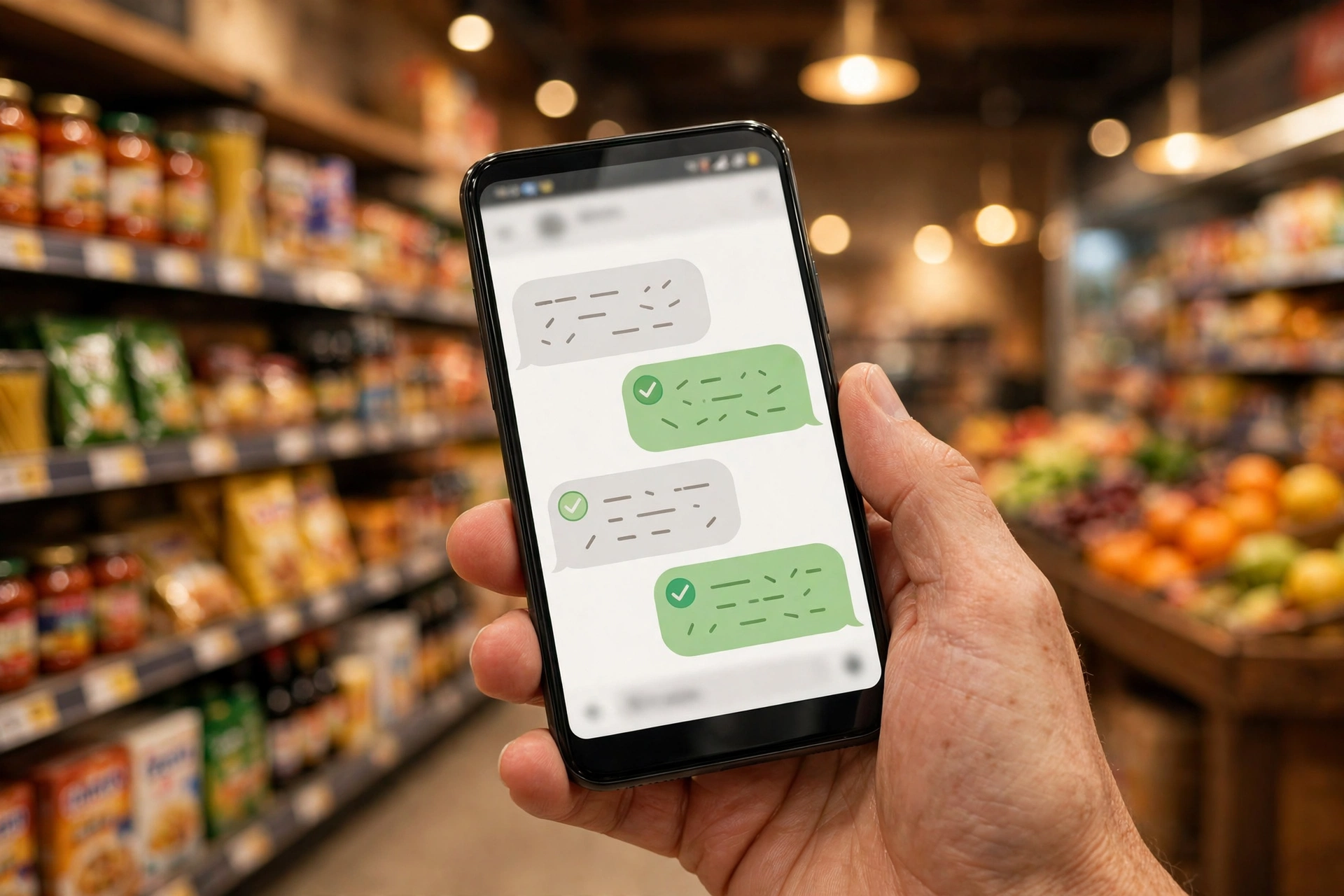
A shopper types a request the way they would say it: snacks for a party of twelve or the weekly shop for a family of four. Gemini turns that into real products from the chosen store, fills the cart, and checks out — no store app needed.
Choosing a store on purpose
Name the store in your request, or start it with an @mention such as @Safeway. When an AI picks the products, the store that gets named gets the sale. Loyalty accounts can be linked, and Gemini shows live stock, so it suggests items that are actually available. More than 50 Connected Apps are now live across Gemini and Search.
- The list becomes the order. A vague brief becomes a concrete cart, substitutions included.
- Comparison happens inside the chat. The decision is made before any storefront loads.
- Checkout is one step, not a journey. No product, basket or payment pages — the conversation is the funnel.
What the Universal Commerce Protocol changes
UCP is the quiet part of this story. It is an open protocol, not a Google-only feature: any retailer can adopt it, and any AI assistant can speak it. Google co-developed it with retailers including Target. It defines how an agent discovers products, checks price and availability, builds a cart and completes checkout, with the merchant remaining the merchant of record — Google is the surface where the sale starts, not the seller.
Two reasons it matters. First, a retailer does not need to build its own AI assistant to be bought through one — it needs a clean, machine-readable product feed and a checkout an agent can complete. Second, the competition is open: independent grocers and regional chains can appear in the same conversational surface as the big national names, provided their data earns the agent’s trust.
It is not just groceries
The pattern extends beyond the weekly shop. Experian and H&R Block bring money into Search, and Angi and Thumbtack will bring local services. A task that used to mean opening an app and filling in forms now starts as a sentence and ends as a completed booking or order.
ChatGPT’s wallet and agent payments and Shopify’s agentic commerce push are the nearest parallels. Google’s grocery move is the same idea at the scale of a weekly necessity, which is how a new behaviour becomes normal. Recent agent benchmarks show long-horizon tasks are still hard, but a grocery order is a short, well-defined task — and that is why it works now.
What this means for retailers, grocers and restaurants
Being found inside an AI conversation is a second storefront, and the winners are the businesses whose data an agent can read, trust and act on.
Your product feed is your new shop window
An AI agent cannot browse your shelves. It reads your feed. Every product needs an accurate name, a current price, live stock status, and a description that says what the item actually is. A stale feed means skipped or wrong suggestions — and the customer blames you, not the AI. Our guide to AI voice agents for restaurants covers the same shift in phone orders.
Pickup, delivery and loyalty must be machine-readable
Gemini can offer delivery or pickup only if it knows what you offer, where, and by when. Delivery zones, cut-off times, minimum order values and pickup windows must be structured data, not a paragraph buried on a contact page. The same applies to loyalty: if a customer’s points cannot be applied inside the AI checkout, they will order from the store where they can. That plumbing is a large part of what AI agent development looks like in practice.
The conversation is the new point of sale
When checkout lives inside a chat, clear descriptions win the order. A grocer listing “party snacks for twelve, nut-free” as a bundle is easier for an agent to sell than forty separate crisps. That is the same discipline behind good chatbot development and mobile app development.
How to get your business ready
You do not need to rebuild your store to prepare, and you should not wait for the feature to reach your market.
- Audit your product and menu data. Names, prices, stock and options must be accurate and consistent everywhere you sell.
- Publish structured fulfilment details. Delivery areas, cut-off times, minimums and pickup slots: explicit and machine-readable.
- Make loyalty portable. Make sure loyalty benefits work through a third-party checkout, not only inside your own app.
- Test the conversational path. Ask an AI assistant for your own products the way a customer would.
- Watch UCP, but do not wait for it. The protocol is open and still evolving; Coheser can help you prepare for it.
Preparation costs far less than a new sales channel. See our UK AI agent development cost guide and custom software cost guide for realistic ranges, AI automation for logistics companies, and our n8n vs Make vs Zapier comparison.
What to watch out for
Three cautions. First, this is US-only for now, and Google has not confirmed when — or whether — it reaches the UK, the UAE, Saudi Arabia or Pakistan, so businesses outside the US should prepare, not promise it. Second, the merchant stays the merchant of record, so refunds and complaints still land on the retailer. Third, the agent is only as good as your data: a wrong allergen substitute or delivery slot is a trust problem, not a tech glitch.
Frequently asked questions
Can I use Gemini grocery shopping in the UK?
Not yet. The grocery Connected Apps launched in the United States on 20 November 2026, and Google has not confirmed international timing. UK users got OpenTable in an earlier batch, but there is no date for grocery outside the US.
Which stores work with Gemini grocery shopping?
Target, Albertsons, Safeway and Shaw’s, alongside Instacart, which was already available. Name a store in your request, or use an @mention such as @Safeway.
What is the Universal Commerce Protocol?
UCP is an open protocol, co-developed by Google with retailers including Target, that lets an AI assistant find products, check price and stock, build a cart and complete checkout. The merchant remains the seller of record.
How should my business prepare for agentic commerce?
Start with clean, machine-readable product data, accurate live stock, clear delivery and pickup options, and loyalty that works through third-party checkout. Then test what an AI assistant finds when it looks for you. If you want help, talk to Coheser about your store, or contact us for a readiness review. For automation that works today, look at SnapLive and our AI calling pricing guide.