Mobile App Maintenance Cost: What You Pay After Launch

Amir Farid
7 min read
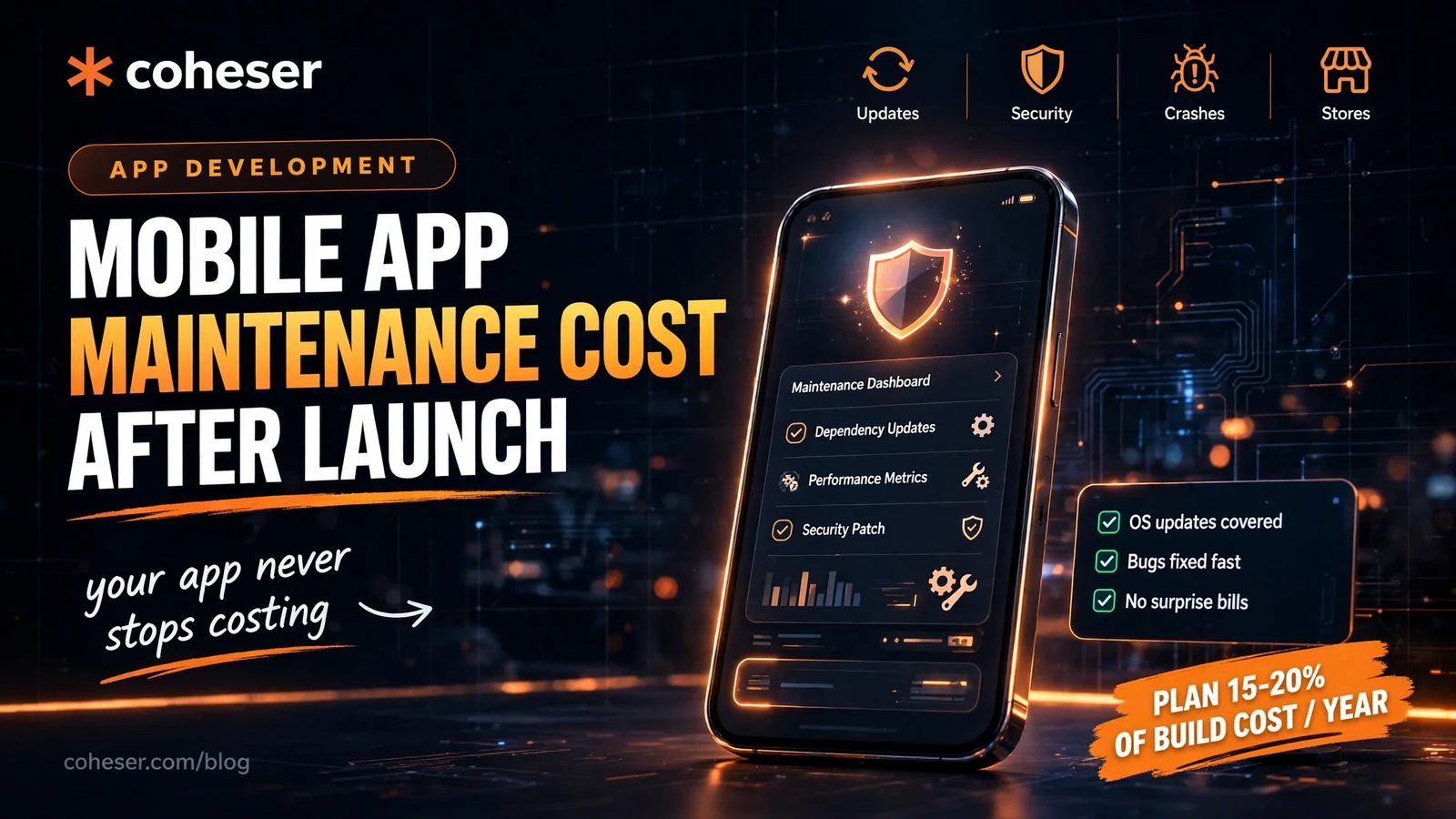
Mobile app maintenance costs roughly 15 to 20 percent of the original build cost per year. That is the rule of thumb most developers use, and it is a useful starting point, but it is not a quote. A simple app that cost £30,000 to build might cost £4,500 to £6,000 a year to maintain, while a larger app with payments and integrations that cost £150,000 to build might cost £22,500 to £30,000 a year. What you actually pay depends on how complex the app is, how often it changes, and how much work you keep in house.
Maintenance is everything that keeps an app working, secure and up to date after it goes live. Operating systems change, libraries get patched, users report bugs, and store rules move. An app left alone slowly falls behind, until one day a routine phone update breaks it.
What mobile app maintenance actually covers
When a developer quotes a maintenance retainer, the work usually falls into a few buckets.
Bug fixes and operating system updates
Real users find problems no test plan catches: a button works on one phone model and fails on another. Apple and Google also release a major operating system update every year, and each one can change how permissions, notifications and payments behave.
Security patches and app store compliance
Most apps rely on third-party libraries for payments, maps and login, and those libraries receive security fixes regularly. Apple and Google also change their rules regularly, and an app that passed review last year can be rejected on its next update.
How much does mobile app maintenance cost?

There is no single price, so think in ranges. The figures below are planning estimates, not quotes.
- Simple app (a handful of screens, no login, little or no server): roughly £300 to £800 a month, or £3,600 to £9,600 a year.
- Mid-size app (accounts, payments, push notifications, a small admin panel): roughly £800 to £2,500 a month, or £9,600 to £30,000 a year.
- Complex app (real-time features, multiple integrations, a large user base): roughly £2,500 to £8,000+ a month, or £30,000 to £96,000+ a year.
That is why the 15 to 20 percent rule is useful. If your app cost £60,000 to build, budgeting £9,000 to £12,000 a year for maintenance is a sensible starting point. A realistic mobile app development cost estimate should always include a maintenance line, not just the build.
The cost drivers that move the price up or down
Two apps can cost the same to build and very different amounts to maintain.
How the app was built
A well-built app with clean code, automated tests and up-to-date libraries is cheaper to maintain than a rushed one. Our comparison of Flutter vs React Native for your business app explains how a single codebase can cut ongoing maintenance in half compared with two separate native apps.
Platforms and integrations
Maintaining separate iOS and Android apps roughly doubles the update and testing work. A cross-platform app built with Flutter app development shares most of its code, so a fix ships once, not twice. Every integration is also a dependency: payment gateways, maps and messaging services all change their APIs from time to time.
What you pay every year, line by line
Some maintenance costs are fixed and predictable.
- Apple Developer Program: $99 a year to distribute on the App Store. See Apple's enrolment page for the current fee.
- Google Play Console: a one-time $25 registration fee, with no annual charge. See Google Play Console for details.
- Hosting and databases: from a few pounds a month for a small app to hundreds or thousands for a busy one. Cloud hosting scales with traffic, so this line grows as the app grows.
- Third-party services: push notifications, analytics, crash reporting, email and SMS all have their own pricing, often free at low volumes and metered above that.
- Monitoring and backups: tools that watch your servers and alert you to failures, plus automated backups. Cheap compared with a day offline.
On top of those fixed costs sits the human work: bug fixes, updates and support. That is where most of the budget goes. A custom software development partner can bundle these costs and the development hours into one predictable monthly retainer.
What happens if you skip maintenance
Skipping maintenance saves money for a while, and then it costs far more.
The app breaks, or the store removes it
Apple or Google changes something, users update their phones, and a core feature stops working. The fix is urgent, the developer is booked, and you are paying emergency rates to restore an app that should never have broken.
Security holes pile up, and a rebuild becomes necessary
An unpatched library with a known vulnerability is an open door. If your app handles customer data or payments, a breach can mean fines, lost trust and legal trouble. And an app left unmaintained for two years rarely needs a small update. It needs a rebuild, because libraries are years out of date and the code no longer builds with current tools.
How to budget for maintenance before you launch
The cheapest time to plan maintenance is before the app exists.
Ask for a maintenance estimate with the build quote
Any serious proposal for a mobile app should include a first-year maintenance figure. If a quote only covers the build, ask what happens on day one after launch.
Set aside 15 to 20 percent, and separate it from new features
Use the rule of thumb as a budget line, not a promise. If your app is a SaaS product with paying customers, budget towards the higher end, because downtime costs you revenue directly.
Keep two budgets. One keeps the app alive: fixes, updates, security, hosting. The other buys growth: new features and redesigns. Mixing them means feature work quietly eats the maintenance budget.
How to keep maintenance costs under control
Maintenance is not a cost you can remove, but you can keep it lean.
- Build cross-platform where it fits. One codebase means one set of fixes. See our guide to Flutter app development for when this is the right call.
- Keep dependencies few and current. Every library you add is a future update. Update them in small steps rather than letting them drift for a year.
- Automate testing. Automated tests catch regressions before users do, and they make every future update faster and safer.
- Monitor, don't guess. Crash reporting and server monitoring tell you what is actually broken. Without them, you find out from angry reviews.
- Use automation for support. A chatbot or an AI calling agent can handle routine user questions and cut the support load. Our guide to AI agents for small business automation shows how.
The same thinking applies to a restaurant ERP, a custom AI agent or a workflow automation project: the maintenance load follows the rate of change in the business, not the calendar.
Frequently asked questions
How much does it cost to maintain an app per month?
As a rough guide, a simple app costs £300 to £800 a month, a mid-size app £800 to £2,500 a month, and a complex app £2,500 to £8,000+ a month.
Is app maintenance really 15 to 20 percent of the build cost per year?
It is a widely used rule of thumb, not a fixed price. It works well as a budgeting starting point, especially in the first year. Apps with heavy integrations or rapid growth can cost more, while simple apps can cost less.
What is included in app maintenance?
Typical maintenance covers bug fixes, operating system and library updates, security patches, hosting, monitoring and backups, app store compliance, and user support. New features are usually billed separately.
What happens if I stop maintaining my app?
The app keeps working for a while, then breaks. A phone update, an expired certificate or a changed store rule can take it offline without warning. Security vulnerabilities accumulate, and after a year or two the app often needs a partial or full rebuild. Steady maintenance is almost always cheaper than rescue work.
If you are planning an app, or you already have one and the maintenance bill keeps growing, talk to Coheser. We build and maintain web and mobile apps, and our free AI consultation is a straightforward conversation about what your app costs to run. No pressure, no jargon, just an honest answer.