Google's December 2026 Core Update: Pre-Announced — What Your Business Should Do Now

Amir Farid
7 min read
Google's December 2026 Core Update: Pre-Announced — What Your Business Should Do Now
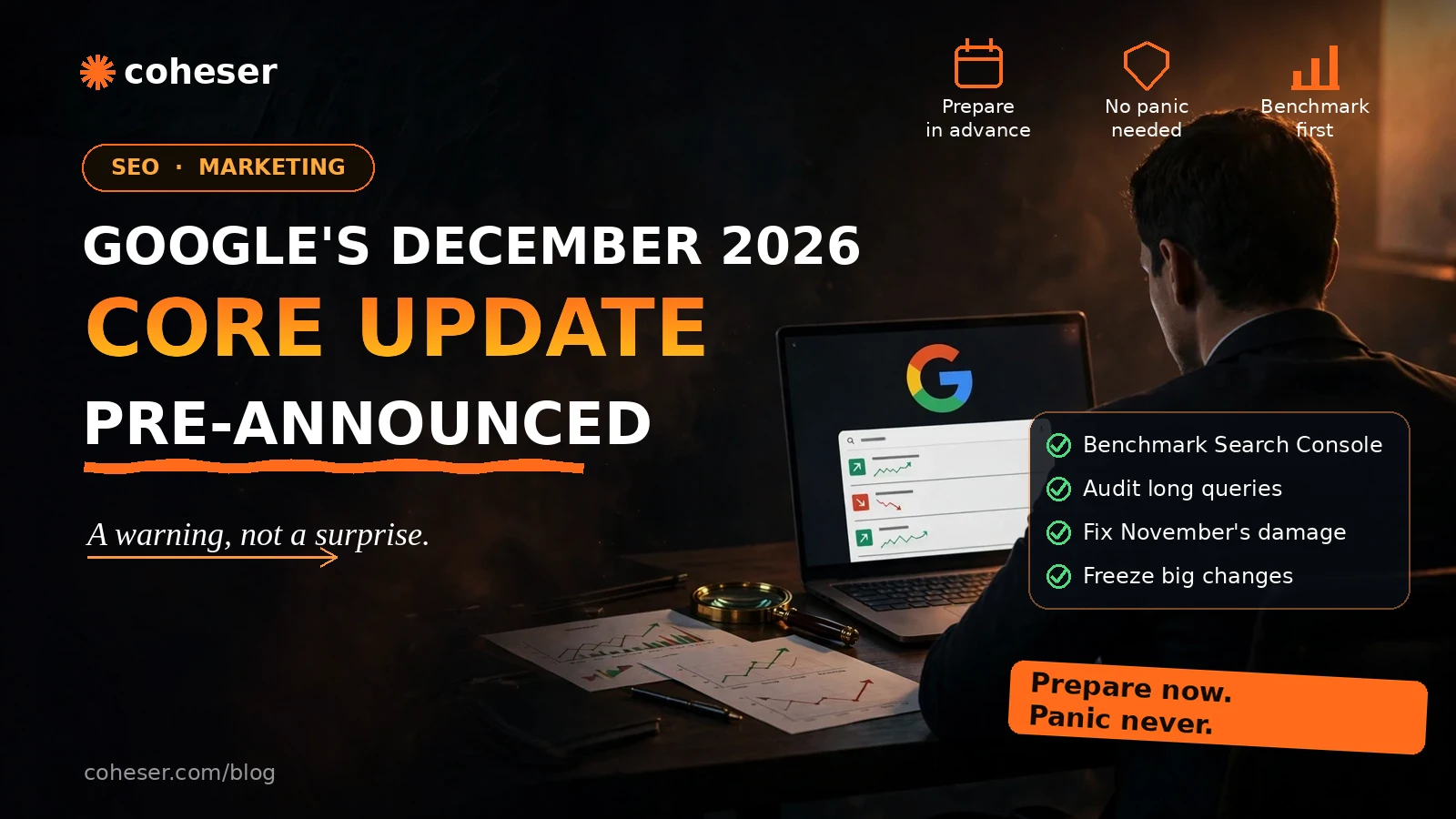
Google has done something it has never done before: announced a core update before it started. On 24 November 2026, Google's Search Status Dashboard pre-announced the December 2026 core update — the first advance notice Google has ever given. The update is scheduled to be released in December 2026, but Google has given no exact start date, and a Google spokesperson has called it "not imminent". Google has confirmed three times it is not live yet. That gives business owners a rare preparation window. This post covers what Google said, what it did not, and the checklist to use first.
What Google actually said — and what it did not
Google's words, in full: "Preannounced the December 2026 core update, which focuses on multiple improvements to how our systems understand and rank relevant content (including for longer and more complex questions), as well as improving personalized results for people who have personalization turned on." It applies to all locations and languages where Google Search is available, and ends: "This update is scheduled to be released in December 2026."
That is the whole announcement: no start date, no end date, no affected site types, no guidance on what to change. Caution: the dashboard briefly listed the update as active before it started — a display glitch. Do not treat it as confirmation until Google posts a date. The WebTures report covers what the announcement says and what it does not.
Why a pre-announcement is new — and what arrived with it

Until now, every core update entry has opened with "Released" — the notice went up as the rollout began. December's is the only one that opens with "Preannounced": the first time Google has told site owners a core update is coming before it starts.
The same day, Google launched the Search Ranking Hub, a central page for ranking documentation, advance notice and feedback. Verified site owners can send feedback from Search Console with the Submit Feedback button, naming the update with a hashtag — Google's example is #NovemberCoreUpdate2026. It is not an appeal, and it brings no manual ranking adjustments. Google reviews submissions in aggregate, so use it only for a problem bigger than your own site — scraper sites outranking the original source, for example. The lolasquared guide covers the feedback channel in full.
Close out the November update first
The November 2026 core update ran 10–24 November — 13 days, 19 hours and 57 minutes by Google's own times. Less than an hour after it finished, the December pre-announcement went up. It was Google's third core update of 2026, after March and May. Our guide to the November 2026 core update has the detail.
Assess November's impact now, before December starts, or the two updates will blur together on one chart. Google's advice: wait until the update is complete, then at least a week more, and compare a week afterwards with the week before it began. For November, compare 1–7 December against 3–9 November — the same weekdays, with a full week's gap after the rollout. If December's starts before your comparison week ends, wait for it to finish, add a week, and compare again.
What the December update focuses on
Google named two areas of focus: understanding what a person means, and results shaped around that person.
Longer and more complex questions
The first focus is "multiple improvements to how our systems understand and rank relevant content (including for longer and more complex questions)". Think of the long, specific questions people type when they know roughly what they want — "which AI agent handles WhatsApp bookings for a Manchester dental clinic". Pages that answer the whole question are rewarded; thin pages that repeat it without answering are at risk.
Personalized results
The second focus is "improving personalized results for people who have personalization turned on". Results vary by the searcher's history and settings, so searching for your own business is a poor way to check your ranking — use Search Console's Performance report instead. Record today's gap between your logged-out rank tracker and Search Console, so you can interpret changes after December instead of guessing.
The UK rules analysts think are behind the notice
Analysts have an inference for why Google would pre-announce now — not a Google statement. The UK Competition and Markets Authority designated Google as holding strategic market status in general search in October 2025 and imposed its Fair Ranking Conduct Requirement in June 2026: at least 30 business days' notice of certain policy changes, at least 15 for significant ranking changes, with compliance due by 17 December 2026. Analysts infer a mid-to-late December rollout from that calendar — but Google has not linked the pre-announcement to the UK rules.
For UK businesses, the rules matter beyond this update: they cover how Google ranks, not only when it warns you — including a rule that opting out of Google's search generative AI features cannot be held against you. Our guide to opting out of AI training explains the settings.
Your preparation checklist — seven things to do now
A preparation window, not a panic — work through these before the rollout starts.
- Benchmark Search Console now. Export Performance data for the last 28 days: top pages, queries, positions.
- Isolate your long queries. Filter for queries of six words or more and list the pages getting traffic from them.
- Audit thin content on complex questions. Check your most-visited pages answer fully — detail, exceptions, next step.
- Check the personalization gap. Compare your logged-out rank tracker with Search Console and record the gap today.
- Fix what November already exposed. If November moved any of your pages, fix those first.
- Freeze big technical changes during the rollout. Changing URL structure or migrating during the rollout means you cannot separate your change from the update.
- Watch the dashboard for the start date. Once Google posts a rollout date, fix your comparison windows around it.
Coheser builds and maintains business websites in the United Kingdom and the UAE, from WordPress development to custom software development — if your site needs this audit, contact Coheser.
What not to do — and how to judge the impact afterwards
Do not panic: no rewriting pages because you heard something was bad for SEO, no deleting content — Google calls that "a last resort" — and no quick fixes. Core updates do not target specific sites or pages.
If you do improve things, be patient: Google says it could take several months for its systems to learn. When December's finishes, judge it as you judged November's: wait at least a week, then compare a week afterwards with the week before it began. A fall in long queries points to answer depth; one spread across everything points to technical causes.
Coheser runs this work across sectors — restaurants using voice agents, law firms using AI agents. See what an agent could do for your site in our AI chatbot vs AI agent guide, AI receptionist guide for small businesses, WhatsApp AI agent vs human support comparison and AI agents vs RPA comparison. For costs, see our UK custom software cost guide and UK AI agent development cost guide; Saudi businesses can start with our guide to hiring an AI development company in Saudi Arabia.
Frequently asked questions
Has the December 2026 core update started?
No. Google pre-announced it on 24 November 2026 and has confirmed three times it is not live yet. No start date has been given.
When will the December 2026 core update start?
Google has only said it is "scheduled to be released in December 2026". Analysts infer a mid-to-late December rollout, but that is their inference, not a Google statement.
Why did Google pre-announce a core update for the first time?
Google has not said. Analysts link it to the UK Competition and Markets Authority's fair-ranking rules — but Google has not confirmed that link.
What should my business do before the update starts?
Benchmark Search Console, isolate long queries, audit thin content, record your rank-tracker gap, fix what November exposed, and freeze big technical changes.
How will I know if the update affected my site?
Wait until it completes, then at least a week more, and compare with the week before it began. A fall from 2 to 4 is small; a fall from 4 to 29 is large.