PATEO's In-Vehicle AI Box: Local AI That Works Without the Cloud

Amir Farid
7 min read
PATEO's new in-vehicle AI Box runs its core AI locally in the car, without needing a cloud connection. Announced in Shanghai on 3 November 2026, it is built on NVIDIA DRIVE AGX Thor and runs NVIDIA Nemotron 3.5 ASR for speech recognition alongside ByteDance's Doubao, a 35-billion-parameter mixture-of-experts language model. Voice interaction and agent-style actions therefore keep working where connectivity is weak or absent, while connected services and cloud updates extend the system when a connection is available.
For any business, not just carmakers, the lesson is bigger than one product: on-device AI can now carry real work, proactive agents can act on context instead of waiting for commands, and hardware plus a service layer can create recurring revenue.
PATEO's In-Vehicle AI Box: Local AI That Works Without the Cloud
What PATEO announced, in plain English
The AI Box is a dedicated in-vehicle AI unit built on NVIDIA DRIVE AGX Thor. It runs a suite of models locally: Nemotron 3.5 ASR for speech recognition, Doubao for language understanding and response, a text-to-speech model, and a smaller 2-billion-parameter model for semantic classification and request rejection, supporting multilingual voice interaction and real-time streaming speech recognition.
The distinction matters: a cloud-dependent assistant stops being useful the moment the signal drops, while a locally running suite keeps core functions available and treats the cloud as an extension. If you are weighing a voice or agent project, start with our guide to AI chatbots versus AI agents, because the difference between answering and acting shapes everything that follows.
When local inference beats the cloud
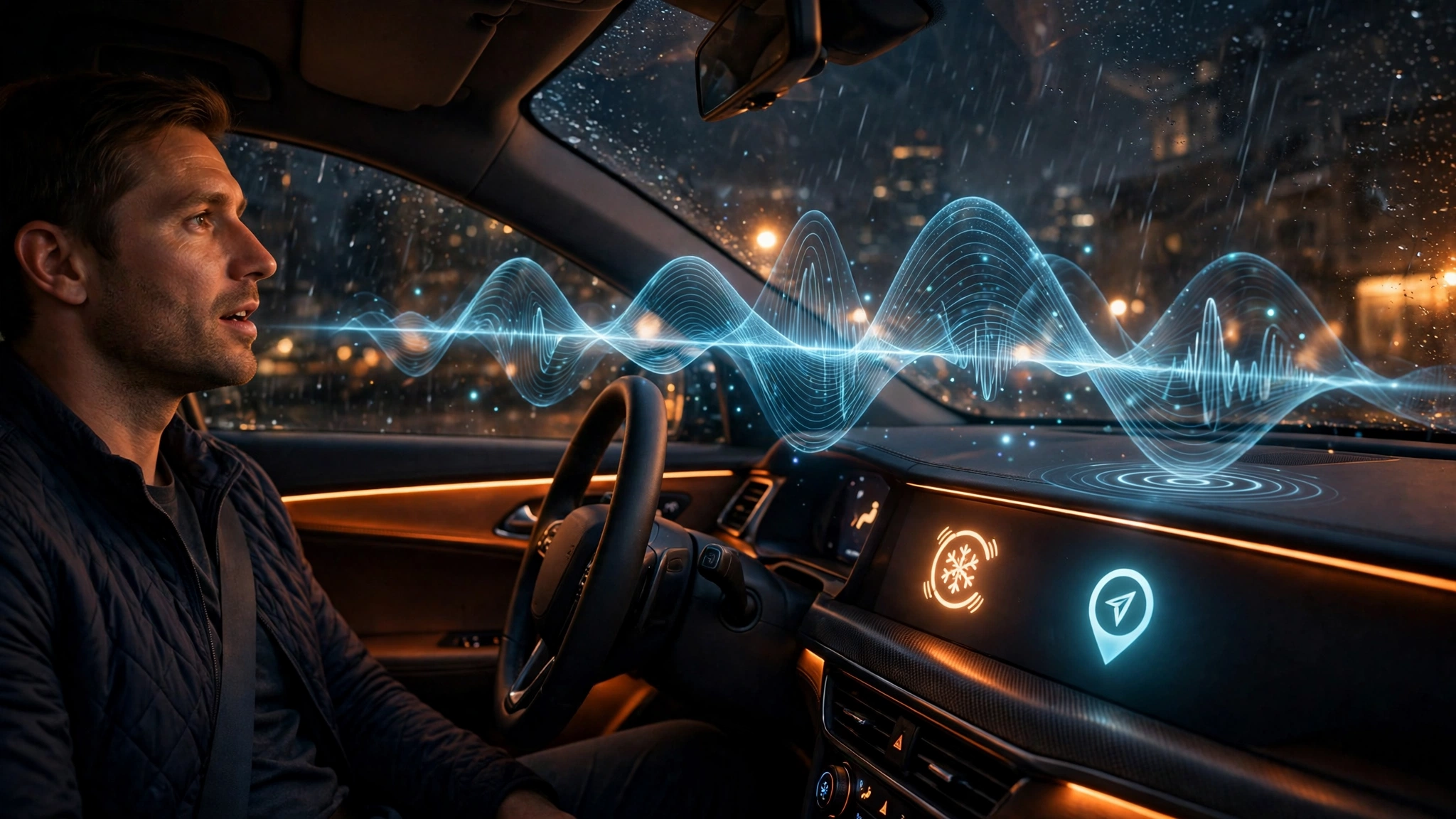
Cloud AI has four real-world weaknesses: connectivity, latency, privacy and running cost. Cars cross dead zones, factory floors have patchy Wi-Fi, and clinics may not send recordings off-site. Every cloud request also adds round-trip delay and a per-token bill that grows with volume.
Local inference flips those trade-offs: no outage for core functions, faster voice responses, data staying on the device, and no per-request API bills once the hardware is paid for. That is the same cost discipline behind custom software development and SaaS development: cost per completed job, not headline capability, decides whether a system earns its keep.
A quick test for your own project
- Must the job work where connectivity is unreliable? Then local inference is required.
- Does a slow answer break the experience? Voice and safety alerts qualify.
- Must data stay on-site? Privacy rules may settle it.
- Is volume high and value per interaction low? Cloud bills eat the margin.
Why the Thor hardware matters
Running a 35-billion-parameter model locally needs serious compute and memory, not just software. As conversation turns and agent actions accumulate, the key-value (KV) cache — the conversation's working memory — grows, raising memory capacity and bandwidth demands alongside peak compute (TOPS). Thor's accelerated compute and high memory bandwidth keep local inference responsive as that context builds up.
Second, adding dedicated AI compute without replacing the main control chip gives existing vehicles an upgrade path whose processors cannot support larger models by software update alone. PATEO also cites its modular software architecture and NVIDIA's edge/cloud ecosystem for deployment, tuning and customisation across vehicle programs.
From voice commands to a proactive agent
PATEO's AI Agent platform combines voice, visual and sensor inputs to interpret requests and cabin conditions. Within vehicle safety permissions, it can invoke cabin controls and online services, coordinate concurrent and longer-running tasks, and — with user authorisation — remember preferences and habits. That is the step from an assistant that waits for a command to an agent that acts on context.
Proactivity without guardrails is a liability, and PATEO's design points to three controls every proactive agent needs: permissions (the agent touches only what it is explicitly allowed to touch, with safety overriding convenience), opt-in memory, and safety limits (a small classification model rejects out-of-scope requests before a large model improvises). Any team building AI agents for business use needs the same three.
What PATEO's announced scenarios show — and what they do not prove
PATEO describes several cabin scenarios, best read as announced use cases rather than independently tested results. Its Sentinel AI is presented as alerting drivers to risks such as parking violations, flooding and fire; driver and passenger are each described as adjusting climate independently by voice or gesture; fatigue detection on long highway drives is described as prompting suggestions such as opening a window or starting a massage; and poor air quality is described as prompting window-closing and recirculation, based on location and learned habits.
Read these as a design pattern: sense something, interpret it in context, and act within permission — a loop portable to almost any business. The claims remain PATEO's announcements; measure them on your own data before promising them to customers. Our guide to AI agents for small business automation in 2026 shows how a staged pilot works in practice.
The business model lesson: hardware plus a service layer
The AI Box is not only a hardware story. PATEO's "Tokenomics" strategy aims for recurring revenue from deploying and using AI capabilities — selling the ongoing use of intelligence, not just the box. In June 2026 it partnered with Mininglamp, Xunce and Saimo Technology to jointly develop a token-based physical AI world model and TokenOS, and it reports a project nomination from a leading domestic robotics computing provider, extending the platform beyond vehicles.
For software and service businesses, the lesson is direct: a one-off sale caps revenue at delivery, while a capability customers keep using keeps earning — which is why SaaS products are usually subscriptions. The commercial milestones back the direction of travel, if not yet the scale: at Auto China 2026 in Beijing, PATEO announced joint development with ByteDance and a leading NEV automaker, and it holds a project nomination for a new-generation vehicle from a leading NEV automaker, with mass production expected in Q2 2027 — a pipeline to watch, not delivered volume.
How businesses outside automotive can apply the pattern
You do not need to build cars to use this pattern. Anywhere work happens away from a reliable connection, or where a fast spoken response matters, the same architecture applies: a capable local model, a small model for classification and refusals, clear permissions, opt-in memory, and the cloud as an extension.
Voice agents for customer-facing work
A restaurant, clinic or service business can run a voice agent that books, answers routine questions and qualifies callers even when the internet falters. See our AI calling agent and CRM development work.
Field equipment and frontline teams
Technicians, delivery drivers and warehouse staff work where signal is worst and hands are busiest. A local agent on a handheld or vehicle unit can guide a checklist or flag a safety risk without waiting for the cloud. Pair it with ecommerce systems or a restaurant ERP.
Retail kiosks and in-store help
A kiosk that freezes when store Wi-Fi drops is a failed purchase. A local model keeps product help and ordering running, syncing sales and stock when the connection returns. Our teams in the United Kingdom, UAE, USA and Pakistan can scope to a single site first, then roll out.
The rollout rule stays the same: pick one workflow, prove it on real work with human checks, then expand. PATEO's announcement shows the full shape — local models, proactive agency, permissions, memory and a service revenue layer — in one product. To scope a pilot, contact Coheser. For the announcement itself, see PRNewswire on PATEO's AI Box.
Frequently asked questions
What is PATEO's in-vehicle AI Box?
A dedicated in-vehicle AI unit built on NVIDIA DRIVE AGX Thor, announced in Shanghai on 3 November 2026, running Nemotron 3.5 ASR and ByteDance's 35-billion-parameter Doubao locally, plus text-to-speech and a 2-billion-parameter classification model.
Does the AI Box work without an internet connection?
Its core functions run locally without a cloud connection, including multilingual voice interaction and real-time streaming speech recognition. Connected services and cloud updates extend it when available.
Is the AI Box already in mass-produced cars?
Not yet. PATEO holds a project nomination for a new-generation vehicle from a leading NEV automaker, with mass production expected in Q2 2027.
Can a non-automotive business use the same on-device AI pattern?
Yes. Voice agents, field equipment and retail kiosks can all run a capable local model for core work, with the cloud as an extension — provided permissions, opt-in memory and safety limits are built in.