OpenAI + ServiceNow: ChatGPT Workflows Explained for Business

Amir Farid
7 min read
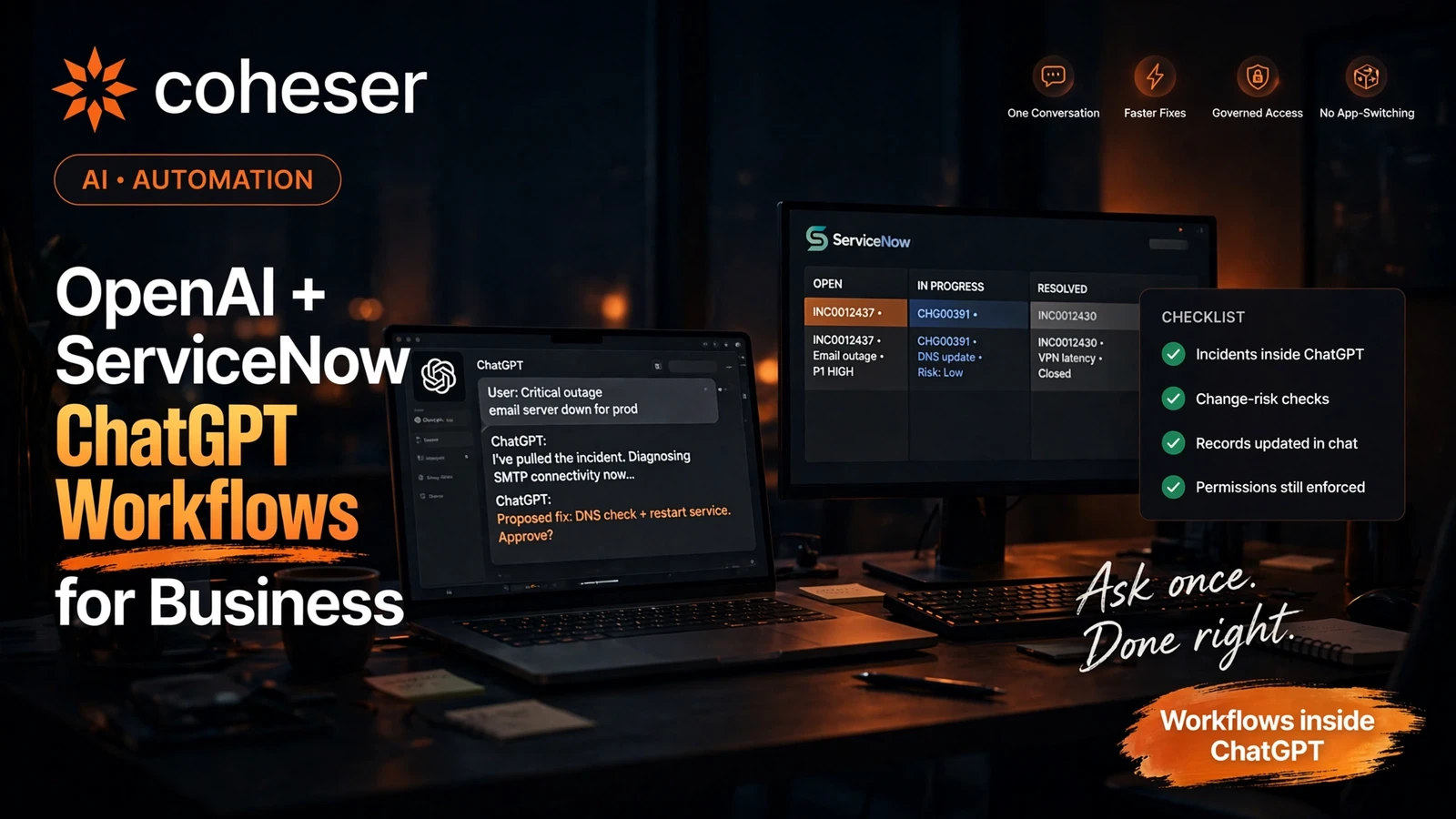
OpenAI and ServiceNow announced an expanded partnership on 28 October 2026 that puts real business workflows inside ChatGPT. From today, a new ServiceNow plugin in the OpenAI marketplace lets staff investigate incidents, assess change risk and update ServiceNow records without leaving a ChatGPT conversation. The bigger vision is mostly 2027 roadmap. Below: what is live, what is roadmap, why permissions matter, and what to do without ServiceNow.
OpenAI + ServiceNow: ChatGPT Workflows Explained for Business
Already on ServiceNow? Pilot the plugin now. If not, the announcement still shows where automation is heading. Our team builds AI agents for business workflows and AI automation for everyday operations.
What was actually announced — and what is live today
The October announcement builds on a multi-year agreement from 20 January 2026, under which OpenAI became a preferred intelligence capability on the ServiceNow AI Platform — covering enterprises running, in ServiceNow's description, over 80 billion workflows a year. The expansion makes that tangible: a ServiceNow MCP plugin in the OpenAI marketplace from 28 October 2026.
Be precise about "live":
- Live now: the ServiceNow MCP plugin, bringing business context and workflow actions into ChatGPT.
- Rolling out: ChatGPT Work and Codex for all ServiceNow employees, beyond engineering. OpenAI also uses ServiceNow workflows internally.
- Planned for 2027: Codex in AI Workflow Factory, OpenAI models in Build Agent and Autonomous Engineer, a joint security solution, and voice in the Control Tower.
- Not disclosed: pricing and adoption figures — treat third-party price claims with suspicion.
The immediate win is the plugin; the full vision arrives through 2027.
The ChatGPT plugin, in plain English

Most staff use ChatGPT for drafting, but it knows nothing about your live work: open tickets, pending approvals, customer cases. The plugin connects ChatGPT to ServiceNow, so the assistant reads business context and takes workflow actions in one conversation — no app-switching, no copied ticket numbers.
IT: investigate, assess, update
A major incident lands at 9am. The engineer asks ChatGPT to find similar past incidents, see what fixed them, assess change risk, and update the record — previously several jobs, now one place.
HR: answers with actions attached
In HR, an employee asking about leave or onboarding gets an answer tied to real workflows, and the assistant can trigger the next step — a case, an approval, a record update — not just a policy link. That chatbot-versus-agent distinction is the point; see our comparison of AI chatbots versus AI agents.
Customer service: context before conversation
In customer service, agents pull a customer's history and open cases into the conversation before replying, cutting "repeat your account number" moments and speeding first responses. It does not replace agents; it removes admin between agent and customer.
Why permissions and governance matter more than the demo
Every workflow demo looks impressive. The deployment question is duller: what can the AI do, on whose authority, with what audit trail? ServiceNow's answer is Action Fabric, applying the customer's existing permissions, approvals and business rules to ChatGPT actions. The AI inherits the employee's limits — no self-approved changes or bypassed sign-offs.
That is the right design, and the part to interrogate hardest. Ask three things in every pilot: does it respect role-based access exactly as ServiceNow does today? Is every AI action logged as traceably as a human action? Which actions are read-only, need approval, or blocked — and who can change that?
Governance goes beyond one plugin. OpenAI has joined ServiceNow's newly announced Control Tower Alliance as a founding member, and ServiceNow has joined OpenAI's Trusted Access for Cyber programme. The partnership supports ServiceNow's "Shift Zero" strategy of proactive, preventative security. Weighing AI automation services? Have the governance conversation first.
The 2027 roadmap, in one timeline
- End of 2026: enhanced capabilities for the ServiceNow MCP plugin.
- Q1 2027: voice capabilities in the Super Intelligence Control Tower.
- January 2027: early access to the joint security solution, combining OpenAI cybersecurity with ServiceNow's asset, identity and business context.
- 2027: Codex in AI Workflow Factory, helping developers build and modernise apps on ServiceNow business context; OpenAI models also powering Build Agent and Autonomous Engineer.
- Q2 2027: general availability planned for the joint security solution.
The app-building and security pieces belong in a 2027 budget, not this year's pilot. Pilot the live plugin now; judge each 2027 item when it ships. The same discipline applies in our coverage of Oracle, OpenAI and ChatGPT in business software.
What if your business is not on ServiceNow?
The uncomfortable truth: most enterprise AI announcements are built for companies already paying enterprise licence fees. Without ServiceNow, the plugin does you no direct good — you cannot buy it without the platform, priced for large organisations, not a 20-person firm.
Still, it tells every business three things: assistants are becoming action-taking agents inside business tools; permissions and audit trails are becoming the deciding feature, not the model; and vendors expect staff in one interface, not ten tabs. The question is how to get that without an enterprise bill.
The trade-off is cost versus coverage. An enterprise platform gives deep, governed integration across hundreds of workflows, at enterprise cost. A lighter stack covers your highest-value workflows — lead follow-up, support triage, invoice chases, onboarding — at a fraction of the cost, usually in weeks not quarters. Our guide to AI agents for small business automation walks through that choice.
The Coheser alternative: workflow automation without enterprise licences
For businesses outside ServiceNow, the alternative is automation around tools you already use: AI agents connected to your CRM, inbox, WhatsApp, spreadsheets or custom system, with human approval where it matters. Start with three to five time-eating workflows — enquiry qualification, invoice chases, support triage, post-call updates — each with clear rules on what the agent does alone and what needs a click.
Where the work fits depends on your stack: custom software development for a system built around your processes; SaaS development for productising a tool for customers; ecommerce development for the storefront and its workflows; Flutter app development for one Android and iOS app; and a purpose-built CRM system, which often pays for itself faster than any AI add-on. We work across the United Kingdom, the UAE, Saudi Arabia, the USA and Pakistan.
Your pilot checklist: try this before you commit
Run the same discipline either way: a two-to-four-week pilot with real users beats a six-month evaluation.
- Pick one workflow, not ten — incident triage, leave requests or case routing — with a measurable baseline like time per case.
- Write down the permission boundary: what the AI may do alone, what needs approval, what is blocked. Test with a real user account.
- Measure the boring metrics: minutes saved, error rate, human corrections. If corrections outnumber savings, the pilot has failed honestly.
- Check the audit trail: every AI action recorded with who, what and when. If you cannot audit it, do not scale it.
- Judge 2027 items separately — do not bundle the plugin pilot with a commitment to Codex, Build Agent or the security product.
- Price the whole thing: licence, implementation, training, support. No pricing was disclosed, so check any quote line by line.
If it passes, expand one workflow at a time; if it fails, you have learned cheaply. Background: Unite.AI on the expanded OpenAI–ServiceNow partnership and WorkflowOTG on the partnership across enterprise workflows.
Frequently asked questions
Is the ServiceNow ChatGPT plugin available now?
Yes. The ServiceNow MCP plugin has been available in the OpenAI marketplace since 28 October 2026, under the customer's existing permissions.
Do I need ServiceNow to use it?
Yes — the plugin connects ChatGPT to a ServiceNow instance, so it only works for organisations running ServiceNow. Others can build automation around existing tools, usually faster and far cheaper.
When will Codex and the joint security product be available?
Codex in AI Workflow Factory is expected in 2027; the joint security solution is planned for early access in January 2027 and general availability in Q2 2027. Treat both as roadmap until confirmed.
Is my business data safe when ChatGPT takes workflow actions?
ServiceNow says Action Fabric applies the customer's existing permissions, approvals and business rules, so the AI acts within the employee's limits. Before scaling, test boundaries with real user accounts and confirm the audit trail.