Apple Intelligence Meets Qwen in China: What Businesses Must Learn

Amir Farid
7 min read
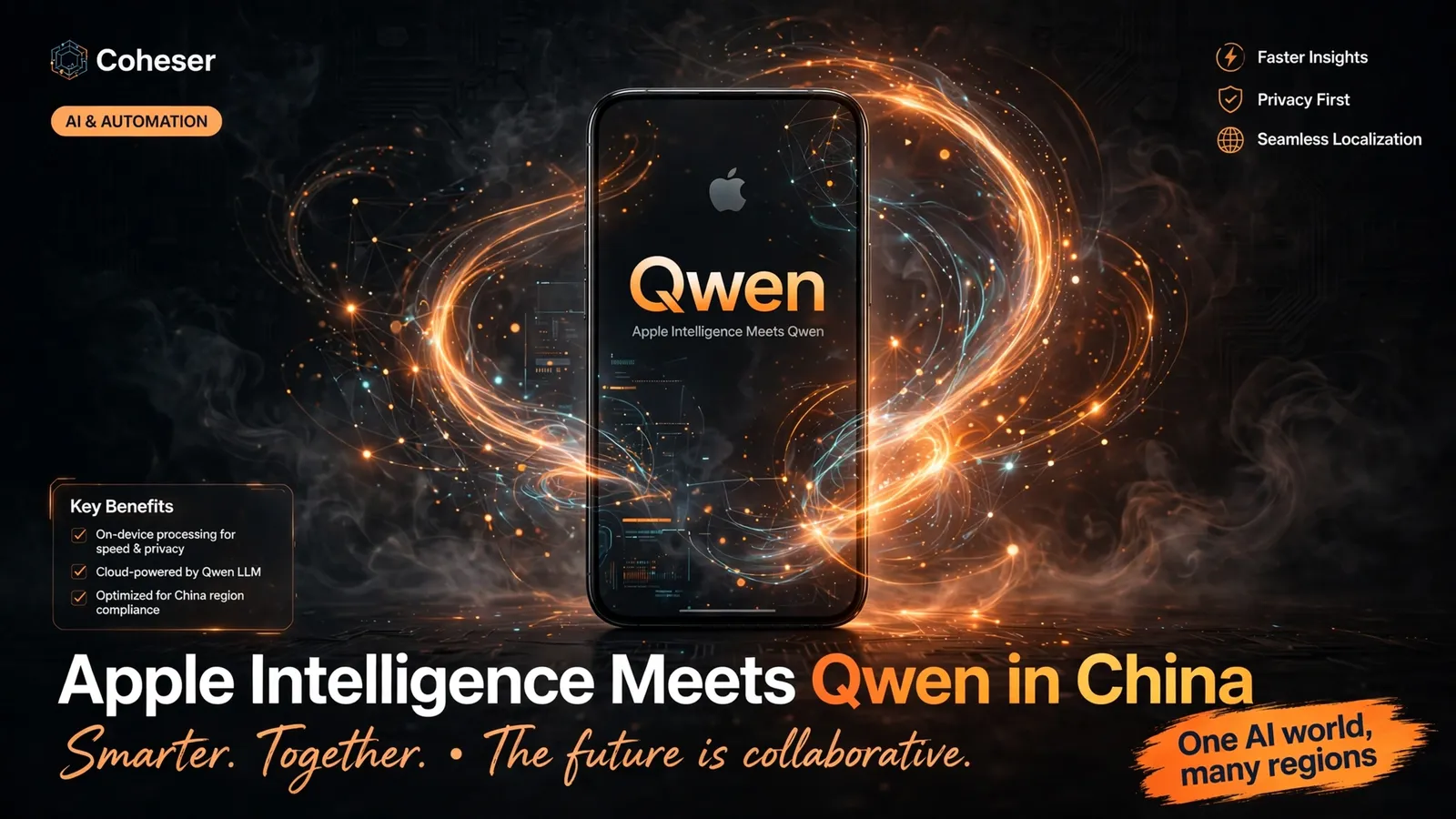
Apple Intelligence Meets Qwen in China: What Businesses Must Learn
Apple Intelligence is coming to China powered by Alibaba's Qwen model. Announced on 31 October 2026, the integration brings Siri, Writing Tools and Visual Intelligence to users in China through Qwen, rather than through the ChatGPT integration used outside China. Developer beta testing starts on 4 November 2026, with the official rollout following in iOS 27.3 in December 2026.
For businesses, the headline is not just a new phone feature. It is a clear sign that the AI world is splitting by region, and that a single model stack will no longer serve every market. If your company works across more than one country, plan for regional model differences, data-residency rules and multi-model strategies now, rather than discovering them market by market.
What Apple and Alibaba Announced
According to reports from CGTN and Business Today, Alibaba announced on 31 October 2026 that Qwen will integrate into Apple Intelligence for users in China. The timeline is short and specific: developer beta testing begins on 4 November 2026, and the official rollout arrives with iOS 27.3 in December 2026.
That pace matters: the beta gives developers a window to test how their apps behave when Apple Intelligence answers through Qwen in China rather than through another model elsewhere. Businesses operating in China, or serving Chinese customers abroad, should use that window instead of waiting for December to discover problems.
Who Gets It, and On Which Devices
The integration is available on iPhones bought in China, or where both the device location and the Apple Account country or region are China. Both conditions must point to China. Support starts from iPhone 15 Pro upwards, so customers on older devices will not see the same experience, and your support guides should reflect that split.
What Changes for Users in China

For users in China, Siri, Writing Tools and Visual Intelligence will connect to Qwen for text and image understanding and for content generation. The announcement also highlights Writing Tools, photo object removal and real-time translation: drafting and rewriting text, a visible photo-editing use, and removing a language barrier in the moment.
What This Means for Customer Expectations
When customers in one market get a capable AI assistant built into their phone, they start expecting the same help from every brand they deal with: harder chatbot questions, photo and voice understanding, and answers in their language straight away. That expectation travels, so building your own AI agents and chatbots to a consistent standard, even when the underlying model differs by region, is how you meet it without rebuilding your product for each market.
What Is Not Included in This Release
The next-generation Siri capabilities previewed in June 2026 are not included in this release. The China launch covers the current Apple Intelligence features through Qwen, not the future Siri upgrade. That restraint is a useful lesson: announce a specific scope and date, rather than promising everything at once. When you launch AI features, tell customers exactly what your assistant can do today, in which markets and on which devices.
Why China Gets a Different Model
Outside China, Apple Intelligence uses ChatGPT. Inside China, a domestic model is used instead, reflecting China's regulatory and data rules. A global product cannot simply ship the same model everywhere and assume it complies. Any company offering AI features across borders faces the same question in each market: does the model, data flow and provider meet local rules? Increasingly, the answer varies by country.
Alibaba has also said it will not use user requests or generated responses for model training. That commitment matters for trust, especially for business users handling sensitive information. When you choose a provider, ask the same question directly and get the answer in writing.
The Bigger Lesson: One AI World, Many Regions
The real business lesson is structural. The AI world is splitting by region, and betting your whole product on a single provider is now a strategic risk, not just a technical choice. In practice, that split means:
- Different models, different answers: The same prompt can produce different results depending on the model behind it, so quality checks must run per region.
- Different rules, different data flows: Where data is processed and stored may need to change by market.
- Different availability, different roadmaps: Features arrive on different dates in different regions, so launch plans must handle staggered availability.
- Different partners, different integrations: A local partner, like Alibaba in China, may be the only compliant route into a market.
Companies operating across the United Kingdom, USA, UAE, Saudi Arabia and Pakistan already deal with different languages, payment methods and customer habits. Regional AI is the next layer of that reality, and companies that plan for it early will adapt faster.
How to Plan a Multi-Model Strategy
A multi-model strategy does not mean using every model on the market. It means designing your product so the model can change without breaking the experience.
1. Separate Your Product Logic From the Model
Keep your business rules, brand tone, safety checks and workflows in your own system, not buried inside a single model's prompts. When you build custom software or a SaaS product this way, swapping the model behind a feature becomes a configuration change, not a rebuild. Your AI automation should call the right model for the right region, while customer-facing behaviour stays consistent.
2. Design for the Strictest Market First
Map your data flows for each market: what data leaves the device, where it is processed, how long it is kept, and whether it is used for training. Then design to the strictest requirement among your markets. That is cheaper than retrofitting privacy controls after launch.
3. Test the Same Journey in Every Region
Do not assume a feature that works well with one model works equally well with another. Test the same journey — the same question, photo and document — through each regional model you support, checking accuracy, tone, language quality and failure behaviour. A model strong in English may struggle with Urdu, Arabic or Chinese phrasing.
4. Keep Humans in the Loop Where It Counts
Automate routine work and escalate the rest cleanly. A WhatsApp bot or an AI calling agent should know when to hand over to a person, carrying the full conversation with it. When a model gives an uncertain answer, a human fallback protects the customer relationship.
What This Means for Your Next Build
If you are planning a new app, platform or automation project, build regional flexibility into the brief from day one. Ask before work starts: which models will we use in each market, and what happens if one becomes unavailable there? Where will customer data be processed in each region? How will we test quality per market? Can we swap models without rewriting the product?
Whether you are building a Flutter app, a React Native app, a MERN stack platform or a Laravel system, those questions belong in the specification, not in a post-launch fix. See our comparison of AI chatbots versus AI agents. Technology is only useful when it fits the market it serves.
If you operate across regions and want help planning a system that works under different models and data rules, talk to the Coheser team. We build AI, software and apps for businesses in the UK, USA, UAE, Saudi Arabia and Pakistan, and can help you design for regional differences before they become urgent.
Frequently asked questions
When does Apple Intelligence with Qwen launch in China?
Developer beta testing starts on 4 November 2026, and the official rollout arrives with iOS 27.3 in December 2026.
Which iPhones support Apple Intelligence with Qwen?
Devices from iPhone 15 Pro upwards support Apple Intelligence. The Qwen integration is available on iPhones bought in China, or where both the device location and the Apple Account country or region are China.
Will Qwen use my requests to train its model?
Alibaba has said it will not use user requests or generated responses for model training. Businesses should still confirm data handling in writing for their own use case.
What should businesses outside China take from this announcement?
Plan for regional AI differences now: let the model vary by market, map data flows per region, test the same journey through each model, and avoid betting on a single provider.